Operational Images Operational Images
Introduction
Operational images, an idea Farocki articulated in 2000, describes images made for machine eyes rather than human ones – not intended to be seen as representations of the physical world, but to perform tasks and operations based on the data acquired through them. This discourse has become increasingly relevant to the development of machine vision and its entanglement with surveillance, as well as to the machine learning processes that now underpin generative AI imaging systems. While these operations tend to remain invisible to the human eye, their effects are now embedded in ubiquitous imaging systems – such as automated speed cameras, face recognition and object detection systems – and their social, political and economic impact becomes increasingly legible in their social, political and economic consequences. Extending Farocki’s original sense of the term, other images have become operational by generating data through image circulation and quantified metrics attached to social media platforms. These networked images do not merely represent content: they produce measurable signals in the form of likes, follows, comments, watch time, which trigger algorithmic operations determining visibility, circulation, and value. A quarter of a century after their introduction, algorithmic operations are not just everywhere, but they are also part of the way we are now interacting with images on a daily basis.
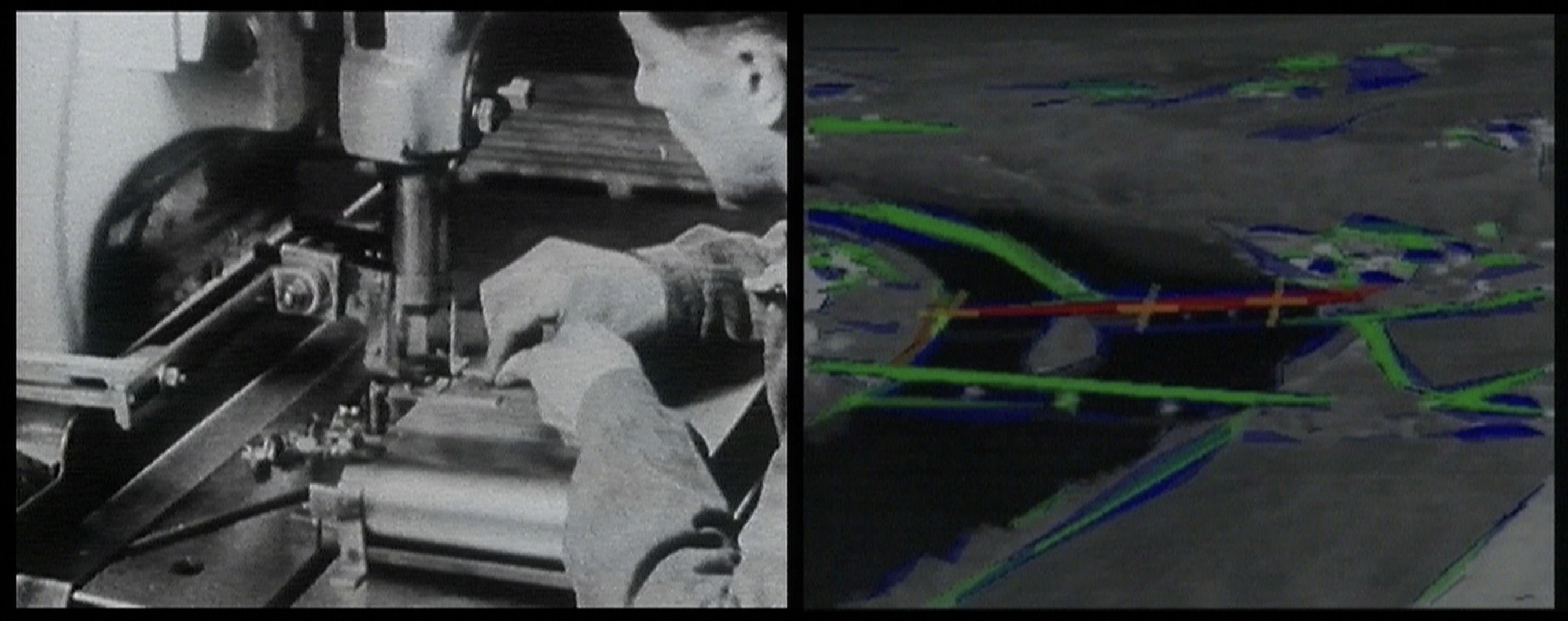
On the other hand, artists and practitioners have engaged with the tensions of the operational image as a form of tactical media, understanding its logic in order to carve out spaces for resistance and critique against dominant and commercial image regimes. They have understood the way machines operate and develop traps, baits, counterstrategies that do not reject the algorithmic layers of the image but reclaim it and weaponise it, turning the image into a decoy. Borrowed from the language of military and cybersecurity contexts, the notion of the decoy captures how these images act within algorithmic, political, and aesthetic systems as instruments of misdirection or resistance. Rather than being passively consumed as traditional photographs, they perform interventions, targeting the protocols that structure visual culture today, and exploiting the tension between an image’s representational surface and its underlying operations.
Through a study of different projects and case studies within the field of contemporary digital and networked images, I propose the idea of the image decoy as a form of subversion and resistance to the dominant economic and cultural value systems of the image. An image decoy, in the sense proposed here, is an image that does not refuse the algorithmic gaze but impersonates its expected inputs, offering a machine or a platform exactly what it is trained to detect, while redirecting that operational capacity against the very systems that deploy it. Acting as bait and trap, the image decoy reveals the hidden operations of imaging systems, but also reacts to them, infiltrates them, reshapes them and turns the field of digital and networked images into a battlefield. This is the ground where visuality emerges as a negotiated act – following Sean Cubitt’s idea of visuality not simply as the act of seeing but as a cultural, technological, and political process that determines how images are produced, circulated, and interpreted (Cubitt 2014).
Ranging from vernacular to artistic practices over the past two decades, many of the projects analysed in this paper were first encountered through curatorial research into live formats for exploring digital and networked images – an ongoing programme dedicated to investigating how networked images could be performed and experienced within their own native operating environments, offering an alternative to the physical rooms of the museum. Here, the selected projects are organised into four thematic clusters, each highlighting a typology of image decoy and a specific property of digital images: visibility and invisibility, automation and machine agency, the circulatory powers of networked images, and digital image infrastructures. Rather than strict categories, these are presented as broader, sometimes overlapping areas that map the different ways algorithmic images can be reclaimed by viewers and users.
Image Operations and Operators
Flusser introduced the notion of “technical images” (Flusser 1985), which, as opposed to traditional images, result from mathematical calculations and are produced by an apparatus whose internal “program” determines the creative possibilities available to the photographer. For Flusser, the photographer does not stand outside this system but operates within it as a “functionary,” choosing only among the finite combinations the apparatus permits: the camera is “programmed to produce photographs, and every photograph is a realization of one of the possibilities contained within the program of the camera.” (Flusser [1983] 2000, 26). The implications of Flusser’s claims regarding the underlying laws of a novel form of visuality, together with philosopher Roland Barthes’ idea of an “operational language” (1957), form the basis of Farocki’s concept of “operational images.” These images have come to pervade an array of different realms, “both military and non-military, both private and public, both industrial and post-industrial” (Pantenburg 2017), finding some of their earliest and most explicit forms in weapons targeting and guidance systems.
This capacity of images to act rather than merely depict is instrumental to artist Trevor Paglen’s notion of “seeing machines” (Paglen 2014): non-human vision systems designed to “look at photographs” with specific objectives – recognizing objects and faces, evaluating aesthetic patterns and behavioural cues – increasingly attached to distributed surveillance and policing infrastructures, from automated speed cameras to object detection systems. Most recently, images have also become the primary fuel for machine learning datasets powering generative AI systems, where the outputs of text-to-image models obscure complex algorithmic processes and black-box operations – systems in which photographic biases are not only reproduced but amplified – which raise ethical questions regarding authorship, copyright laws and intellectual property, but can also be seen as complicit in generating propaganda through a new fascist aesthetic (Meyer 2025).
The introduction of non-human actors and semi-autonomous imaging systems is analysed by scholars from the fields of software studies and digital humanities, who examine the interwoven relationships between human and machine agents in the acts of image creation, circulation, and spectating. Media scholars Mitra Azar, Geoff Cox, and Leonardo Impett have written about “ways of machine seeing” (2021), questioning how computational technologies change the way we see the world. Media scholars Ingrid Hölzl and Rémi Marie build upon the notion of the “algorithmic turn” (Uricchio 2011) to explore the implications of the image as software, rather than just static data, and the idea of what they term “softimages”: “The photographic paradigm of the image put in place with the invention of the central perspective, is supplemented (but not replaced) by a new paradigm, the algorithmic. The image becomes soft, not only infinitely malleable but merged with software. It becomes operational, part of algorithmic processes, where the representational image (on our screens) acts as a lure for the actual processes of surveillance and control (behind the screen)” (Hölzl and Marie 2020). Drawing on posthumanities, media scholar Joanna Zylinska explores the conjoining of human and non-human visions and agencies in imaging practices and modes of seeing. She proposes the notion of “nonhuman photography” (Zylinska 2017), which encapsulates photographs that are not of the human, not by the human, and not for the human. Seeing machines and non-human “photographers” are not confined solely to software, but are enmeshed in both digital and physical environments and have very real consequences beyond the boundaries of the code.
At the core of this interrelation between human and non-human actors lies a global infrastructure that media scholar Benjamin H. Bratton calls “the stack” (2015). Bratton defines the stack as a megastructure that is both a technological apparatus and a geopolitical architecture. It contains and connects different forms of computation at various scales, linking hardware and software infrastructures with human users — from energy and mineral sourcing to the server farms that power cloud infrastructures, and from quantified users to algorithms and robots. Yet the operational image is not a neutral technical fact. The capacity to render the world machine-readable is unevenly distributed, and the infrastructures Bratton describes as “the stack” are also infrastructures of power: they determine who is surveilled and who surveils, whose faces are legible to recognition systems and whose bodies are rendered as noise, whose creative labor becomes training data and whose does not. Operational images are entangled with what Shoshana Zuboff calls “surveillance capitalism” (Zuboff 2019), in which behavioural and visual data are extracted as raw material for prediction products, and with the broader logic of platform capitalism (Srnicek 2017), in which the circulation of images is structured by proprietary algorithms optimized for engagement rather than representation, meaning, or consent. It is precisely because operational images are bound up with these asymmetries of power and extraction that artists and practitioners have sought to reclaim their underlying logic – not to escape operationality, but to turn its own techniques of capture, calculation, and circulation against the systems that deploy them.
Image Decoys and Counter-Operations
Rather than simply rejecting or reinforcing visual traditions shaped by advertising and propaganda, artists and users repurpose photographic conventions within media ecologies that exploit images’ operational properties to resist the logics of attention economies and platform capitalism, as well as the politics of representation and circulation in digital visual cultures. Operationality does not entirely replace the representational surface of the image: representation remains active in today’s digital environments, but it is transformed by its algorithmic operations within the contested terrain of contemporary media systems.
This strategy of turning a system’s own operational logic against itself situates image decoys within a longer lineage of “tactical media”. Coined by theorists Geert Lovink and David Garcia in the mid-1990s, the term describes practices that seize the tools of dominant media culture – camcorders, faxes, websites, and later social media platforms – and redeploy them for purposes of critique and disruption, exploiting the fluidity of temporary, opportunistic interventions rather than the fixed positions of institutional art or activism (Lovink and Garcia 1997). Tactical media does not seek to build alternative infrastructures from scratch: rather, it works parasitically within existing ones, hijacking their logistics, protocols, and vernacular forms.
This tactical lineage extends to contemporary media landscapes and phenomena. Rita Raley’s Tactical Media (2009) reframed the concept for the era of networked compu-tation and data, examining how artists intervene in informatic systems rather than broadcast media, while Annet Dekker and David Garcia have traced its continuation into the present through the figure of the media artist as “trickster”: a practitioner who works through deception, fiction, and inversion to make the operations of media perceptible and contestable (Dekker and Garcia 2017). Notably, in reflecting on this legacy, Garcia – co-author of the original tactical media manifesto – observes that these tactics were never intrinsically emancipatory: the same repertoire has been taken up across the political spectrum, and in the networked present “spreadability” has become the unit of measure for a tactic’s success. This ambivalence has since become impossible to ignore. The tactical exploitation of networked media’s operational properties – the gaming of recommendation algorithms, the coordinated manipulation of trends, the weaponisation of virality – now underpins some of the most consequential phenomena of contemporary digital culture, from organised trolling and disinformation campaigns to the circulation of computational propaganda. The image decoy sits within this expanded and ethically ambivalent field: it names a tactic that is available to artists and activists, but also to corporations, state actors, and bad-faith operators, and its critical value lies in making that shared operational logic legible.
It is through the tactical misuse and reappropriation of techniques such as metadata manipulation, steganography, bot baiting, hashtag hijacking, SEO gaming, augmented reality, dataset poisoning, and adversarial attacks, that images are transformed into undercover agents deceiving both human and algorithmic eyes: they may resist platform capitalism or automate its value extraction, subvert digital surveillance or exploit it for private gain, counter misinformation or manufacture it as propaganda. Rather than refusing the algorithmic gaze, these images feed it precisely the signals it is trained to recognise – a face, a hashtag, a license plate, a viral image – while smuggling a different payload underneath. In this sense image decoys can be understood as instances of counter-operational images. Where Volker Pantenburg identifies the counter-operational strategies through which Farocki renders operational images visible and available for reflection (Pantenburg 2017), the decoys examined here extend this logic in a different direction: rather than making the operation legible, they redirect its operational capacity against the systems that deploy it.
Ranging from vernacular gestures to sustained artistic research over the past two decades, the projects examined in this paper are organised into four clusters, each addressing a distinct property of the operational image. Hiding in Plain Sight considers tactics of visibility and invisibility, in which images conceal messages or interventions within widely circulated, seemingly innocuous surfaces. Image Triggers turns to automation and machine agency, examining how images can be designed to bait, confuse, obfuscate or short-circuit the automated systems such as surveillance cameras and scraping bots that autonomously scan for pictures. Occupy the Internet addresses the circulatory power of networked images, exploring how tagging, hashtags, and search engine optimization can be mobilized to reclaim algorithmic visibility. Finally, Superspreaders engages with the infrastructures of digital images themselves, examining how images can be weaponized to infiltrate, corrupt, or repurpose the technical systems – datasets, firmware, security protocols – through which they circulate and multiply.
The four clusters proposed here emerged from the works encountered through curatorial research conducted at Fotomuseum Winterthur over the past decade, principally through two programmes: SITUATIONS , an experimental exhibition format and research lab dedicated to the changing role of photography in digital and networked culture, which ran between 2015 and 2021, and Screen Walks , a collaborative livestream series co-developed with The Photographers’ Gallery in London between 2020 and 2025, in which artists, researchers, and practitioners led live explorations of digital and net-worked spaces, performing and experiencing images within their native operating environments. Surveying this body of commissioned and exhibited work over several years, alongside adjacent vernacular practices encountered online, I began to notice recurring tactics through which practitioners engaged the operational layer of the image – patterns that cut across otherwise very different projects and media. The four clusters are a way of organizing those recurring tactics: rather than an exhaustive taxonomy, they are proposed as an initial, adaptable grammar, and the cases discussed below were selected because each renders one of these operational tactics especially legible.
Grouping these works together reveals a heterogenous corpus of intentions, as they issue from different actors and motivations. Some are conceptual artworks, others are works of design or activism, others still are vernacular gestures circulated by anonymous internet users, and one is a piece of criminal malware. This heterogeneity is not incidental, but rather highlights that the image decoy is defined through a shared operational tactic, not a shared purpose, medium, or professional field. That the same underlying logic can be found in a museum commission, a protest hashtag, an artist’s dataset intervention, and a phishing attack suggests that the operationality of the image has become a widely legible language – one increasingly understood, and put to use, by actors well beyond the art world, and available for tactics ranging from protest to sabotage.