Machine Learning Photography Machine Learning Fotografie
Presentations
Choose a virtual world or open-world game and explore its natural landscapes with a photographic approach.
You can document a specific typology of virtual flora or terrain, investigate the edges and out-of-bounds spaces where the simulation breaks down, or develop a sustained engagement with light, atmosphere, and time of day — working within or against the visual conventions of landscape photography.
Create a series of 8–12 images accompanied by a short text (150–200 words) describing your approach, the environment you chose, and what your images reveal about the relationship between nature and its digital simulation.
Upload the text and the images with your name and a caption on this online document.
Photography has always been shaped by what it excludes — by who holds the camera, whose stories get told, and whose images end up preserved. Machine learning algorithms trained on photographic datasets inherit and amplify these absences and bias. But artists have begun turning this back: using generative models not to produce more images of the already-visible, but to speculate about what was never photographed, never archived, never allowed to exist. Working with GANs, LoRAs, and diffusion models, the artists in this lesson train their algorithms on specific, often marginal image corpora — looted bronzes, queer Latin American history, Black women under slavery — and use the generated output as a form of counter-archive. These images are not documents. They are propositions: what might have been photographed, if the conditions of photography had been different. In doing so, they ask not just what AI can produce, but what photography has historically failed to record — and what it might still owe.
Study Cases
Robbie Barrat, Neural Network Balenciaga, 2018
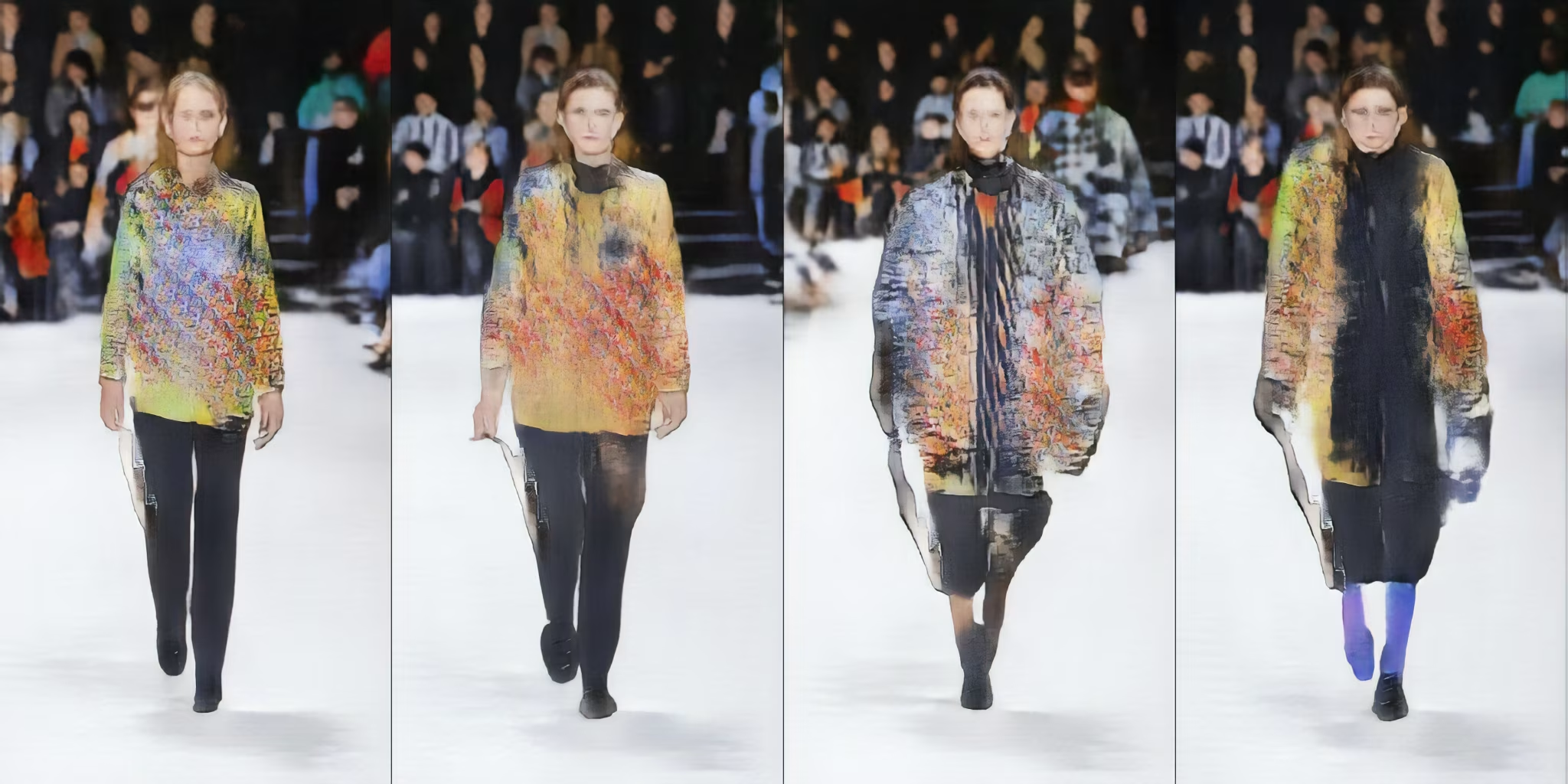
"Using a corpus of Balenciaga runway shows, catalogues, and campaigns, a Pix2PixHD network was trained to reconstruct Balenciaga outfits from Densepose silhouettes. The results are outfits which are novel but at the same time heavily inspired by Balenciaga's past few years under Demna Gvasalia. The network lacks any contextual awareness of the non-visual functions of clothing (e.g. why people carry bags, whether or not bags are separate from pants, why people prefer symmetrical outfits) - and in turn produces more strange outfits that completely disregard these functions." – Robbie Barrat, artist website, 2018.
- More about Neural Network Balenciaga: ssense.com/en-in/editorial/fashion/do-androids-dream-of-balenciaga-ss29
Felipe Rivas San Martín, Un Archivo Inexistente, 2022-2024
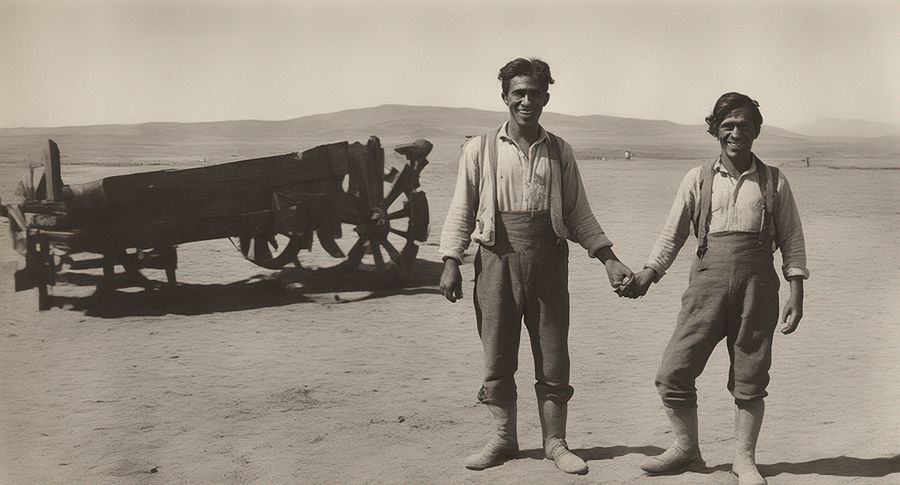
"The project A Nonexistent Archive, initiated in 2022 by Rivas San Martín, starts precisely from that absence (of historical images of sexual diversity). Instead of finding a preserved archive, the artist sets out to create a speculative one: 108 images of working-class homosexual couples in Latin America at the beginning of the 20th century, generated through artificial intelligence." It "evokes a complex feeling such as anemoia, that ability to feel nostalgia for something we have not experienced" – Mariairis Flores Leiva "This archive not only highlights the subversive capacity of digital art and AI to reimagine queer pasts, but also the importance of considering stimuli, imperfections, and errors as forms of queer resistance and affirmation" –Eduardo Carrera Rivadeneira "construct an archive of queer affects, imagining possible pasts that compensate for the historical absence of certain figures and experiences in the visual record." –Sebastián Valenzuela Valdivia – Artishock, artishockrevista.com/2025/02/21/felipe-rivas-san-martin-archivo-homosexual-ia, 2025
Mayara Ferrão, Álbum dos Desesquecimentos, 2024
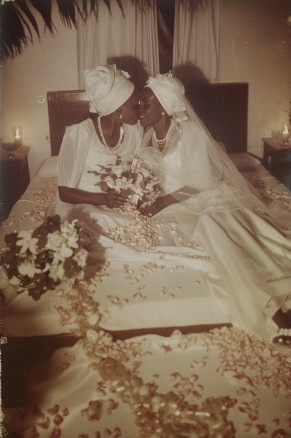
""Ferrão has been dedicated to an investigation that combines archival research on slavery with the manipulation and generation of images through AI. Her aim, she explains, is to construct fictional narratives of affectionate exchanges between Black women and to reimagine colonial representations through a speculative exercise that seeks to ask: What if these women had been able to live their loves in the past? However, the very question finds a bold response in her work: these women did live and love, but their loves became unimaginable in a world shaped by cis-heteronormative white supremacy." [...] "In a context where the racist bias of AI systems is widely debated, with algorithms mostly coded by white men, Ferrão is not alone in appropriating a technology that was not designed for or by Black people." – Fernanda Silva e Sousa, Verve Galeria
Juan Covelli, Speculative Treasures, 2021
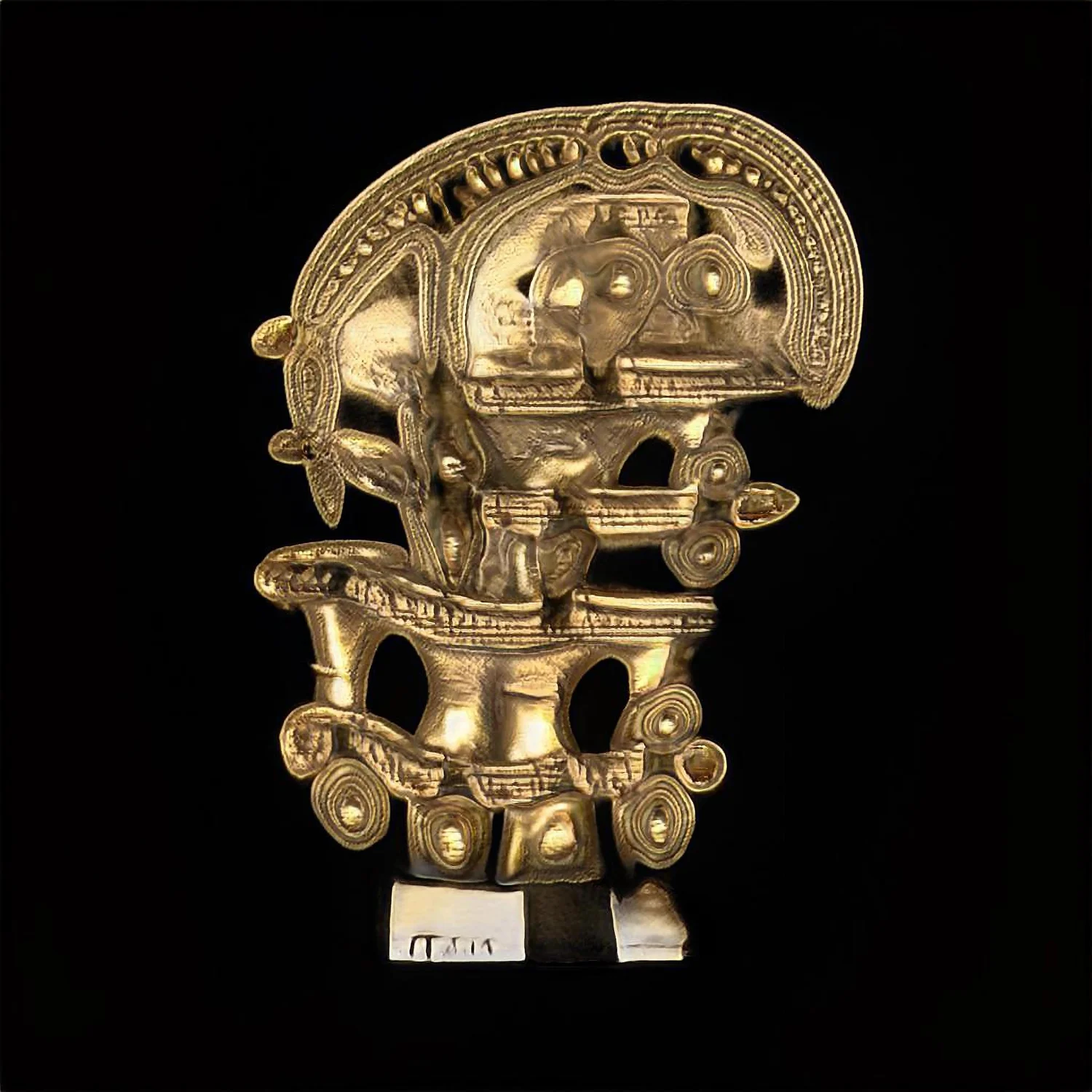
"IThe Speculative Treasure series presents a series of images that aim to transgress questions about repatriation, archaeology and heritage, through digital decolonial approaches. In 1892, the Colombian President Carlos Holguín sent the Quimbaya Treasure to Madrid to exhibit it for the celebrations of the "IV Centenary of the Discovery of America" and then give it to María Cristina, queen consort of Spain, in appreciation for her intervention in a territorial dispute between Colombia and Venezuela. Years later, the treasure, which includes more than a hundred objects in the form of beads, musical instruments and anthropomorphic figures made of gold and tumbaga, became part of the collection of the Museum of America in Madrid, where it is currently exhibited. In 2017, at the initiative of a popular petition and after years of legal proceedings, the Constitutional Court of Colombia decreed that the gift had been made illegally and ordered the Colombian Government to initiate procedures for its repatriation. Since then, the Museum of America and the Spanish Government have collaborated with the investigation, but have refused to return it. The Colombian artist Juan Covelli has trained a generative adversarial network, an artificial intelligence algorithm, with images of the Quimbaya Treasure. Generative algorithms are systems designed to create synthetic images from the defining features of the photographs they are trained with. The resulting images do not reproduce any particular object, but instead produce a visual imaginary from all of them. Covelli makes use of the virtual representation of the Treasure, as a decolonial tool for the symbolic repatriation of cultural heritage." – Getxophoto, festival website, 2022
- More about Speculative Treasures: instagram.com/p/CmjpDtsuky9/?img_index=1
Minne Atairu, Igùn AI: Prototype X, 2024
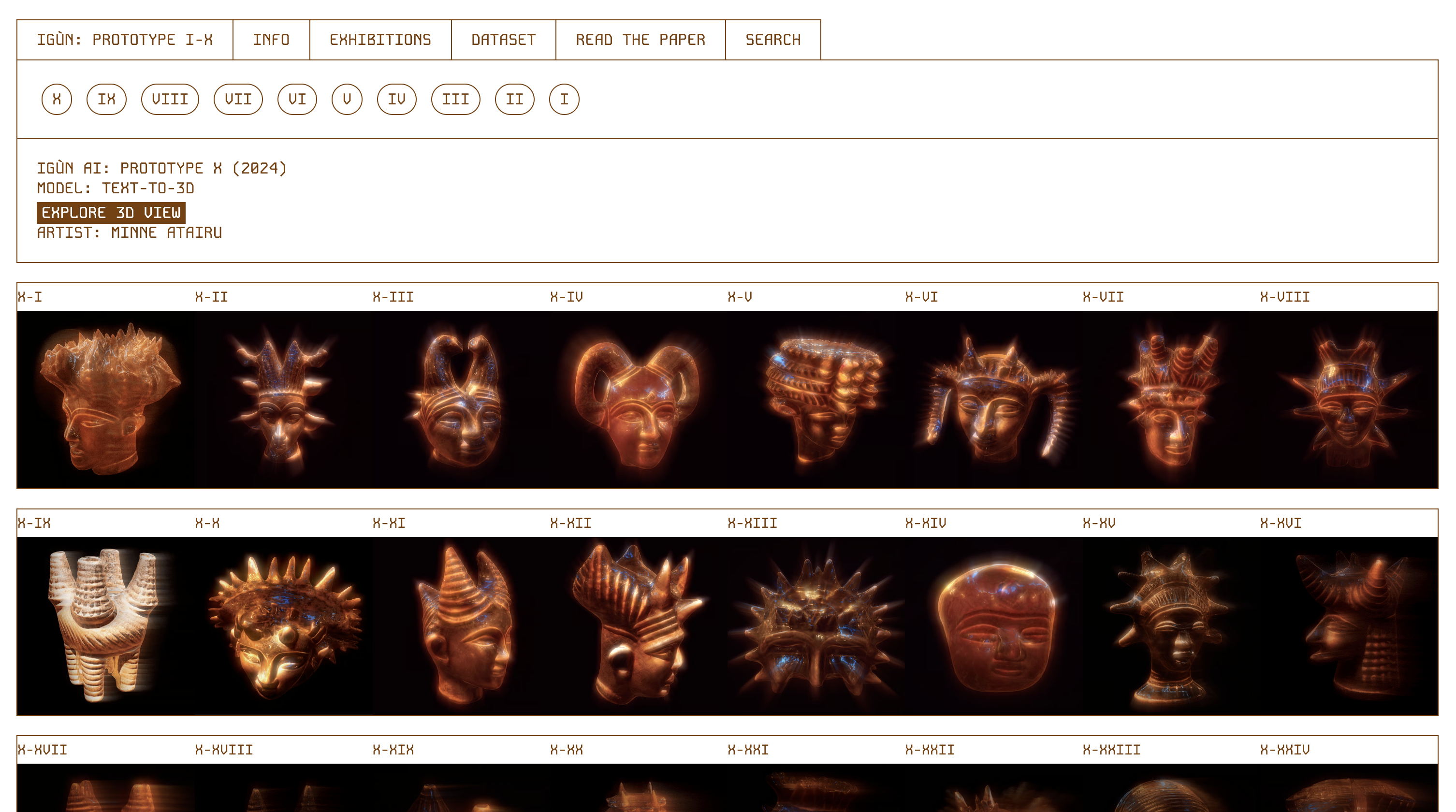
"Minne Atairu is a researcher and artist who studies the impact of colonialism on West African art. In her project Igùn, she uses artificial intelligence in a new context: to re-imagine a past that has been stolen. She explores the "artistic absence" in the Kingdom of Benin between 1897 and 1914, during the British invasion, when the production of bronze objects was confiscated and exported. Atairu uses AI, AR and 3D printing to recreate this lost cultural environment with bronze heads, vessels, altars, texts, poems and so on. In doing so, she uses the data sets of the stolen objects and develops different narratives, including marginal and negated narratives outside the official royal circles. What emerges is a statistically predicted past that is thus induced and somehow also imaginary, but generated in a dynamic present where it can trigger awareness and acts of reparation." – Neural magazine, Minne Atairu – Igùn, 2022 "The 1897 invasion had a devastating impact on Benin's artistic landscape. British imperial soldiers razed the royal palace - a cultural complex that housed artist studios, residencies and repositories for imported art materials including the kingdom's bronze reserves. Amidst the chaos, Oba Ovonramwen—the Kingdom's sole patron of the arts, was dethroned and exiled. The Oba's exile prompted an exodus of artists from Benin city to satellite towns, where they forsook their artistic pursuits to engage in subsistence farming. This forced economic migration ushered in a 17-year (1897-1914) artistic recession — a period which lacks visual/archival records. Igùn is my attempt to answer a question about this dearth in documentation: What artifacts might have been produced during the 17-year artistic recession? In Igùn: Prototypes I—IX, I leveraged the capabilities of StyleGAN2, a machine learning algorithm, to create a vast and varied collection of speculative artifacts. This process involved fine-tuning each algorithm with a dataset of looted Benin Bronzes - all curated from Western museums. No single prototype is designed to definitively answer my research question. Instead, my objective is to delve into the oft-conflicting artistic facts, and fictions that pervade this period." – Minne Atairu, prototypex.info, 2024
- More about Minne Atairu: minneatairu.com
Tutorial
Assignment
Select a photographic archive, image collection, or visual corpus that reflects a historical absence, erasure, or gap — something that was not photographed, was destroyed, or was systematically excluded from the visual record.
Using a LoRA, train or prompt a model with images from or related to this archive. If you have no access to replicate, you can send your LoRA dataset to me and I’ll create a model trained on your images for you.
Generate a series of 8–12 images and accompany them with a short text (200–250 words) that describes: the archive you chose, the absence you are responding to, and what the generated images propose — not as historical truth, but as speculative possibility.
Upload the text and images with your name and a caption to this online document.
Präsentationen
Wähle eine virtuelle Welt oder ein Open-World-Spiel und erkunde seine natürlichen Landschaften mit einem fotografischen Ansatz.
Du kannst eine bestimmte Typologie virtueller Flora oder eines Geländes dokumentieren, die Ränder und Out-of-Bounds-Räume untersuchen, an denen die Simulation zusammenbricht, oder dich nachhaltig mit Licht, Atmosphäre und Tageszeit auseinandersetzen — innerhalb oder gegen die visuellen Konventionen der Landschaftsfotografie arbeitend.
Erstelle eine Serie von 8–12 Bildern, begleitet von einem kurzen Text (150–200 Wörter), in dem du deinen Ansatz, die gewählte Umgebung und das beschreibst, was deine Bilder über das Verhältnis zwischen Natur und ihrer digitalen Simulation enthüllen.
Lade den Text und die Bilder mit deinem Namen und einer Bildunterschrift auf dieses Online-Dokument hoch.
Fotografie war schon immer durch das geprägt, was sie ausschließt — davon, wer die Kamera hält, wessen Geschichten erzählt werden und wessen Bilder aufbewahrt werden. Machine-Learning-Algorithmen, die mit fotografischen Datensätzen trainiert werden, erben und verstärken diese Abwesenheiten und Verzerrungen. Doch Künstler:innen haben begonnen, dies umzukehren: Sie verwenden generative Modelle nicht, um noch mehr Bilder des ohnehin Sichtbaren zu produzieren, sondern um über das zu spekulieren, was nie fotografiert, nie archiviert, nie zugelassen wurde zu existieren.
Mit GANs, LoRAs und Diffusionsmodellen trainieren die Künstler:innen in dieser Lektion ihre Algorithmen auf spezifische, oft marginalisierte Bildkorpora — geraubte Bronzen, queere lateinamerikanische Geschichte, schwarze Frauen unter der Sklaverei — und nutzen die generierten Ergebnisse als eine Form von Gegenarchiv. Diese Bilder sind keine Dokumente. Sie sind Vorschläge: Was hätte fotografiert werden können, wenn die Bedingungen der Fotografie andere gewesen wären? Dabei fragen sie nicht nur, was Generative KI produzieren kann, sondern was die Fotografie historisch nicht festzuhalten vermochte — und was sie möglicherweise noch schuldet.
Fallbeispiele
Robbie Barrat, Neural Network Balenciaga, 2018
"Using a corpus of Balenciaga runway shows, catalogues, and campaigns, a Pix2PixHD network was trained to reconstruct Balenciaga outfits from Densepose silhouettes. The results are outfits which are novel but at the same time heavily inspired by Balenciaga's past few years under Demna Gvasalia. The network lacks any contextual awareness of the non-visual functions of clothing (e.g. why people carry bags, whether or not bags are separate from pants, why people prefer symmetrical outfits) - and in turn produces more strange outfits that completely disregard these functions." – Robbie Barrat, artist website, 2018.
- Mehr über Neural Network Balenciaga: ssense.com/en-in/editorial/fashion/do-androids-dream-of-balenciaga-ss29
Felipe Rivas San Martín, Un Archivo Inexistente, 2022–2024
"The project A Nonexistent Archive, initiated in 2022 by Rivas San Martín, starts precisely from that absence (of historical images of sexual diversity). Instead of finding a preserved archive, the artist sets out to create a speculative one: 108 images of working-class homosexual couples in Latin America at the beginning of the 20th century, generated through artificial intelligence." It "evokes a complex feeling such as anemoia, that ability to feel nostalgia for something we have not experienced" – Mariairis Flores Leiva "This archive not only highlights the subversive capacity of digital art and AI to reimagine queer pasts, but also the importance of considering stimuli, imperfections, and errors as forms of queer resistance and affirmation" –Eduardo Carrera Rivadeneira "construct an archive of queer affects, imagining possible pasts that compensate for the historical absence of certain figures and experiences in the visual record." –Sebastián Valenzuela Valdivia – Artishock, artishockrevista.com/2025/02/21/felipe-rivas-san-martin-archivo-homosexual-ia, 2025
Mayara Ferrão, Álbum dos Desesquecimentos, 2024
""Ferrão has been dedicated to an investigation that combines archival research on slavery with the manipulation and generation of images through AI. Her aim, she explains, is to construct fictional narratives of affectionate exchanges between Black women and to reimagine colonial representations through a speculative exercise that seeks to ask: What if these women had been able to live their loves in the past? However, the very question finds a bold response in her work: these women did live and love, but their loves became unimaginable in a world shaped by cis-heteronormative white supremacy." [...] "In a context where the racist bias of AI systems is widely debated, with algorithms mostly coded by white men, Ferrão is not alone in appropriating a technology that was not designed for or by Black people." – Fernanda Silva e Sousa, Verve Galeria
Juan Covelli, Speculative Treasures, 2021
"IThe Speculative Treasure series presents a series of images that aim to transgress questions about repatriation, archaeology and heritage, through digital decolonial approaches. In 1892, the Colombian President Carlos Holguín sent the Quimbaya Treasure to Madrid to exhibit it for the celebrations of the "IV Centenary of the Discovery of America" and then give it to María Cristina, queen consort of Spain, in appreciation for her intervention in a territorial dispute between Colombia and Venezuela. Years later, the treasure, which includes more than a hundred objects in the form of beads, musical instruments and anthropomorphic figures made of gold and tumbaga, became part of the collection of the Museum of America in Madrid, where it is currently exhibited. In 2017, at the initiative of a popular petition and after years of legal proceedings, the Constitutional Court of Colombia decreed that the gift had been made illegally and ordered the Colombian Government to initiate procedures for its repatriation. Since then, the Museum of America and the Spanish Government have collaborated with the investigation, but have refused to return it. The Colombian artist Juan Covelli has trained a generative adversarial network, an artificial intelligence algorithm, with images of the Quimbaya Treasure. Generative algorithms are systems designed to create synthetic images from the defining features of the photographs they are trained with. The resulting images do not reproduce any particular object, but instead produce a visual imaginary from all of them. Covelli makes use of the virtual representation of the Treasure, as a decolonial tool for the symbolic repatriation of cultural heritage." – Getxophoto, festival website, 2022
- Mehr über Speculative Treasures: instagram.com/p/CmjpDtsuky9/?img_index=1
Minne Atairu, Igùn AI: Prototype X, 2024
"Minne Atairu is a researcher and artist who studies the impact of colonialism on West African art. In her project Igùn, she uses artificial intelligence in a new context: to re-imagine a past that has been stolen. She explores the "artistic absence" in the Kingdom of Benin between 1897 and 1914, during the British invasion, when the production of bronze objects was confiscated and exported. Atairu uses AI, AR and 3D printing to recreate this lost cultural environment with bronze heads, vessels, altars, texts, poems and so on. In doing so, she uses the data sets of the stolen objects and develops different narratives, including marginal and negated narratives outside the official royal circles. What emerges is a statistically predicted past that is thus induced and somehow also imaginary, but generated in a dynamic present where it can trigger awareness and acts of reparation." – Neural magazine, Minne Atairu – Igùn, 2022 "The 1897 invasion had a devastating impact on Benin's artistic landscape. British imperial soldiers razed the royal palace - a cultural complex that housed artist studios, residencies and repositories for imported art materials including the kingdom's bronze reserves. Amidst the chaos, Oba Ovonramwen—the Kingdom's sole patron of the arts, was dethroned and exiled. The Oba's exile prompted an exodus of artists from Benin city to satellite towns, where they forsook their artistic pursuits to engage in subsistence farming. This forced economic migration ushered in a 17-year (1897-1914) artistic recession — a period which lacks visual/archival records. Igùn is my attempt to answer a question about this dearth in documentation: What artifacts might have been produced during the 17-year artistic recession? In Igùn: Prototypes I—IX, I leveraged the capabilities of StyleGAN2, a machine learning algorithm, to create a vast and varied collection of speculative artifacts. This process involved fine-tuning each algorithm with a dataset of looted Benin Bronzes - all curated from Western museums. No single prototype is designed to definitively answer my research question. Instead, my objective is to delve into the oft-conflicting artistic facts, and fictions that pervade this period." – Minne Atairu, prototypex.info, 2024
- Mehr über Minne Atairu: minneatairu.com
Tutorial
Aufgabe
Wähle ein fotografisches Archiv, eine Bildsammlung oder ein visuelles Korpus, das eine historische Abwesenheit, Auslöschung oder Lücke widerspiegelt — etwas, das nie fotografiert wurde, zerstört wurde oder systematisch aus dem Bildgedächtnis ausgeschlossen war.
Trainiere mithilfe einer LoRA ein Modell mit Bildern aus diesem Archiv oder in Bezug auf dieses Archiv. Falls du keinen Zugang zu Replicate hast, kannst du mir deinen LoRA-Datensatz schicken und ich erstelle ein auf deinen Bildern trainiertes Modell für dich.
Generiere eine Serie von 8–12 Bildern und begleite sie mit einem kurzen Text (200–250 Wörter), der beschreibt: das Archiv, das du gewählt hast, die Abwesenheit, auf die du antwortest, und was die generierten Bilder vorschlagen — nicht als historische Wahrheit, sondern als spekulative Möglichkeit.
Lade den Text und die Bilder mit deinem Namen und einer Bildunterschrift auf dieses Online-Dokument hoch.