Virtual Nature Virtuelle Natur
Presentations
Choose a computer game or virtual environment and conduct a photographic survey of one architectural type within it (e.g. churches, domestic interiors, industrial structures, public spaces).
You can use screenshots, digital photogrammetry or virtual cameras to produce the images. You can choose to go out of bounds and explore the glitchy architecture of the software, or use a specific angle, style and materialisation process, based on traditions of architecture photography and the examples seen in class.
Create a series of 8–12 images that document this typology consistently, as if producing an architectural record. Accompany the series with a short text (150–200 words) describing your approach and the environment you chose.
Upload the text and the images with your name and a caption on this online document
Nature has always been one of photography’s primary subjects — a test for the medium’s ability to render light, texture, and atmosphere. In digital game environments, nature is something else entirely: a technical construction, assembled from texture files, mesh geometries, and procedural algorithms designed to produce the impression of organic life. Trees sway because they are programmed to. Grass bends because a developer decided it should. Clouds move on a loop.
Yet these simulated landscapes are experienced by millions of people as places of solitude, exploration, and even beauty. Artists working in virtual nature photography engage with this paradox — approaching game environments with the sensibility of landscape photographers, while remaining attentive to the specific conditions of digital image-making: the absence of weather, the edges of the map, the seams where the world runs out. In doing so, they raise questions about what we mean by nature, what we expect from images of it, and how simulation reshapes our relationship to the natural world.
Study Cases
Pascal Greco, Place(s), 2021
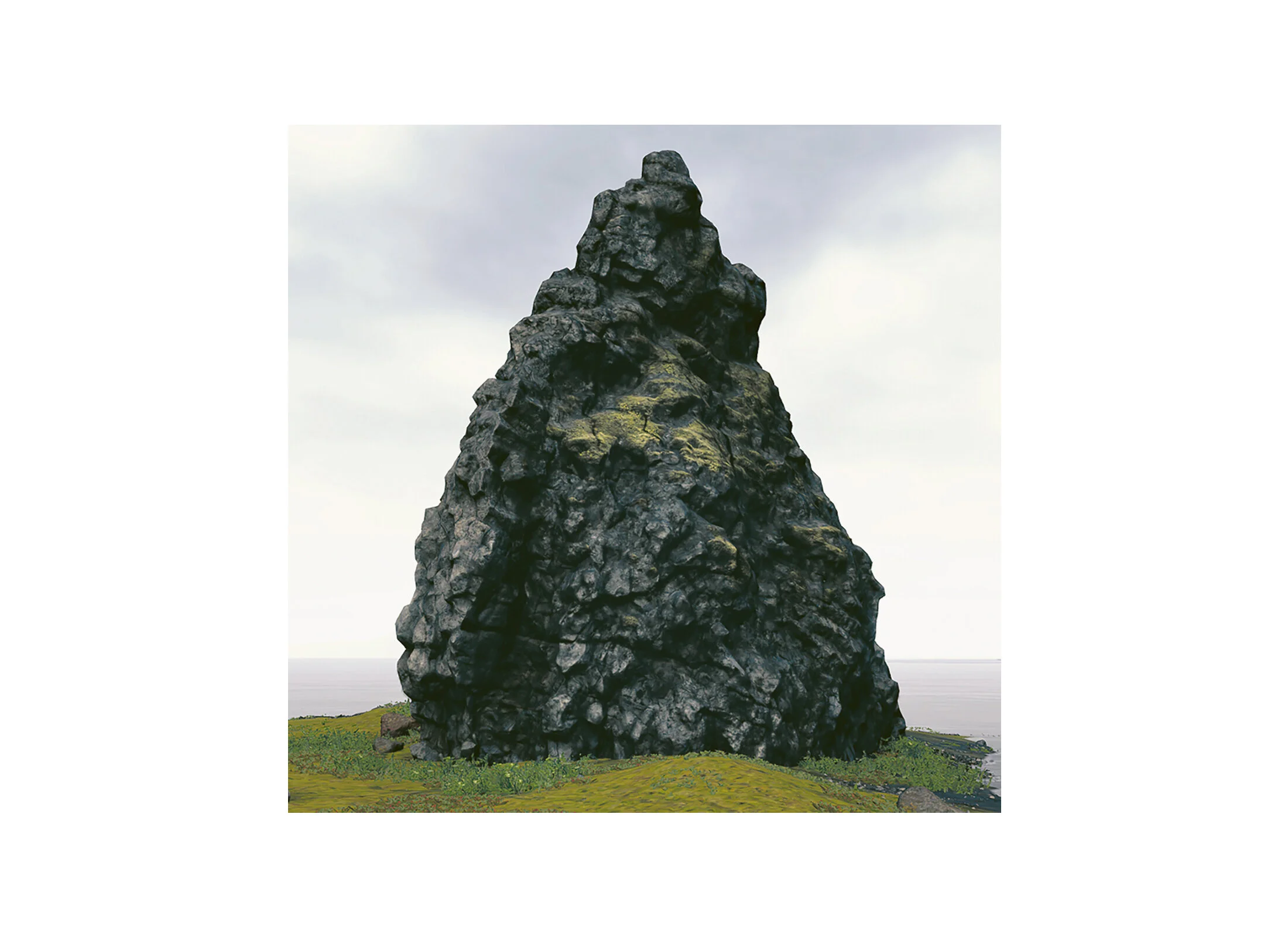
"In March 2020 I had planned a trip to Iceland to continue my photographic project started with my book No Cliché, which aimed at conveying an unusual imagery of much photographed Iceland. Due to travel restrictions, I was unable to set out on the journey. During the lockdown I discovered the game Death Stranding, on Playstation 4, with its landscapes reminiscent of Iceland and instead started taking pictures in the game. This unexpected turn of events gave a new dimension to the project. Using the game and its constraints as a playground for experimentation, I undertook a meticulous yet playful photographic process, translating my approach to photography to the making of digital images. In the same way my polaroids had previously challenged the stereotyped representations of the country, the images that have emerged frame aspects of the landscape that usually remain unseen. But where No Cliché goes against the dominant imagery emanating from the island, Place(s) embraces its codes and plays with the ambiguity of an anonymous landscape made familiar. As digital images, they question both in-game and traditional photography by setting a point where the two meet and intertwine." – Pascal Greco, artist website, 2021
- More about Place(s): pascalgreco.com/places
Alan Butler, Virtual Botany Cyanotypes, 2016–
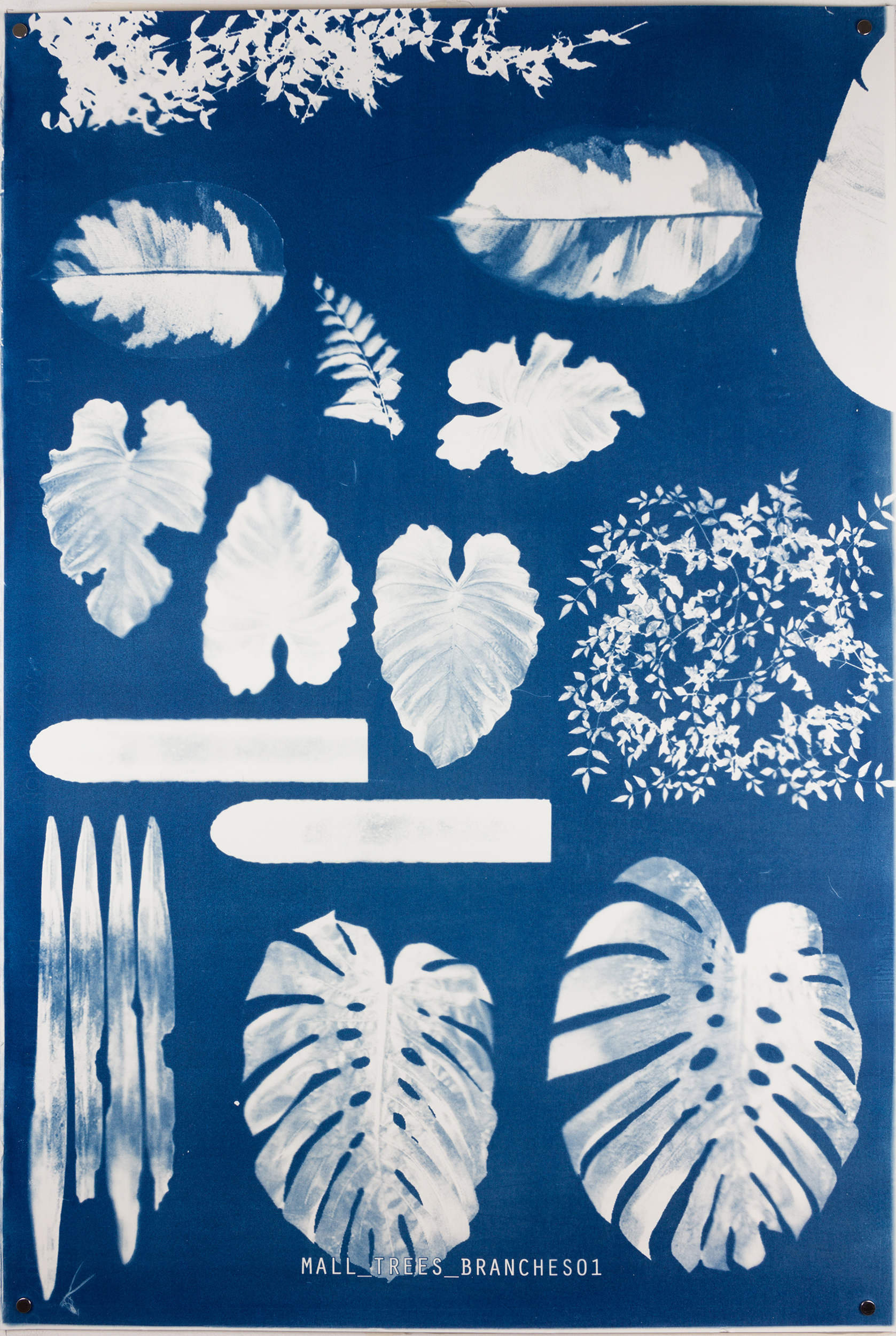
"The Irish artist Alan Butler (b. 1981) abandons the player's goal of winning and transgresses the path designed by the game developers in order to shift his attention to flowers and extracting texture files of trees and plants from the game software. Photorealistic leaves and pixelated cacti become part of a botanical archive documenting the specimens of virtual flora that inhabit game landscapes populated by millions of players. Reminiscent of the 1843 Photographs of British Algae: Cyanotype Impressions by the botanist and photographer Anna Atkins, Virtual Botany Cyanotypes (2016–) documents our contemporary screen landscapes and the ambiguous relationship between nature and its simulation. Through Butler's quasi scientific investigation, the work also shows the evolution of computer graphics over the last decades and the attempt by the game industry to achieve seamless photorealism and the simulation of reality in its every detail." – Marco De Mutiis and Matteo Bittanti, How to Win at Photography – Image-Making as Play
- More about Virtual Botany Cyanotypes: alanbutler.info/virtual-botany-cyanotypes
- Screen Walk with Alan Butler: youtube.com/watch?v=YGANxb9oWG4
Ryohei Takahashi, Grand Theft Auto V’s Botany, 2023
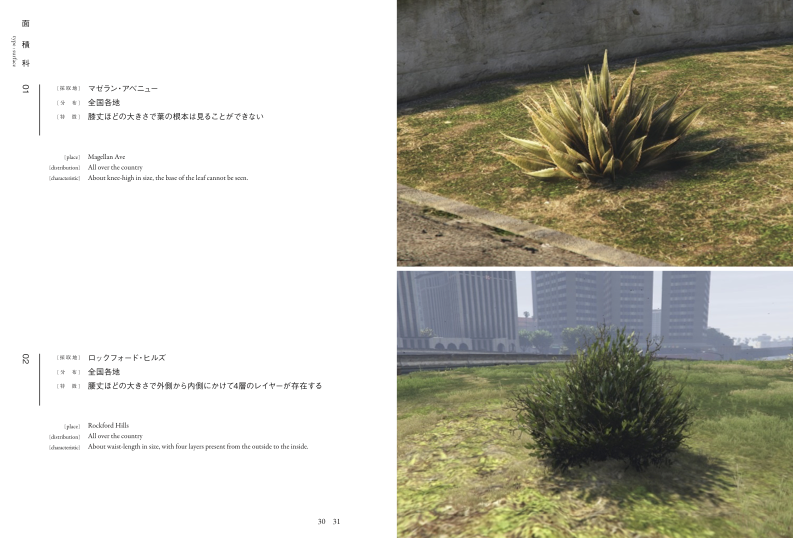
"In Grand Theft Auto V's Botany, Ryohei Takahashi screenshots each of the in-game plants and classifies them through a scientific perspective. The form of the project follows the tradition of photographic books documenting flora, which dates back to 1842's Photographs of British Algae: Cyanotype Impressions by British botanist and photographer Anna Atkins. Yet Takahashi is interested in the digital conditions of game nature and the algorithmic properties of plants and trees in GTA V, rather than the link to their counterpart in the physical world. [...] Like some kind of software botanist, he categorises the game flora by family species such as texture, surfaces, meshes and composites – distinguishing between 2D and 3D plants, and their role in the game. The artist carries on his categorisation not only through the act of looking, but interacting with the flora through the affordances of the game mechanics: can the plants be stepped on, hit or shot through a gun? Through a precise and scientific analysis and categorisation, Takahashi compiles a comprehensive list of assets that reveal the properties and functions of digital nature in GTA V. The game plants exist with two particular purposes: 'for swaying' and 'for hiding.' The movement of their leaves creates the sense of the wind and the passing of time, increasing immersivity in an environment that would otherwise be extremely static. Their placement between walls and the ground, on the other hand, is used for hiding straight lines and the edges where objects meet, which would expose the construction of the virtual world. While these assets do not grow or reproduce like the flora outside of the screen, the plants from GTA V could be seen as breeding: they might appear in other digital worlds, across other games developed by Rockstar Games, and on each GTA V unit sold. With Grand Theft Auto V's Botany, Takahashi ultimately shows how game plants have adapted and evolved in specific ways, and how the study of game nature can go beyond plants as aesthetic elements, revealing technical properties and constraints that connect them with a larger algorithmic world." – Marco De Mutiis and Matteo Bittanti, The Photographer's Guide to Los Santos, 2025
- More about Grand Theft Auto V’s Botany: gta5.photography/artworks/grand-theft-auto-v-s-botany
- More from Ryohei Takahashi: tamabi.ac.jp/works/31826
Thomas Hawranke, OoB, 2017 – 2018
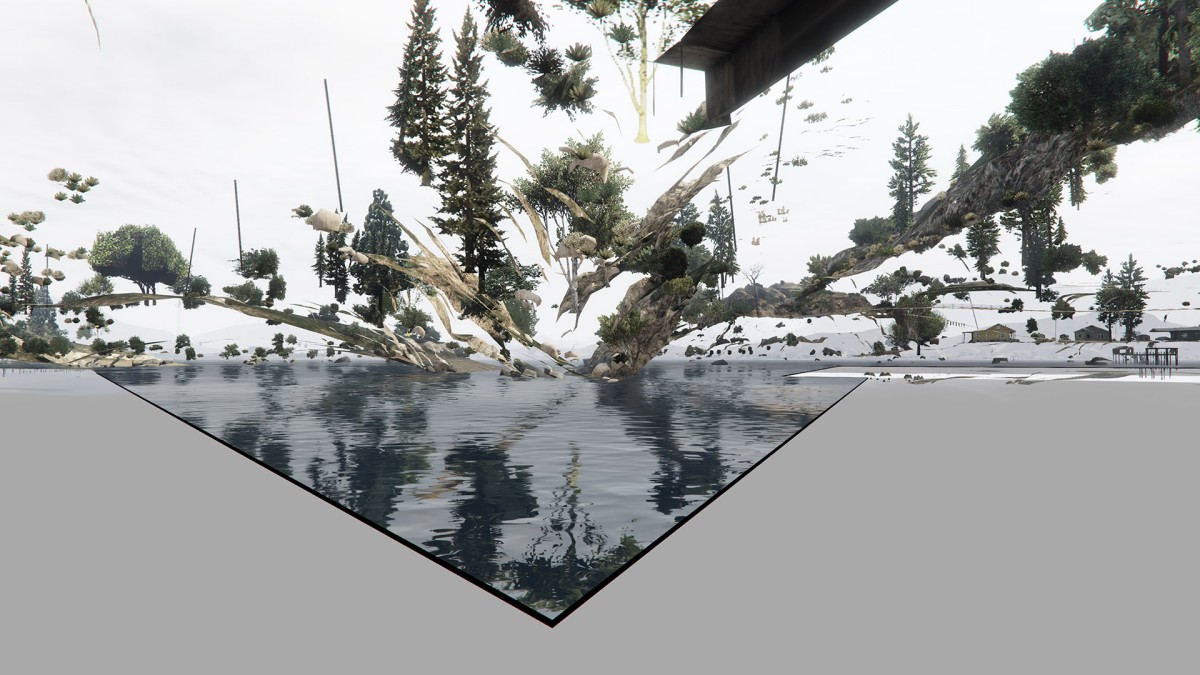
"Media artist Thomas Hawranke engages with video games, both challenging and embracing their boundaries to enhance and expand the camera's vision. His oeuvre, spanning from self-playing video games to profound meditations on non-human agency within simulated spaces, has received global recognition. His 2017 series, titled OoB, was inspired by a serendipitous discovery of a glitch in GTA V. In gaming terminology, an 'out of bounds' (OoB) glitch occurs when characters or objects stray beyond the designed play areas, accessing regions usually hidden from players, such as behind walls, beneath the map, or areas lacking collision detection. These visual inconsistencies, which defy real-world physics, appear in various forms: wall breaches enable passage through solid structures, exploring beneath the map reveals vast, unfinished spaces, boundary skips bypass invisible barriers meant to confine the player, and physics exploits use the game's mechanics to propel entities into forbidden zones. Hawranke's encounter with a crack in the game's foundation led him into this uncharted territory, viewing the world from beneath the map. Modifying the game's code to accelerate its implosion, he documented these uncanny perspectives, resulting in a series of surreal, fragmented landscapes characterised by floating trees, rocks, interrupted skies, and various natural elements detached from coherent ground. The chaotic assembly of these elements suggests a breakdown in the game's spatial logic, highlighting the fragile boundaries between different layers of the game world. Multiple layers of terrain and visible seams underscore the artificiality and mutable nature of digital spaces. The minimalist compositions, often stripped of familiar grounding elements, evoke weightlessness, abstraction, and a sense of post-human weirdness. Elements like a transmission tower embedded in the landscape and floating segments in stark white snowy scenes emphasise the malleability of digital physics and geography. Broad, flat expanses with scattered debris and fractured terrain convey emptiness and isolation. Floating houses and trees above reflective water blur the line between the tangible and the immaterial, challenging stability and permanence in the built environment." – Marco De Mutiis and Matteo Bittanti, The Photographer's Guide to Los Santos, 2025
- More about OoB: gta5.photography/artworks/oob
- More from Thomas Hawranke: thomashawranke.com
Natalie Maximova, The Edge of the World, 2021
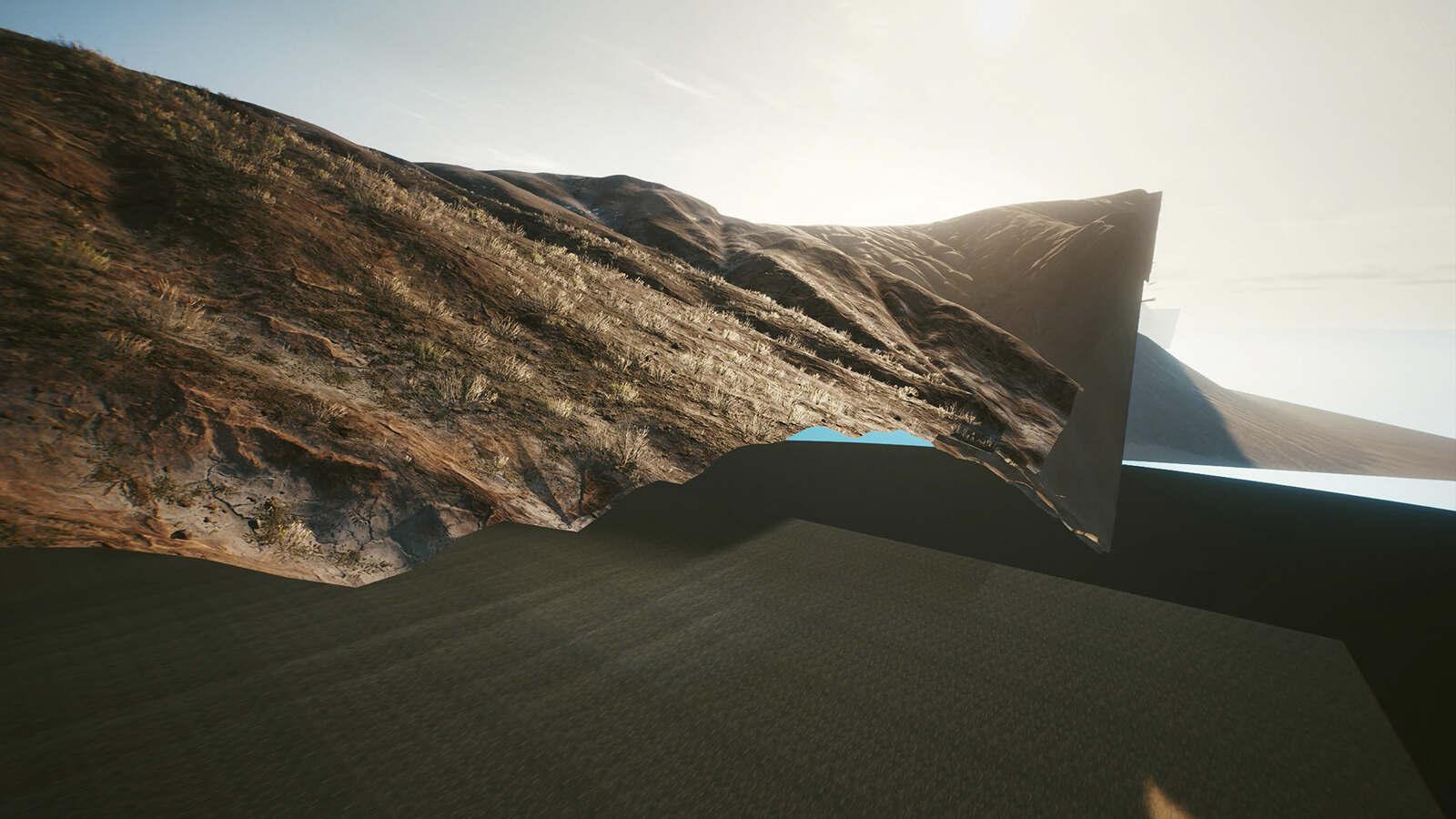
"We are tempted to believe that landscapes extend indefinitely. But where does a landscape begin, and where does it end? Where is its edge? Can a virtual world have a limit? The Edge of the World explores the hidden peripheries of Cyberpunk 2077, pushing against spatial boundaries to uncover the rough, unfinished edges of the game world. By documenting these 'out-of-bounds' spaces, the project exposes the representational logics and constraints that shape digital landscapes. These edges — both frustrating and unexpectedly revealing — do not mark the end of the world, but rather the limits of the known, challenging our assumptions about virtual space and its constructed realities." – Natalie Maximova, artist website
- More about The Edge of the World: nmaximova.com/the-edge-of-the-world
Tutorial
Making Cyanotypes from Virtual Worlds
Alan Butler’s Virtual Botany Cyanotypes draws a direct line between Anna Atkins’ 1843 botanical contact prints and the flora of contemporary game environments. This tutorial guides you through making your own cyanotypes using digital negatives sourced from screenshots of virtual landscapes — a process that bridges the oldest photographic printing technique with images that have never existed outside a screen.
What You Need
| Item | Notes |
|---|---|
| Pre-coated cyanotype paper | Available from photography suppliers (e.g. Jacquard, Sunprint, Fotoimpex); comes ready to use, no chemical mixing required |
| A game screenshot | High contrast images with clear silhouettes work best for first attempts |
| Inkjet transparency film | For printing your digital negative |
| A sheet of glass or acrylic | To hold the negative flat against the paper during exposure |
| UV light source | Direct sunlight or a UV exposure unit |
Step 1: Preparing Your Digital Negative
A digital negative is a high-contrast, inverted image printed onto transparency film. The dark areas block UV light and produce the white areas in the final print; the clear areas allow UV through and produce the characteristic Prussian blue.
Start by selecting a screenshot from your game environment. Isolated plant specimens, tree silhouettes against a bright sky, or texture details extracted from the game world all work well — echoing Butler’s method of extracting individual flora assets.
In an image editor (Photoshop, GIMP, or similar):
- Convert the image to greyscale
- Increase contrast significantly — cyanotype printing compresses tonal range, so what looks too harsh on screen will soften in the final print
- Invert the image (the negative should look like a photographic negative: dark where you want blue, light where you want white)
- Mirror the image horizontally so text or directional elements read correctly in the final print
- Print onto inkjet transparency film using the highest quality setting and maximum black ink density
Step 2: Exposing
Pre-coated cyanotype paper is light-sensitive and should be kept in its packaging until you are ready to expose. Work quickly in subdued indoor light when handling it — avoid direct sunlight or strong artificial UV sources before exposure.
Place your sheet of pre-coated paper face up. Lay the printed transparency film face down on top of it, emulsion side against the coated surface, then press a sheet of glass or acrylic firmly over both to ensure full contact. Expose to UV light:
| Light source | Approximate exposure time |
|---|---|
| Bright midday sun | 5–15 minutes |
| Overcast daylight | 20–40 minutes |
| UV exposure unit | Follow manufacturer’s guidance, typically 3–10 minutes |
The print is ready when the exposed areas have turned a dull grey-bronze and the image is faintly visible. The colour develops fully during washing.
Step 3: Washing and Drying
Rinse the print under running water for at least 5 minutes. As the print washes, the unexposed areas clear to white and the exposed areas oxidise to the characteristic deep Prussian blue. Hang to dry flat, away from direct light. The blue deepens further as the print dries.
Connecting the Process to the Work
Butler’s cyanotypes treat the act of extraction — pulling plant assets from game software — as equivalent to pressing a flower or collecting a botanical specimen. Your digital negative performs a similar gesture: a game screenshot is translated into a physical chemical print, the virtual becomes tactile, and an image born on a screen ends its life as a blue stain on paper.
Consider what you choose to extract and print. A single plant isolated against white echoes the scientific register of Atkins’ algae plates. A landscape fragment, a texture tile, or a glitched terrain edge suggests something stranger — a nature that was never natural to begin with.
Assignment
Choose a virtual world or open-world game and explore its natural landscapes with a photographic approach.
You can document a specific typology of virtual flora or terrain, investigate the edges and out-of-bounds spaces where the simulation breaks down, or develop a sustained engagement with light, atmosphere, and time of day — working within or against the visual conventions of landscape photography.
Create a series of 8–12 images accompanied by a short text (150–200 words) describing your approach, the environment you chose, and what your images reveal about the relationship between nature and its digital simulation.
Präsentationen
Wähle ein Computerspiel oder eine virtuelle Umgebung und führe eine fotografische Untersuchung eines architektonischen Typus darin durch (z. B. Kirchen, Wohnräume, Industriebauten, öffentliche Räume).
Du kannst Screenshots, digitale Photogrammetrie oder virtuelle Kameras einsetzen, um die Bilder herzustellen. Du kannst wählen, ob du „out of bounds” gehst und die fehlerhafte Architektur der Software erkundest, oder ob du einen bestimmten Winkel, Stil und Materialisierungsprozess verwendest, der sich auf Traditionen der Architekturfotografie und die in der Lehrveranstaltung gesehenen Beispiele stützt.
Erstelle eine Serie von 8–12 Bildern, die diesen Typus konsistent dokumentieren, als würdest du einen architektonischen Bestandsaufweis erstellen. Begleite die Serie mit einem kurzen Text (150–200 Wörter), in dem du deinen Ansatz und die gewählte Umgebung beschreibst.
Lade den Text und die Bilder mit deinem Namen und einer Bildunterschrift in diesem Online-Dokument hoch.
Natur war stets eines der zentralen Sujets der Fotografie — ein Prüfstein für die Fähigkeit des Mediums, Licht, Textur und Atmosphäre wiederzugeben. In digitalen Spielumgebungen ist Natur etwas grundlegend anderes: eine technische Konstruktion, zusammengesetzt aus Texturdateien, Mesh-Geometrien und prozeduralen Algorithmen, die den Eindruck organischen Lebens erzeugen sollen. Bäume schwanken, weil sie so programmiert wurden. Gras biegt sich, weil ein Entwickler es so entschieden hat. Wolken bewegen sich in einer Schleife.
Dennoch werden diese simulierten Landschaften von Millionen von Menschen als Orte der Einsamkeit, der Erkundung und sogar der Schönheit erlebt. Künstlerinnen und Künstler, die sich mit virtueller Naturfotografie beschäftigen, setzen sich mit diesem Widerspruch auseinander — sie nähern sich Spielumgebungen mit der Sensibilität von Landschaftsfotografinnen und -fotografen und bleiben dabei aufmerksam gegenüber den spezifischen Bedingungen digitaler Bildproduktion: dem Fehlen von Wetter, den Rändern der Karte, den Nahtstellen, an denen die Welt aufhört. Dabei stellen sie Fragen darüber, was wir unter Natur verstehen, was wir von Bildern davon erwarten und wie Simulation unsere Beziehung zur natürlichen Welt verändert.
Fallstudien
Pascal Greco, Place(s), 2021
„Im März 2020 hatte ich eine Reise nach Island geplant, um mein fotografisches Projekt fortzusetzen, das mit meinem Buch No Cliché begonnen hatte und darauf abzielte, eine ungewöhnliche Bildsprache des viel fotografierten Islands zu vermitteln. Aufgrund von Reisebeschränkungen konnte ich die Reise nicht antreten. Während des Lockdowns entdeckte ich das Spiel Death Stranding auf der PlayStation 4, mit seinen Landschaften, die an Island erinnern, und begann stattdessen, im Spiel Bilder aufzunehmen. Diese unerwartete Wendung gab dem Projekt eine neue Dimension. Das Spiel und seine Einschränkungen als Experimentierfeld nutzend, unternahm ich einen sorgfältigen und zugleich spielerischen fotografischen Prozess, bei dem ich meinen fotografischen Ansatz auf die Herstellung digitaler Bilder übertrug. So wie meine Polaroids zuvor die stereotypen Darstellungen des Landes herausgefordert hatten, rahmen die entstandenen Bilder Aspekte der Landschaft ein, die üblicherweise unsichtbar bleiben. Doch während No Cliché gegen die dominante Bildsprache der Insel arbeitet, übernimmt Place(s) deren Codes und spielt mit der Ambiguität einer anonymen, vertraut gemachten Landschaft. Als digitale Bilder hinterfragen sie sowohl die Spielfotografie als auch die traditionelle Fotografie, indem sie einen Punkt setzen, an dem sich beide begegnen und verflechten." – Pascal Greco, artist website, 2021
- Mehr über Place(s): pascalgreco.com/places
Alan Butler, Virtual Botany Cyanotypes, 2016–
„Der irische Künstler Alan Butler (geb. 1981) gibt das Spielziel des Gewinnens auf und überschreitet den von den Spieleentwicklerinnen und -entwicklern vorgesehenen Pfad, um seine Aufmerksamkeit auf Blumen zu richten und Texturdateien von Bäumen und Pflanzen aus der Spielsoftware zu extrahieren. Fotorealistische Blätter und verpixelte Kakteen werden Teil eines botanischen Archivs, das die Exemplare virtueller Flora dokumentiert, die Spiellandschaften bewohnt, die von Millionen von Spielerinnen und Spielern bevölkert werden. In Anlehnung an Anna Atkins' Photographs of British Algae: Cyanotype Impressions von 1843 dokumentiert Virtual Botany Cyanotypes (2016–) unsere zeitgenössischen Bildschirmlandschaften und das ambivalente Verhältnis zwischen Natur und ihrer Simulation. Durch Butlers quasi-wissenschaftliche Untersuchung zeigt die Arbeit zugleich die Entwicklung der Computergrafik in den letzten Jahrzehnten und das Bestreben der Spieleindustrie, nahtlosen Fotorealismus und die Simulation der Realität in jedem Detail zu erreichen." – Marco De Mutiis und Matteo Bittanti, How to Win at Photography – Image-Making as Play
- Mehr über Virtual Botany Cyanotypes: alanbutler.info/virtual-botany-cyanotypes
- Screen Walk mit Alan Butler: youtube.com/watch?v=YGANxb9oWG4
Ryohei Takahashi, Grand Theft Auto V’s Botany, 2023
„In Grand Theft Auto V's Botany macht Ryohei Takahashi von jeder Pflanze im Spiel einen Screenshot und klassifiziert sie aus einer wissenschaftlichen Perspektive. Die Form des Projekts folgt der Tradition fotografischer Bücher zur Dokumentation von Flora, die auf Anna Atkins' Photographs of British Algae: Cyanotype Impressions von 1842 zurückgeht. Takahashi interessiert sich jedoch für die digitalen Bedingungen der Spielnatur und die algorithmischen Eigenschaften von Pflanzen und Bäumen in GTA V, weniger für ihre Entsprechungen in der physischen Welt. [...] Wie eine Art Software-Botaniker kategorisiert er die Spielflora nach Familienarten wie Textur, Oberflächen, Meshes und Composites — und unterscheidet zwischen 2D- und 3D-Pflanzen sowie ihrer Rolle im Spiel. Der Künstler setzt seine Kategorisierung nicht nur durch das Betrachten fort, sondern auch durch die Interaktion mit der Flora über die Spielmechaniken: Kann man auf die Pflanzen treten, sie treffen oder mit einer Waffe durchschießen? Durch eine präzise und wissenschaftliche Analyse und Kategorisierung stellt Takahashi eine umfassende Liste von Assets zusammen, die die Eigenschaften und Funktionen digitaler Natur in GTA V offenbaren. Die Spielpflanzen existieren mit zwei besonderen Zwecken: ‚zum Schwingen' und ‚zum Verbergen.' Die Bewegung ihrer Blätter erzeugt das Gefühl von Wind und dem Vergehen der Zeit und steigert die Immersion in einer Umgebung, die sonst extrem statisch wäre. Ihre Platzierung zwischen Wänden und dem Boden dient hingegen dazu, gerade Linien und die Kanten, an denen Objekte aufeinandertreffen, zu verbergen, die sonst die Konstruktion der virtuellen Welt sichtbar machen würden. Obwohl diese Assets nicht wie Flora außerhalb des Bildschirms wachsen oder sich reproduzieren, könnte man sagen, dass die Pflanzen aus GTA V sich vermehren: Sie tauchen möglicherweise in anderen digitalen Welten auf, in anderen von Rockstar Games entwickelten Spielen und in jeder verkauften GTA-V-Einheit. Mit Grand Theft Auto V's Botany zeigt Takahashi letztlich, wie Spielpflanzen sich auf spezifische Weise angepasst und entwickelt haben, und wie das Studium digitaler Natur über Pflanzen als ästhetische Elemente hinausgehen kann und technische Eigenschaften und Einschränkungen offenbart, die sie mit einer größeren algorithmischen Welt verbinden." – Marco De Mutiis und Matteo Bittanti, The Photographer's Guide to Los Santos, 2025
- Mehr über Grand Theft Auto V’s Botany: gta5.photography/artworks/grand-theft-auto-v-s-botany
- Mehr von Ryohei Takahashi: tamabi.ac.jp/works/31826
Thomas Hawranke, OoB, 2017 – 2018
„Der Medienkünstler Thomas Hawranke setzt sich mit Videospielen auseinander, fordert deren Grenzen heraus und nutzt sie zugleich, um die Vision der Kamera zu erweitern. Sein Werk — von selbstspielenden Videospielen bis hin zu tiefgründigen Meditationen über nicht-menschliche Handlungsfähigkeit in simulierten Räumen — hat weltweite Anerkennung gefunden. Seine 2017er Serie OoB wurde durch einen zufälligen Fund eines Glitches in GTA V inspiriert. In der Spielterminologie bezeichnet ein ‚Out of Bounds' (OoB)-Glitch das Verlassen der gestalteten Spielbereiche durch Figuren oder Objekte, wodurch Regionen zugänglich werden, die für Spielerinnen und Spieler normalerweise verborgen sind — etwa hinter Wänden, unter der Karte oder in Bereichen ohne Kollisionserkennung. Diese visuellen Inkonsistenzen, die die Physik der realen Welt unterlaufen, treten in verschiedenen Formen auf: Wanddurchbrüche ermöglichen das Durchqueren solider Strukturen, die Erkundung unter der Karte enthüllt weite, unfertige Räume, Grenzübersprünge umgehen unsichtbare Barrieren, und Physik-Exploits nutzen die Spielmechanik, um Figuren in verbotene Zonen zu schleudern. Hawrankes Begegnung mit einem Riss im Fundament des Spiels führte ihn in dieses unerforschte Territorium — er betrachtete die Welt von unterhalb der Karte. Indem er den Spielcode modifizierte, um dessen Zusammenbruch zu beschleunigen, dokumentierte er diese unheimlichen Perspektiven. Das Ergebnis ist eine Serie surrealer, fragmentierter Landschaften, die von schwebenden Bäumen, Felsen, unterbrochenen Himmeln und natürlichen Elementen geprägt sind, die von kohärentem Boden losgelöst sind. Die chaotische Anordnung dieser Elemente deutet auf einen Zusammenbruch der räumlichen Logik des Spiels hin und hebt die fragilen Grenzen zwischen den verschiedenen Schichten der Spielwelt hervor. Mehrere übereinanderliegende Terrainschichten und sichtbare Nahtstellen unterstreichen die Künstlichkeit und Wandelbarkeit digitaler Räume. Die minimalistischen Kompositionen, oft ohne vertraute Bodenelemente, evozieren Schwerelosigkeit, Abstraktion und eine Art post-humaner Fremdartigkeit." – Marco De Mutiis und Matteo Bittanti, The Photographer's Guide to Los Santos, 2025
- Mehr über OoB: gta5.photography/artworks/oob
- Mehr von Thomas Hawranke: thomashawranke.com
Natalie Maximova, The Edge of the World, 2021
„Wir sind versucht zu glauben, dass sich Landschaften unendlich erstrecken. Aber wo beginnt eine Landschaft, und wo endet sie? Wo liegt ihr Rand? Kann eine virtuelle Welt eine Grenze haben? The Edge of the World erkundet die verborgenen Peripherien von Cyberpunk 2077 und dringt gegen die räumlichen Grenzen vor, um die rauen, unfertigen Ränder der Spielwelt zu enthüllen. Indem das Projekt diese ‚Out-of-Bounds'-Räume dokumentiert, legt es die Darstellungslogiken und Einschränkungen frei, die digitale Landschaften formen. Diese Ränder — zugleich frustrierend und unerwartet aufschlussreich — markieren nicht das Ende der Welt, sondern die Grenzen des Bekannten und hinterfragen unsere Annahmen über den virtuellen Raum und seine konstruierten Wirklichkeiten." – Natalie Maximova, artist website
- Mehr über The Edge of the World: nmaximova.com/the-edge-of-the-world
Tutorial
Zyanotypien aus virtuellen Welten herstellen
Alan Butlers Virtual Botany Cyanotypes zieht eine direkte Linie zwischen Anna Atkins’ botanischen Kontaktabzügen von 1843 und der Flora zeitgenössischer Spielumgebungen. Dieses Tutorial führt durch die Herstellung eigener Zyanotypien anhand digitaler Negative, die aus Screenshots virtueller Landschaften gewonnen werden — ein Prozess, der die älteste fotografische Drucktechnik mit Bildern verbindet, die außerhalb eines Bildschirms nie existiert haben.
Was du brauchst
| Material | Hinweise |
|---|---|
| Vorbearbeitetes Zyanotypiepapier | Bei Fotofachhandlungen erhältlich (z. B. Jacquard, Sunprint, Fotoimpex); gebrauchsfertig, kein Mischen von Chemikalien erforderlich |
| Ein Spiel-Screenshot | Bilder mit hohem Kontrast und klaren Silhouetten funktionieren für erste Versuche am besten |
| Inkjet-Transparentfolie | Zum Ausdrucken des digitalen Negativs |
| Eine Glas- oder Acrylscheibe | Um das Negativ während der Belichtung flach auf das Papier zu pressen |
| UV-Lichtquelle | Direktes Sonnenlicht oder ein UV-Belichtungsgerät |
Schritt 1: Das digitale Negativ vorbereiten
Ein digitales Negativ ist ein kontrastreicher, invertierter Ausdruck auf Transparentfolie. Die dunklen Bereiche blockieren UV-Licht und erzeugen die weißen Flächen im fertigen Abzug; die klaren Bereiche lassen UV durch und produzieren das charakteristische Preußischblau.
Wähle zunächst einen Screenshot aus deiner Spielumgebung. Einzeln isolierte Pflanzenexemplare, Baumsilhouetten vor einem hellen Himmel oder aus der Spielwelt extrahierte Texturdetails eignen sich gut — in Anlehnung an Butlers Methode, einzelne Flora-Assets aus dem Spiel herauszulösen.
In einem Bildbearbeitungsprogramm (Photoshop, GIMP oder ähnlichem):
- Das Bild in Graustufen umwandeln
- Den Kontrast deutlich erhöhen — die Zyanotypie komprimiert den Tonwertumfang, weshalb ein auf dem Bildschirm zu hart wirkender Kontrast im fertigen Abzug weicher erscheint
- Das Bild invertieren (das Negativ sollte wie ein fotografisches Negativ aussehen: dunkel, wo Blau entstehen soll, hell, wo Weiß entstehen soll)
- Das Bild horizontal spiegeln, damit Text oder gerichtete Elemente im fertigen Abzug korrekt lesbar sind
- Auf Inkjet-Transparentfolie mit höchster Qualitätseinstellung und maximaler Schwarztintendichte drucken
Schritt 2: Belichten
Vorbearbeitetes Zyanotypiepapier ist lichtempfindlich und sollte bis zur Belichtung in seiner Verpackung bleiben. Bei der Handhabung zügig bei gedämpftem Innenlicht arbeiten — direktes Sonnenlicht oder starke künstliche UV-Quellen vor der Belichtung vermeiden.
Das vorbearbeitete Papier mit der Vorderseite nach oben legen. Die bedruckte Transparentfolie mit der Druckseite nach unten darauflegen, Emulsionsseite zur beschichteten Oberfläche hin, dann eine Glas- oder Acrylscheibe fest darüber pressen, um vollständigen Kontakt zu gewährleisten. UV-Licht aussetzen:
| Lichtquelle | Ungefähre Belichtungszeit |
|---|---|
| Helles Mittagssonnenlicht | 5–15 Minuten |
| Bedecktes Tageslicht | 20–40 Minuten |
| UV-Belichtungsgerät | Herstellerangaben folgen, typischerweise 3–10 Minuten |
Der Abzug ist bereit, wenn die belichteten Bereiche ein mattes Grau-Bronze angenommen haben und das Bild schwach sichtbar ist. Die Farbe entwickelt sich beim Waschen vollständig.
Schritt 3: Waschen und Trocknen
Den Abzug mindestens 5 Minuten unter fließendem Wasser spülen. Während des Waschens klären die unbelichteten Bereiche zu Weiß auf, und die belichteten Bereiche oxidieren zum charakteristischen tiefen Preußischblau. Flach und lichtgeschützt zum Trocknen aufhängen. Das Blau vertieft sich beim Trocknen weiter.
Den Prozess mit der Arbeit verbinden
Butlers Zyanotypien behandeln den Akt der Extraktion — das Herausziehen von Pflanzen-Assets aus der Spielsoftware — als Äquivalent zum Pressen einer Blume oder dem Sammeln eines botanischen Exemplars. Dein digitales Negativ vollzieht eine ähnliche Geste: Ein Spiel-Screenshot wird in einen physischen Chemieabzug übersetzt, das Virtuelle wird greifbar, und ein Bild, das auf einem Bildschirm entstanden ist, endet sein Leben als blauer Fleck auf Papier.
Überlege, was du extrahierst und druckst. Eine einzelne, vor Weiß isolierte Pflanze greift das wissenschaftliche Register von Atkins’ Algenplatten auf. Ein Landschaftsfragment, eine Texturkachel oder ein glitchiger Geländerand deutet auf etwas Seltsameres hin — eine Natur, die von Anfang an nicht natürlich war.
Aufgabe
Wähle eine virtuelle Welt oder ein Open-World-Spiel und erkunde seine natürlichen Landschaften mit einem fotografischen Ansatz.
Du kannst einen bestimmten Typus virtueller Flora oder eines Geländes dokumentieren, die Ränder und Out-of-Bounds-Räume untersuchen, an denen die Simulation zusammenbricht, oder dich nachhaltig mit Licht, Atmosphäre und Tageszeit auseinandersetzen — innerhalb oder gegen die visuellen Konventionen der Landschaftsfotografie arbeitend.
Erstelle eine Serie von 8–12 Bildern, begleitet von einem kurzen Text (150–200 Wörter), in dem du deinen Ansatz, die gewählte Umgebung und das beschreibst, was deine Bilder über das Verhältnis zwischen Natur und ihrer digitalen Simulation enthüllen.