The Lure of Belief The Lure of Belief
Presentations:
Create a series of 3-5 images or a short video piece that revolves around the seduction of the abject, and the eerie feelings of cursed aesthetics, or continue working on the lure of comfort, and ideas of haptic visuals.
Upload a screenshot of your assignment with your name and a caption on this online document
Belief: from the seductive powers of lowres conspiracies to meme ideology
Photography and conspiracy theories
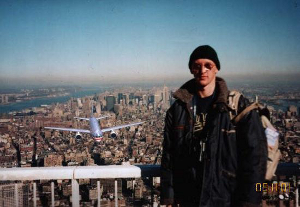
Few images illustrate the seductive power of the faked photograph as clearly as the “Tourist Guy.” In November 1997, Hungarian tourist Péter Guzli photographed himself on the observation deck of the World Trade Center’s South Tower. Four years later, in the aftermath of the September 11 attacks, he edited a Boeing 757 into the background and sent it to a small group of friends as a piece of dark humour. Within days, the image had spread via email to millions of people worldwide, accompanied by a caption claiming the camera had been recovered from the rubble of the Twin Towers. Despite being quickly debunked — the wrong plane model, the wrong approach direction, the wrong weather, the deck closed at that hour — many chose to believe it.
The Tourist Guy case is a founding document of viral image culture: it shows how photographs gain authority not from their content alone, but from the emotional context in which they circulate. Low resolution, degraded by repeated compression and forwarding, the image’s roughness only seemed to confirm its authenticity. Its spread coincided with the early infrastructure of email forwarding and online forums — anticipating the logic of social media conspiracy content that would follow. Guzli himself became a meme: photoshopped into the Hindenburg disaster, the Titanic, the Oklahoma City bombing. The image had escaped him entirely, acquiring a life — and a politics — of its own.
Ellie Wyatt, cherrypicker, 2021
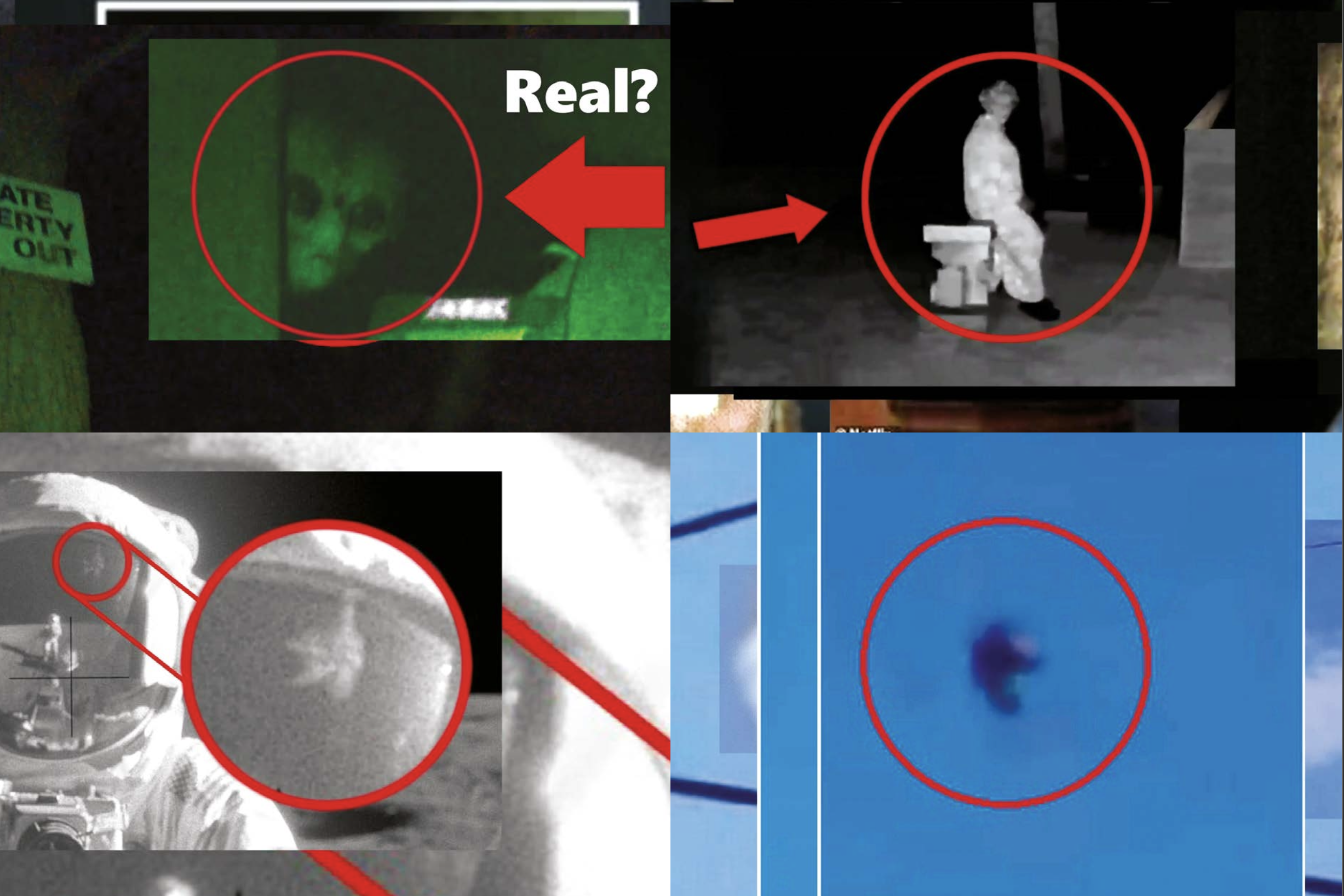
Ellie Wyatt (b. London) is an artist, writer and educator whose practice examines how “truth” is manifested, signalled and cultivated through visual and text-based languages — in particular, how photography and optics intersect with scientific epistemology and contemporary belief systems. Her work is constellation-based and fragmentary, moving across publications, prints, installations, drawings and films; recent projects have explored opacity in scientific image-making and the relationship between conspiracy theory and photographic detail.
cherrypicker is an online moving image work that takes the logic of conspiratorial looking — the scan, the zoom, the fixation on the incriminating detail — as both subject and method. Built as a custom website, the piece inhabits the visual language of conspiracy research: annotated screenshots, zoomed fragments, the restless accumulation of “evidence.” Wyatt stages the photographic close-up not as proof but as a site of productive uncertainty, asking what it means to look very carefully at something and still not know what you are seeing. The title refers to the cognitive bias of selecting only the evidence that confirms a pre-existing belief — a habit, Wyatt suggests, that is inseparable from how we look at images.
Andrea Orejarena and Caleb Stein, American Glitch, 2024
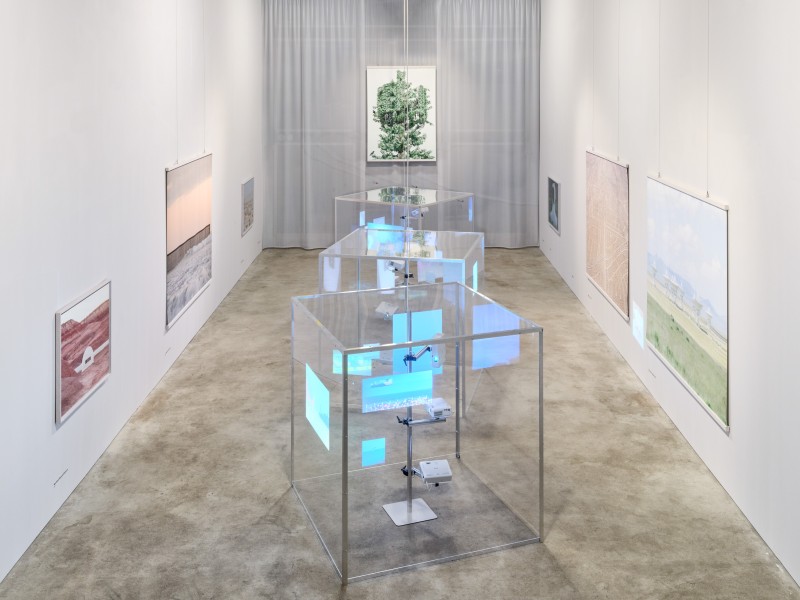
American Glitch investigates the visual mythologies circulating online and their intersections with historical memory, conspiracy theories, and the aesthetics of digital simulation. Working from an archive of over 2,000 images — combining found material with AI-generated visuals — Andrea Orejarena and Caleb Stein offer a critical yet poetic lens on the American media landscape: its promises, its ruptures, and its deepening entanglement with image manipulation and collective fantasy. The project asks what happens when the glitch — the error, the artifact, the moment an image fails — becomes not a sign of malfunction but of hidden truth.
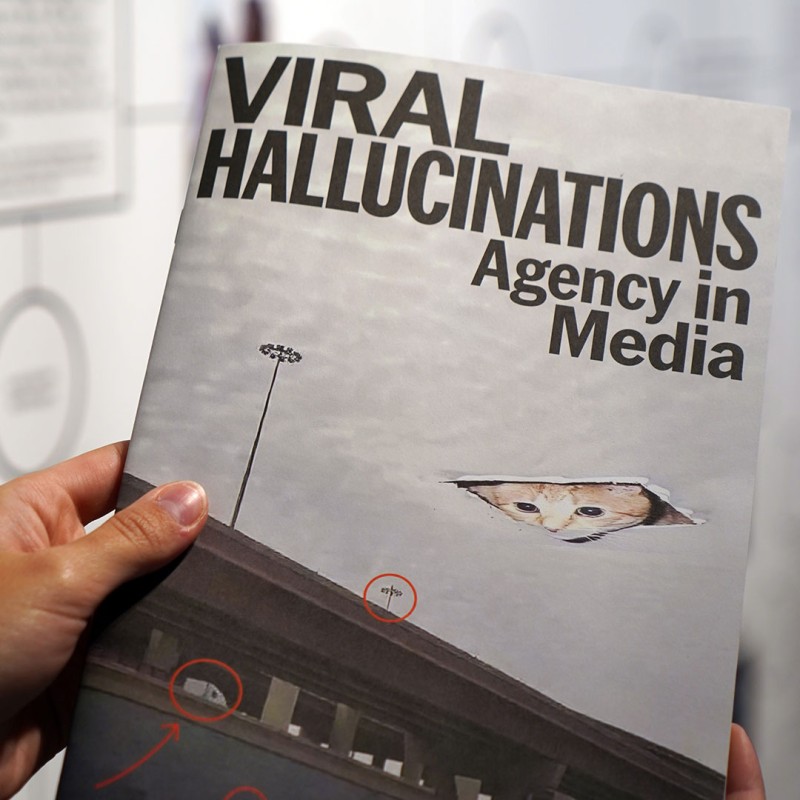
Published alongside the exhibition, Nadine Isabelle Henrich’s booklet Viral Hallucination – Agency in Media (2024) offers a media literacy framework for navigating the images on display.
Sara Bezovšek, A Life of Its Own: American Psycho, 2023–
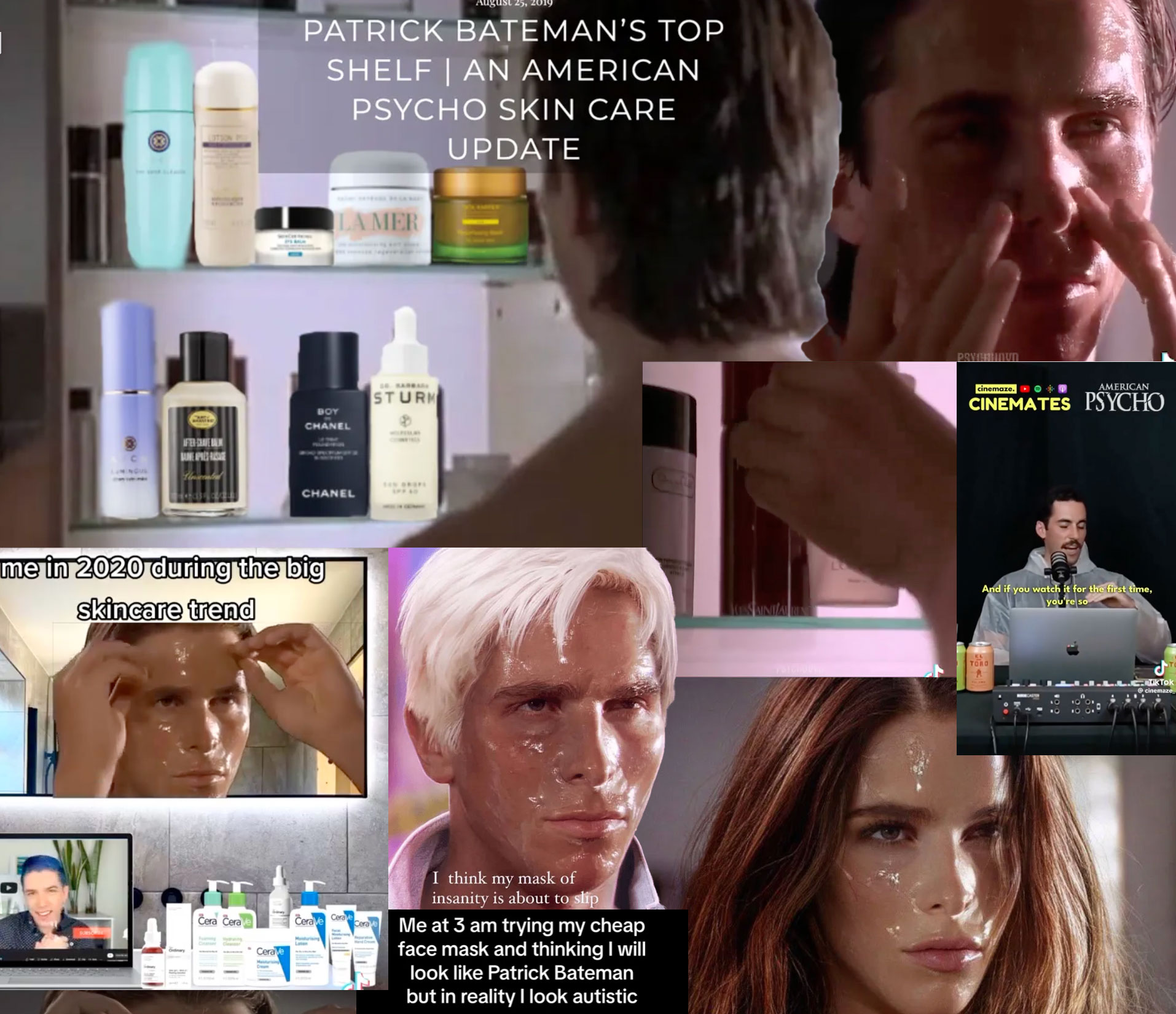
A Life of Its Own is a series of experimental works in the form of webpages, in which artist Sara Bezovšek (b. 1988, Ljubljana) archives and organises found footage, collages, mashup videos, memes, GIFs and screenshots derived from popular films, reconstructing their plots entirely from the fragments that have accumulated online. Each entry focuses on a single film selected for its cultural saturation — the degree to which its visual vocabulary has been extracted, cropped, captioned, and recirculated across social media to the point of becoming a shared symbolic language.
American Psycho (2000) is one such film: a text so thoroughly absorbed into meme culture that its imagery — Patrick Bateman’s dead-eyed grin, the business card scene, the axe — functions today less as cinema than as a repertoire of gestures available for reuse across political and ideological contexts. Bezovšek’s scrollable feed reconstructs the film from these fragments, revealing how a work of satirical critique can be shorn of its irony through repetition and repurposing, becoming instead a vehicle for the ideologies it once mocked. Circulating within a network economy reliant on free creative labour, these image-fragments, Bezovšek argues, can easily be weaponised by different political stakeholders and agendas.
Jakob Ganslmeier and Ana Zibelnik, Bereitschaft, 2024
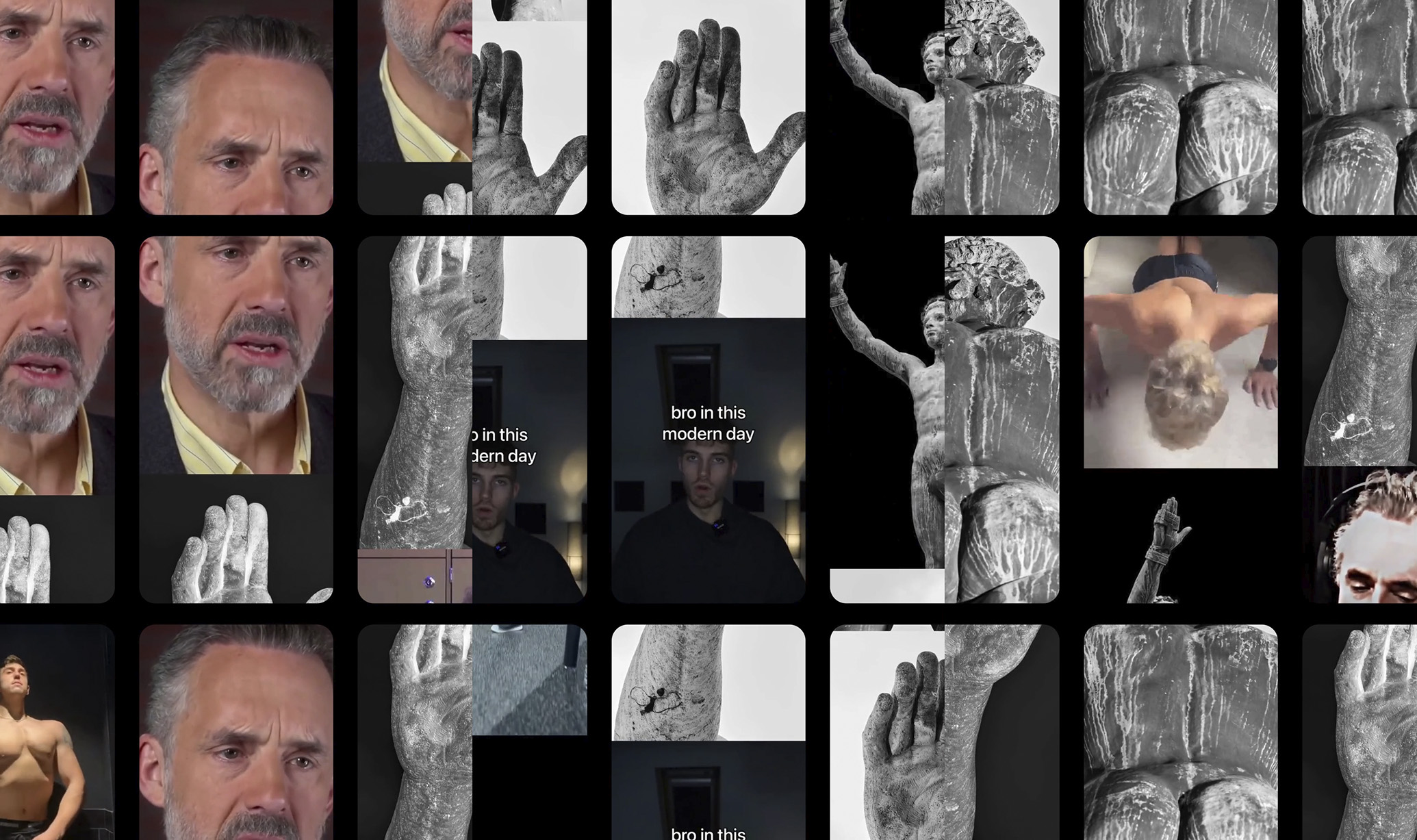
Bereitschaft takes its title from a 1939 sculpture by Nazi sculptor Arno Breker depicting a nude male warrior drawing a sword — an image of bodily readiness and nationalist virility that has recently gone viral on TikTok. Starting from this unlikely digital afterlife, Jakob Ganslmeier and Ana Zibelnik trace the visual logic connecting TikTok fitness culture to far-right ideology: the glorification of the sculpted male body, the advocacy of extreme self-discipline, and the suppression of weakness (disparaged as the inner “bitch voice”) as a political as well as physical ideal. Phenomena like “looksmaxxing,” “mewing,” “bonesmashing,” and “hunter eyes” — fringe practices promoted by influencers advocating an unsettling pursuit of bodily perfection — are shown to be not merely aesthetic but ideological, part of a broader co-optation of mainstream visual language by extremist factions.
The video work maps this pattern with precision: much of the material it presents does not initially appear aligned with far-right ideology, and that is precisely the point. The seduction operates through the visual conventions of fitness content — aspirational, intimate, algorithmically optimised — making its ideological drift difficult to see until the pattern is made explicit. Bereitschaft is an act of that making-explicit: a diagram of how contemporary image culture becomes a vector for political extremism through the lure of the body.
Tutorial
Outpainting — AI outpainting tools allow you to expand the frame of an existing image beyond its original edges, generating new visual content that seamlessly continues the scene. We will use this technique on found conspiracy theory images and viral photographs: extending their backgrounds, adding implied context, or opening up space that changes — or reinforces — their apparent meaning. The exercise asks what it means to let an algorithm complete what a cropped or decontextualised image withholds. Look at the example of Eva Rivas Bao.
Collage-style motion graphics — Taking inspiration from Adrian Flury’s A Place I’ve Never Been (2015), we will explore how found images, text overlays, zoomed crops and graphic elements can be assembled into short moving-image sequences. The focus is on timing and rhythm as tools of persuasion: how the cut, the hold, and the graphic accent guide a viewer’s attention and prime their belief. You can do this manually or using automated tools like AgeLapse to center the image based on a face. See also the example of Lóa Yona Zoe Fenzy, who combined AI generated images with collage-style motion graphics.
Assignment
Read: Stan Portus, Responding to cherrypicker, 2025
Make — choose one:
A. Choose a found image — a screenshot, a meme, a low-res photograph, or a frame from a film — that has circulated online in a way that distorted or detached it from its original meaning. Using any image-editing tools at your disposal (including but not limited to generative AI), annotate, modify, or reframe the image: add red circles, arrows, text overlays, zoomed crops, or other markers typical of conspiracy content, debunking culture, or viral image analysis. The result should be a single composite image or a short sequence (3–5 images). Reflect on how the visual rhetoric of “evidence” — the graphic language used to guide a viewer’s belief — shapes what we think we are seeing, and on the role images play in making beliefs feel seductive or inevitable.
B. Assemble a short video collage using found conspiracy theory images, memes, or viral footage. Draw on the techniques explored in the tutorial — sequencing, graphic overlays, rhythm, repetition — to construct a piece that reflects on how belief is produced through images: how the lure of a particular visual style, aesthetic, or mode of address can make something feel true. The work should engage critically or poetically with the material, rather than simply reproducing its logic.
Presentations: please send presentations for your final project in pdf, pptx, keynote format to Marco.DeMutiis@htwg-konstanz.de by the 12th of May. Your presentation should contain:
- A working title
- A short description (200-300 words) of your project, including concept, format and technical description
- A few images to visualise your idea and give a sense the work
- A proposed timeline for your production
- A moodboard of inspirations and references to works seen in class or that you are inspired by (Optional)