The Stage The Stage
Presentations
Present the series of in-game images of your virtual bed. Add your images, your name and a two-sentence caption to the shared document.
The Stage – the bed as a place for self-construction and photographic production, a stage for “the girl online”.
Last week the screen entered the bed and turned the sanctuary into a battleground. But the screen does not only bring images into the bed to be consumed, it also carries them out. The bed has become a place of image production: a set, a studio and a backdrop. Airbnb listing photos, OnlyFans streams, YouTube videos filmed from under the duvet and bedroom pictures submitted to game shows like Interior Motives all use the photographed (and filmed) bed to construct an identity for an audience. Photographs of beds were staged before, but never by so many people, for so many viewers, and so continuously.
A useful frame is Erving Goffman’s The Presentation of Self in Everyday Life (1959), which divides social life into a front stage, where we perform for others, and a backstage, where the mask can come off – with the bedroom being the classic backstage. On the internet the distinction collapses, because the backstage itself is what gets performed, and the intimate is staged as intimate. Jia Tolentino makes a related argument about the online self in Trick Mirror (2019), where she describes the internet as a place that rewards constant self-presentation. The YouTuber Alice Cappelle describes what this feels like from inside the bedroom:
“I often joke that the bedroom is one of the few places where I actually put effort into my appearance. Makeup, hair, lighting, angles − it all has to be perfect, and for a reason. I’m a content creator, influencer, video essayist, person on the internet, and most of what ends up on my YouTube channel has been filmed in my bedroom. My safe space is suffering from overexposure. I might not leave the house on a filming day and probably won’t see anyone, but I’ll still put on my best performance for whoever’s on the other side of the camera – the fans, the haters, and the ones who just got lost in the algorithm.”
– Alice Cappelle, “Online Bedrooms: the Disappearance of Private Space”, CCCB Lab, 20 September 2025
The bed is already the space where identities are created, rehearsed and formed – from childhood to teenage years, with the bedroom carrying the traces of every version of its inhabitant. The bed becomes a stage especially for the construction of a female identity, playing an important role in shaping girlhood even before the camera makes this space public. With the bed as a stage for internet representation, a messy, clean, cluttered or minimal aesthetic can be performed to signal a particular identity, each following its own economy, politics and ideology attached to online “girl beds”.
The construction of the self as “the girl online” names a role that online culture hands to all of us: a surface onto which desires, expectations and algorithms are projected. Some of the works in this lesson accept the projection, and some use it tactically, as a way of gaining space and agency. In that sense, the stage is also a battleground, one where the fight is about who controls the image.
The works in this lesson start from the bedroom as a set, in the teenage portraits of Adrienne Salinger from 1995, and as a webcam stage, in Jennifer Ringley’s JenniCam from 1996, the first always-on bedroom camera. The bedroom then becomes a game, in the YouTube show Interior Motives. In the online bedroom videos of Thomas and Soda it becomes a stage under constant observation, and in Faccani’s girl bedroom a space between imposed identity and agency. A section on the girl online then looks at the tactics that theory describes. The bed also becomes a stage for the paid performance of rest, from cam rooms to sleep streams and Instagram accounts. We end with the aestheticised bed as an instrument of power, in Vespignani’s Airbnb listings from the occupied West Bank. The question running through all of them is this: when does the bed become a stage, who is the audience, and who writes the script?
Adrienne Salinger, Teenagers in Their Bedrooms, 1995 / 2025
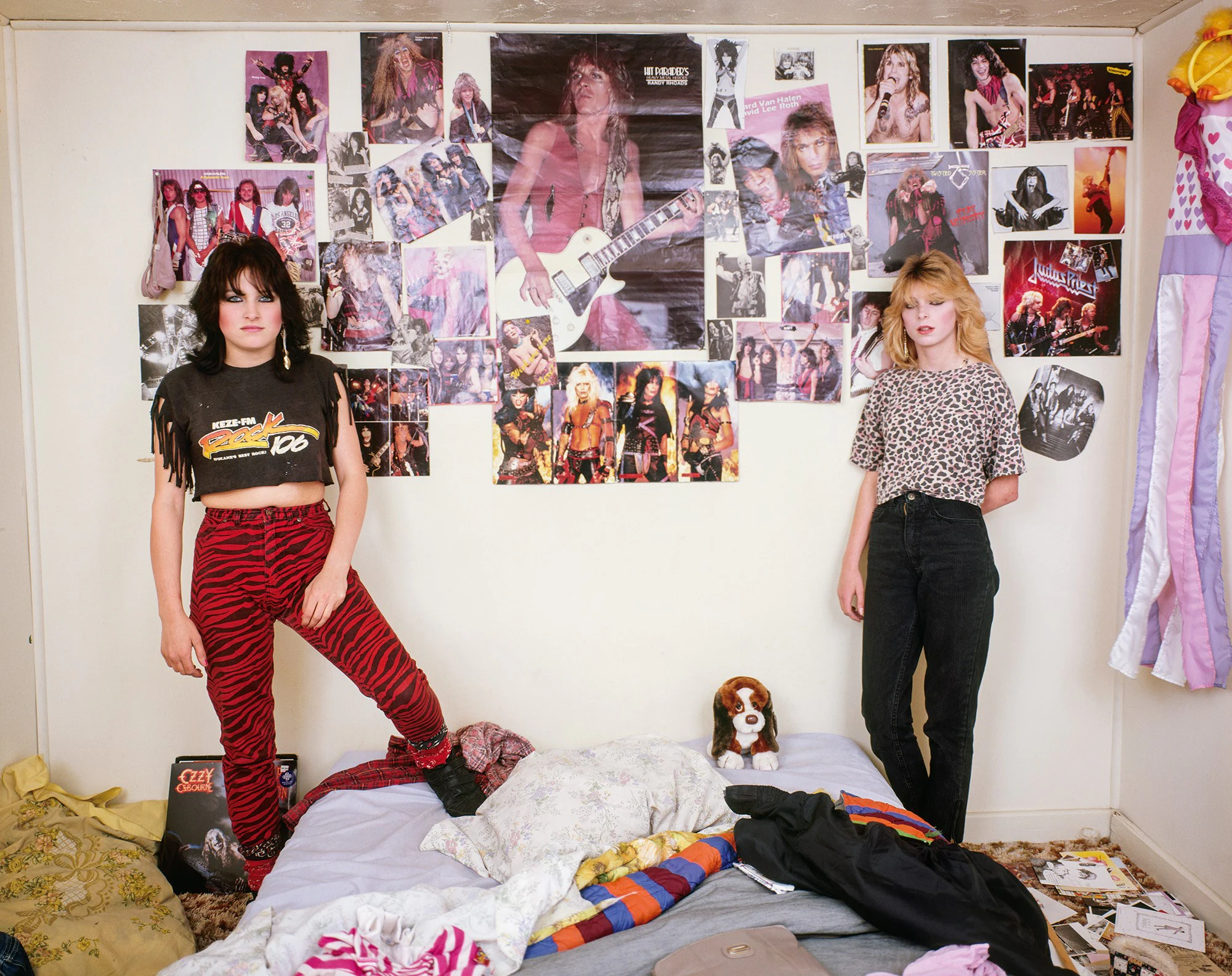
Adrienne Salinger photographed American teenagers in their bedrooms in the 1980s and 1990s. She found them in gyms, parks, restaurants and shopping-mall restrooms in New York, Washington and California, photographed around two hundred of them, and selected forty portraits for the book In My Room: Teenagers in Their Bedrooms (1995). Each portrait was made with a large-format film camera and is paired with snippets from the long conversations she had with her sitters while they faced it.
The rooms in the portraits are full of things that teenagers use to try on identities: posters, magazine clippings, street signs, trophies. The bedroom is shown as a workshop of the self, which the sitter stages for one photographer and one lens. The book was reissued by D.A.P. in 2025, with 26 further prints from the archive, and the reissue invites a comparison with today. The smartphone has changed the bedroom from a container for a private inner world into a space constantly penetrated by online stimuli, where self-presentation is shaped by the awareness of being watched. Salinger herself wonders whether anyone would be let into teenagers’ spaces today.
More info: dwell.com/article/teenagers-in-their-bedrooms
Jennifer Ringley, JenniCam, 1996–2003
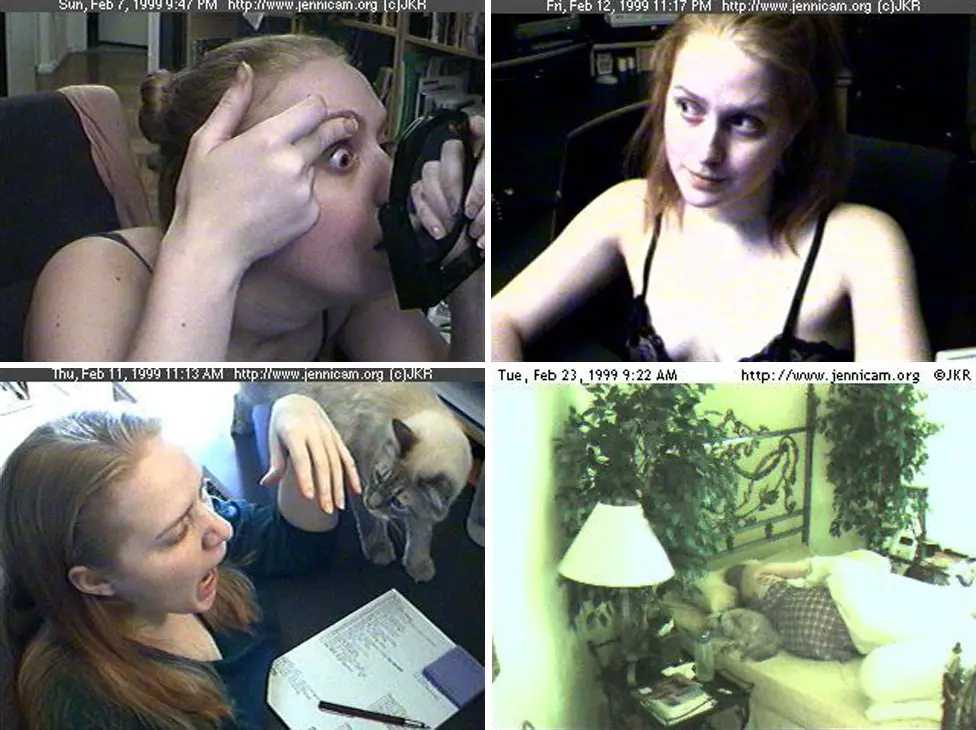
In April 1996, a year after Salinger’s book, Jennifer Ringley, then a student at Dickinson College in Pennsylvania, installed a webcam in her dorm room and put its images online as JenniCam. The page refreshed with a new still every few minutes, and from June 1997 faster updates were available to paying visitors. After moving to Washington, D.C., she added further cameras, including one covering the bedroom. At its peak the site was reported to reach millions of visitors a day, and more than a hundred outlets covered it. She closed it on 31 December 2003, citing PayPal’s new anti-nudity policy.
Where Salinger’s teenagers pose for one photographer who then leaves, the camera here never leaves. Ringley said that she never felt a need to hide anything, and that “I’m still alone in my room, no matter what”, yet an audience of millions, and a paid tier, turned the room into a stage and her into a celebrity: she appeared on late-night television, and clips from her spin-off show were included in MoMA’s Fame After Photography (1999). JenniCam anticipates much of what follows in this lesson, from always-on bedroom cameras to cam rooms and sleep streams, in which being watched in bed becomes a form of work.
More info: bbc.com/news/magazine-37681006
Ben Mora, Interior Motives, 2025–
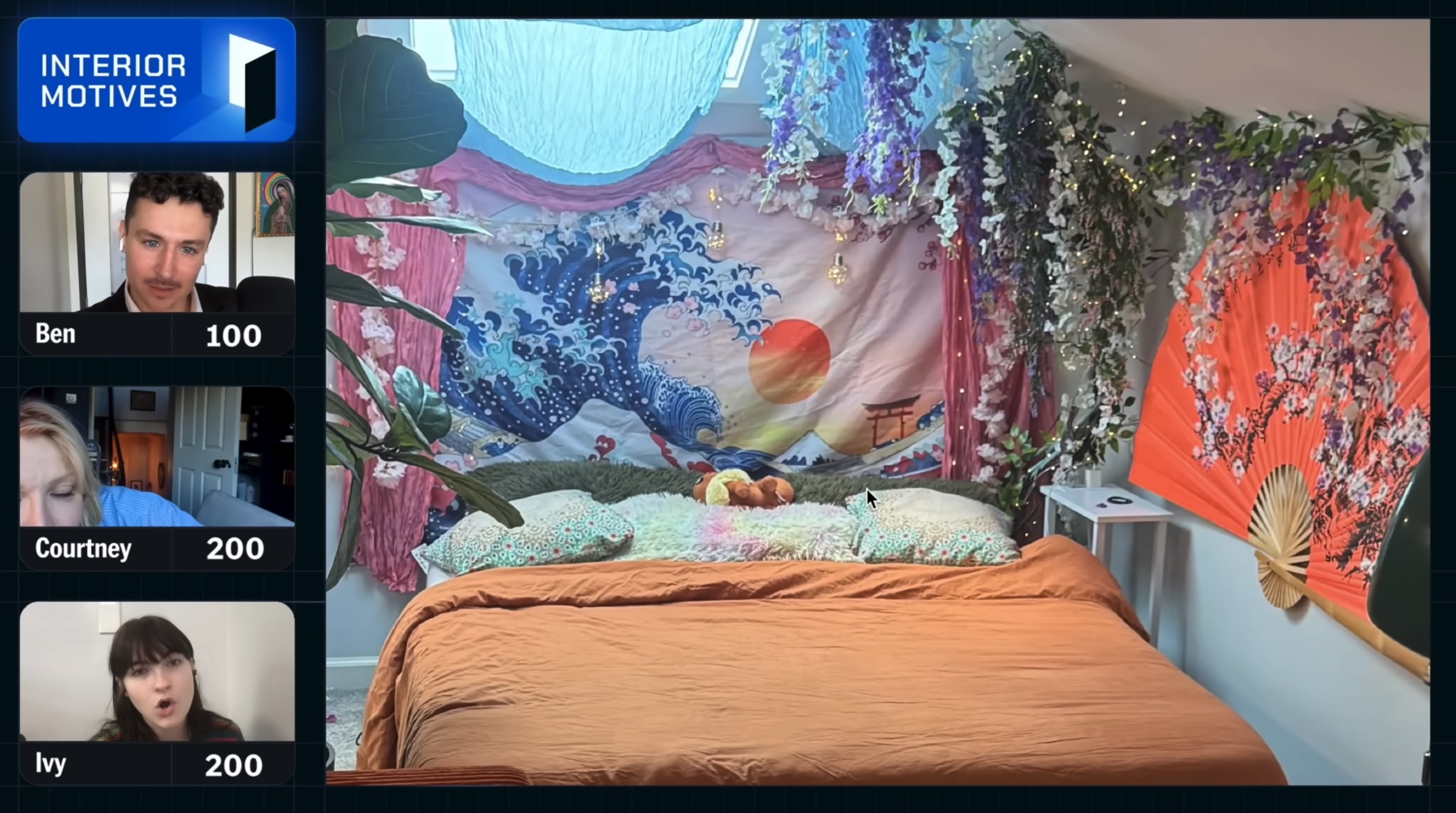
Interior Motives is a YouTube game show hosted by Ben Mora that began in 2025. Celebrity guests and internet personalities are shown photographs of bedrooms, sometimes also fridges and car interiors, submitted by viewers, mostly LGBTQIA+ people in the US. They have to guess the age, gender and location of the person who lives there from visual clues alone. Mora describes it as “GeoGuessr for gender, essentially”. When the guess is revealed, the inhabitant’s image and Instagram handle appear on screen so that viewers can look them up.
The show treats the bedroom as a portrait and the bed as evidence. Every room is read as a statement about identity, which is exactly the logic of the online bedroom in reverse: the audience decodes what the occupant has composed, consciously or not. Mora says the format works against neat categories and welcomes unpolished rooms, which sets it apart from the hypercurated personas of social media. Yet the game still turns private rooms into content, and the housing crisis shows up in the background of many of the pictures.
More info: dazeddigital.com/life-culture/article/71124
Mackenzie Thomas, I’m At Home, 2026
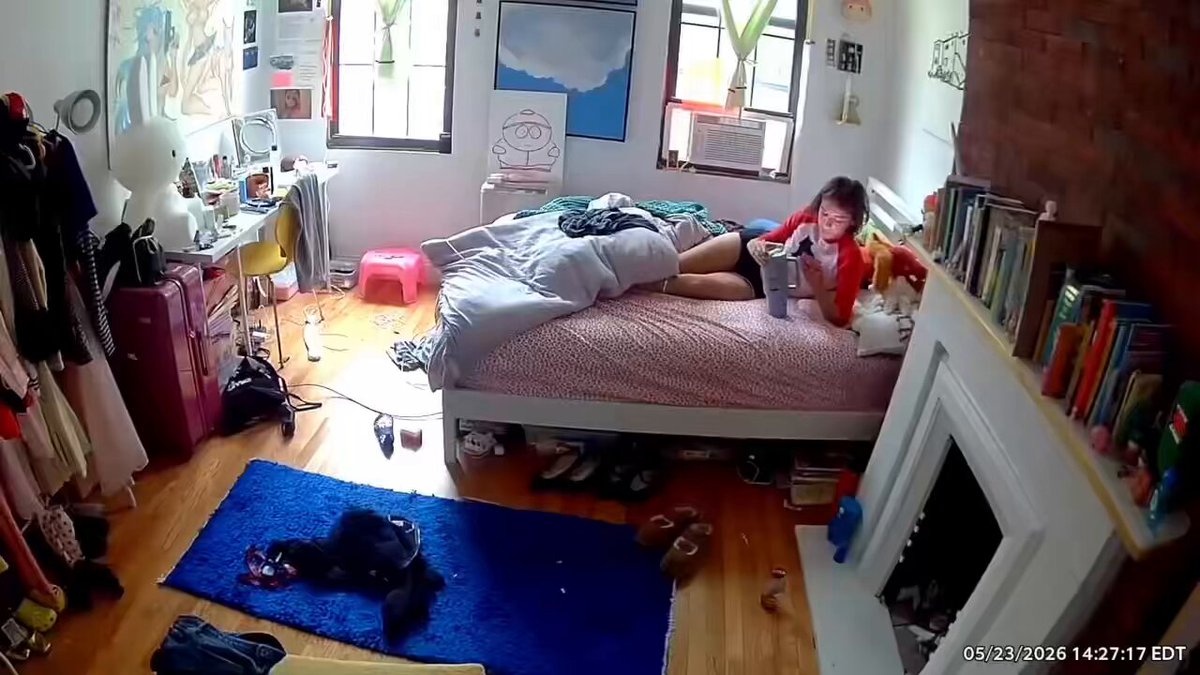
I’m At Home is a short film and performance piece in which Mackenzie Thomas turns her bedroom into a public stage. She recorded roughly 30 days of static security-camera footage inside her bedroom and condensed it into a 15-minute video. The piece deals with self-surveillance, the boundaries between private and public space, theatre and contemporary sexuality.
By framing the bed and the room as a permanent stage, the video turns ordinary domestic life into a monitored performance. The camera never leaves its position, so there is no backstage left: the room is both set and archive, and the person in it is both performer and watcher of her own life. Where Cappelle’s bedroom is a studio that has to be made perfect before the camera is switched on, here the camera is always on, and the question becomes what it means to perform for the internet when nothing is ever off the record.
More info: youtube.com/watch?v=fccuzvnb8JA
Molly Soda, ROOM MAKEOVER! *messy girl aesthetic inspired* girl clutter ♡, 2023
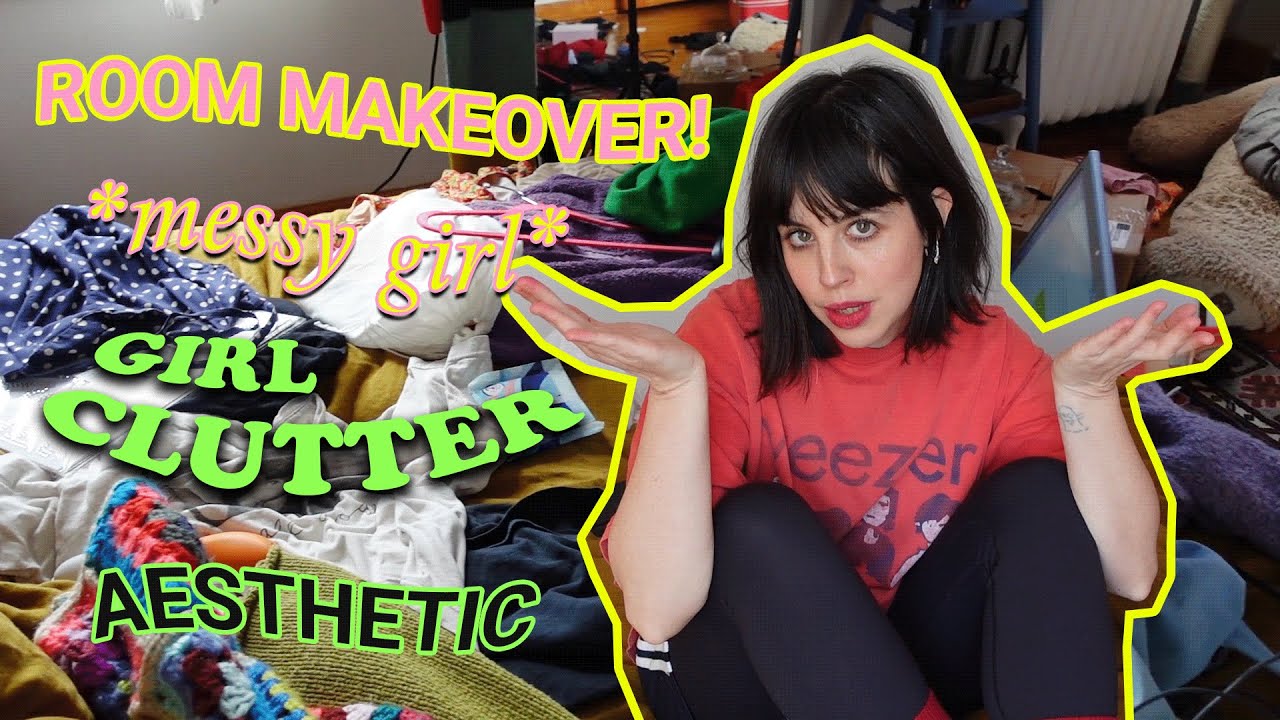
Molly Soda is an artist who has used her own bedroom and her own online presence as material for a long time. In this 15-minute video she gives her room a makeover inspired by the “messy girl” aesthetic, in the format of the YouTube room-makeover genre. Her Substack essay on the same theme is called “Girl Clutter”, and her shared YouTube playlists, such as “Making the Bed”, collect further research from vernacular visual culture in which the bed is the subject.
Clutter is normally what happens when nobody is looking, and here it is arranged for the camera and named as an aesthetic. This is the opposite of the sanctuary, which depends on privacy, and it shows how a “natural” bedroom can be a deliberate composition. Messy, clean, minimal and cosy all become looks that can be adopted to signal a certain kind of identity, and each one can be copied and photographed.
More info: mollysoda.substack.com/p/girl-clutter
Benedetta Faccani, Girl Bedroom, 2026
Girl Bedroom is a master’s thesis in Industrial Design at the Royal Academy of Art in The Hague (KABK), published on the Research Catalogue. Faccani traces the history of the girl bedroom from a private space of self-construction to a public place that extends bedroom culture into the digital age.
Her research focuses mainly on physical rooms, but also reflects on what happens to the girl and to bedroom culture when it moves online. During the pandemic, millions of young people had to let teachers, classmates and friends into their rooms through screens, virtual classrooms and video calls, and the bedroom became the backdrop for school, work and social life, causing the boundary between public and private to collapse entirely. Faccani asks if the girl now curates her room consciously, knowing it will be seen, and how this changes when the room stops being the one place in the house outside the public eye.
Faccani also reflects on her own position and the tension between critique and participation: many mainstream narratives about girls are shaped by consumer culture and patriarchal expectations. She asks why anything associated with girls has to be seen as frivolous, silly or unserious, and why femininity demands justification in the first place. Her conclusion is that this tension, between femininity and feminism, lightness and activism, is not a failure but a fundamental part of girlhood.
Read together with the Girl Online (below), the research points to a bedroom that is a place where identity is imposed (by a culture that tells girls what their room should look like and what a girl is) and a place where it can be claimed. The girl bedroom becomes a space that moves from imposed identity to agency, which is why this work could just as well belong to the Battleground.
More info: researchcatalogue.net/view/4691042/4691041
The Girl Online
The idea that “we are all girls online” goes back to Alex Quicho’s essay “Everybody Is a Girl Online”, published in Wired in 2023. It looks at the frameworks that shape how we behave in digital spaces, in particular how many of our desires are projected onto us from outside, through algorithms, recommendations and social media. Calling this position “girl” is not a gender claim. It points to the mechanism that has long reduced people read as female to a role of projection, an empty vessel filled with other people’s desires, and online we all occupy this position as soon as we want to be liked, seen and desired.
The interview “Being a Girl Online”, with Charlotte Reuß and Sophie Publig, builds on Quicho’s text and describes the girl online less as a person than as a set of tools, a practice that moves between agency and imposed identity:
“[...] we think of the Girl Online less as a person and more as a set of tools or a kind of practice. [...] So, rather than an identity, it’s more of a practice. [...] They take all the projections placed onto them — the expectations, the stereotypes, the aesthetics — and use them to their advantage, almost like a Trojan Horse.”
– Charlotte Reuß, in “Being a Girl Online”
Reuß adds that no one can step outside these structures (“imagining ourselves somehow outside this system isn’t just unrealistic — it’s dangerously naïve”), and that the ambivalence is therefore the place to work from: gaming the algorithm, staying one step ahead of being captured by it. Publig gives an example in the account Bimbo University (@nikitadumptruck), which explains global political and economic events in “girlified” language. It feeds the algorithm what it wants on the surface and reroutes the content underneath. The bedroom is the natural home of this tactic, because it is where the mask is put on.
The same tactical use of the girl online’s visual language can be found in artistic work. In Opsec and Beauty (2019), Addie Wagenknecht pairs YouTube beauty-product reviews with cybersecurity advice, and in The Bots (2020), Eva and Franco Mattes use a light, personal register to talk about homophobia, neo-Nazism and disinformation in Greece.
Micaela Carolan, from 100 Empty Cam Rooms, 2025
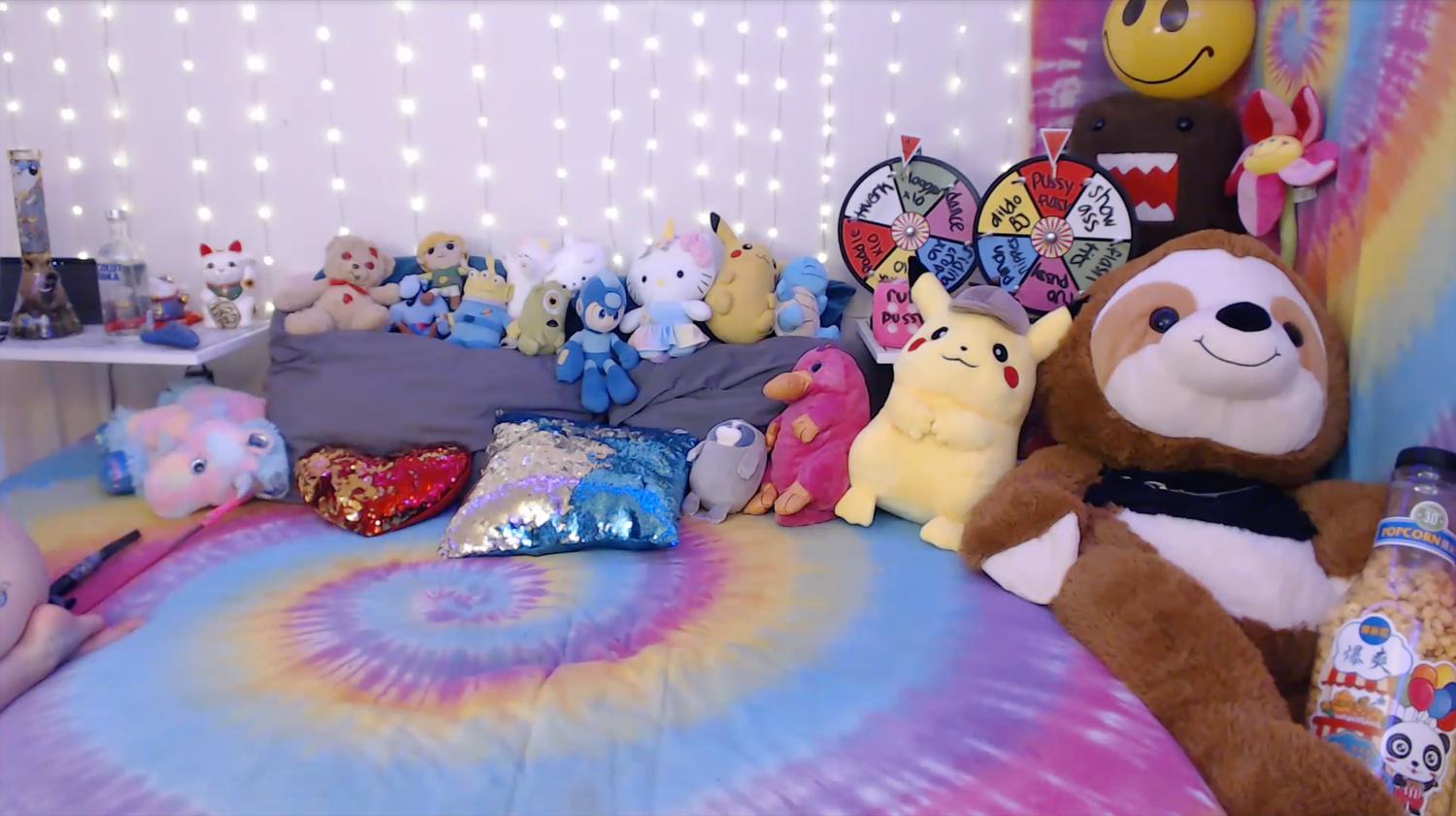
The bed is also a stage in the most literal sense for the economy of cam workers and sex workers, who perform for the camera on and around it. Micaela Carolan’s 100 Empty Cam Rooms looks at this stage when nobody is on it. In the artist’s words, it is “a speculative portraiture series composed from images of vacant webcam rooms. Without their occupants, decoration, lighting, props and traces of labor become inadvertent portraits of the people who performed there.”
An empty cam room shows the set without the performer. It reminds us that the space exists to produce a certain kind of image, and that making that image is labour, in the same way that the naps of Warburton’s animators were part of a working day. The bed is a workplace here, and the performance of intimacy is what it produces.
More info: micaelacarolandesign.com, donotresearch.substack.com
Sam Taylor-Johnson, David, 2004
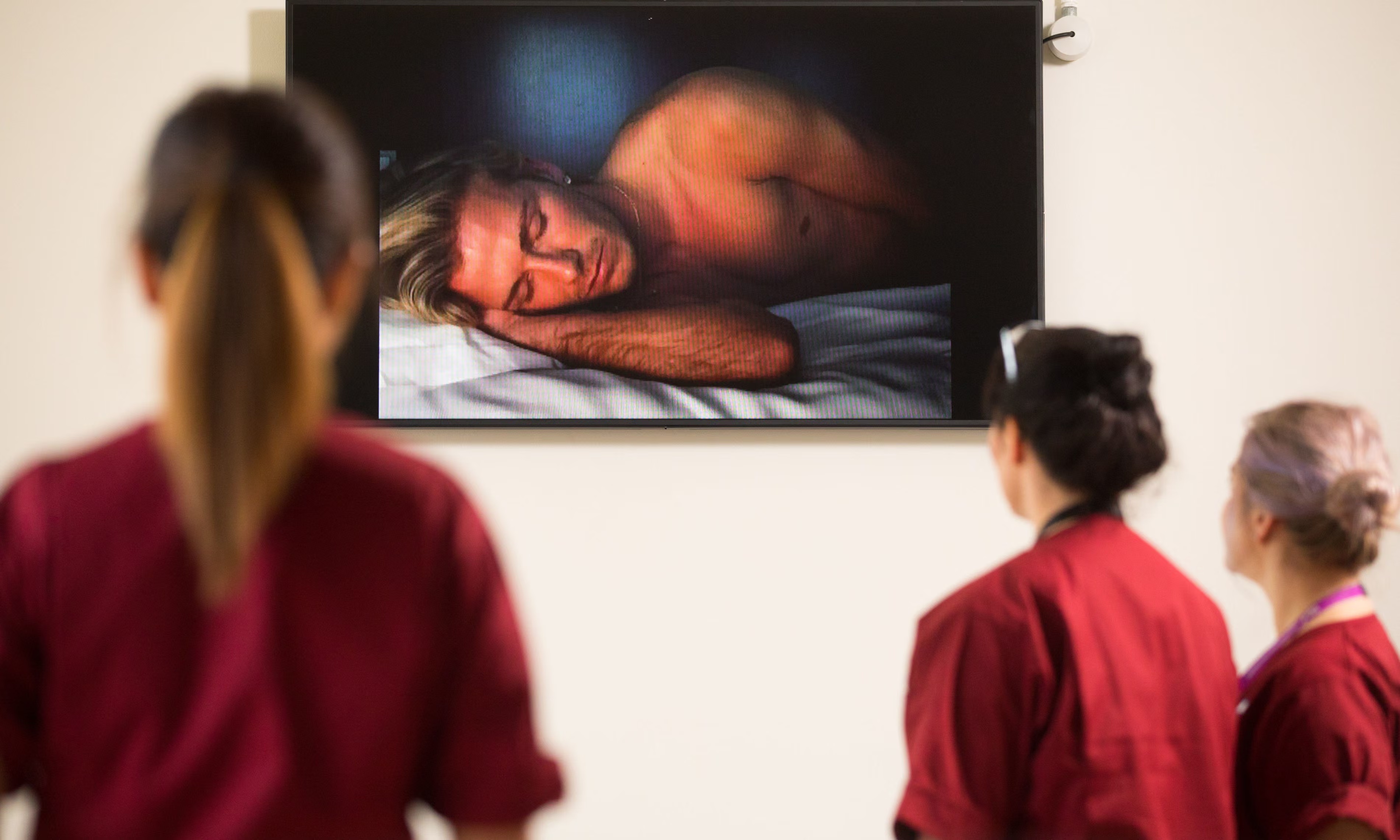
In David (2004), Sam Taylor-Johnson filmed the footballer David Beckham asleep in a Madrid hotel room in a single take of 107 minutes, a work commissioned by the National Portrait Gallery in London. Early Big Brother live streams also found a surprise audience in their night-time footage of housemates sleeping. Emerging practices like sleep streams redefine the bed as a stage within the digital reaction economy. Streamers broadcast themselves asleep, and viewers watch for community and entertainment, as someone to fall asleep with. The sleepstream today has become a business model, with a different variation appearing on streaming platforms (see below).
BBC News, “Sleep streams: How Kai Cenat and others make money filming themselves sleep”

“Other forms of sleep streams have started to emerge. Rather than paying streamers to sleep, viewers pay to keep streamers awake. By donating money, people can trigger loud noises, alerts, flicker lights, or make things happen in a room to disturb the streamer from their siesta. These videos are like a live-action video game, in which the streamer is simply trying to fall asleep and the players - or the viewers - are doing whatever they can to wake them up.”
Here, the sanctuary is turned inside out. The streamer StanleyMov says he makes enough from occasional sleep streams to pay his rent, and viewers can pay $95 to give him an electric shock through a bracelet. “Usually when I do sleep streams, it’s to make YouTube videos and make content out of it afterwards, so for me getting zapped is basically just content for the YouTube channel,” he told the BBC. Sleep, which Crary describes as an obstacle to the 24/7 economy, has become a product to sell to people who want to watch it, and a game for people who want to interrupt it. The sleeper performs, the audience holds the controls, and the bed is a stage on which rest is something other people can pay to take away.
Amélie Pichard, Stay in Bed With Me, ongoing
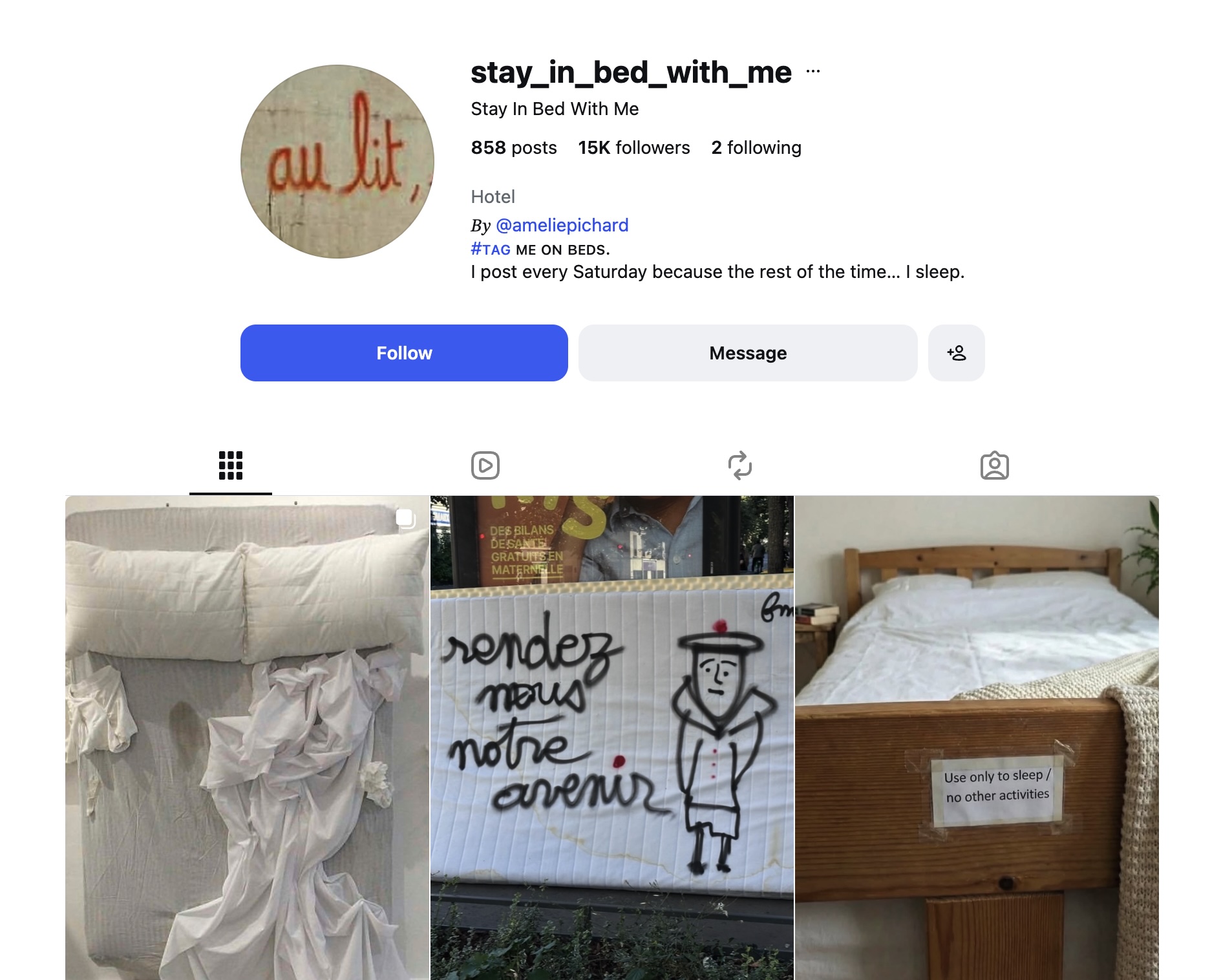
Stay in Bed With Me is an Instagram account by the designer Amélie Pichard.
More info: instagram.com/stay_in_bed_with_me
Federico Vespignani, Nice Rooms with Beautiful Views, 2026
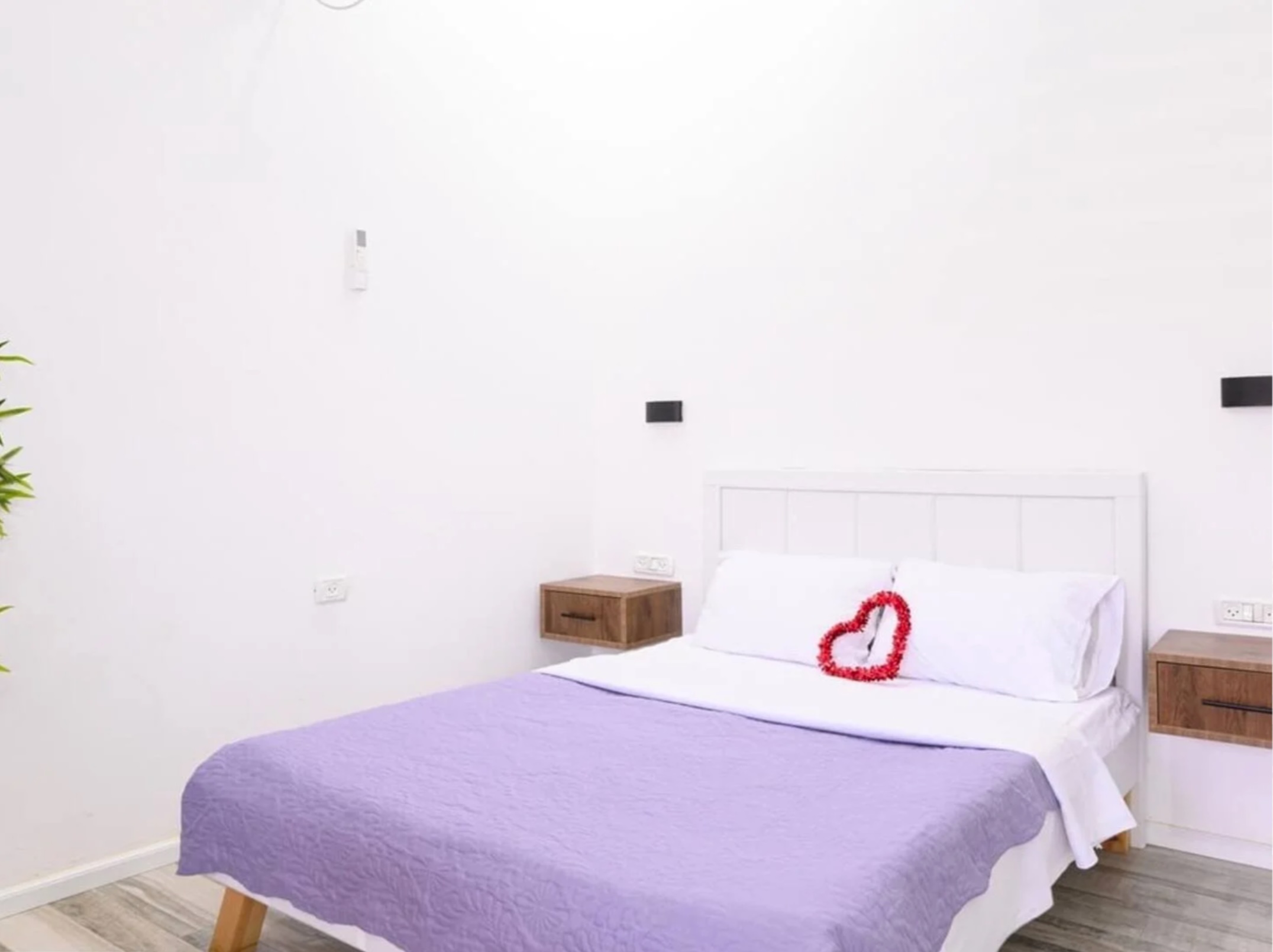
In Nice Rooms with Beautiful Views, Federico Vespignani appropriates Airbnb listings for rooms in Israeli settlements in the occupied West Bank. The images are the ones used to rent them. His project examines, in its own words, the role of “short-term holiday homes in aestheticizing and normalizing life in settlements in the Occupied Palestinian Territory”.
Even in places of conflict and war, the bed is a stage for peace and harmony. A photograph of a bed makes no political statement, and that is why it works so well: it looks like any other holiday, and the viewer sees a room and a view where there is a settlement. The work reveals what Vespignani calls “a troubling logic: the more people feel at home in a colony, the less it is perceived as such.” Here the staged bed is no longer a tool for constructing the self but a tool of power, and the question of what is outside the frame is a political one.
More info: federicovespignani.com/nice-rooms-with-beautiful-views
Interviews
Over the semester you will develop a project based on one of the topics explored in class. Just a reminder that the project has two components:
- A written text. This can be a conversation or interview with a photographer, designer, artist or author connected to the themes of Bedbound, or a written reflection that engages critically with their work.
- An image-based output related to the topics explored in class, in a form of your choosing: for example portraits of people watching Netflix in bed, custom pillow covers and printed bedsheets, a projection only visible from a bed, or a sleeping performance streamed on Twitch.
Now it’s a good moment to start thinking about your writing assignment as well, and decide who could be a good subject for an interview – if you plan to submit a conversation rather than personal text.
The works in this lesson show that the person in the bed is rarely the only author of its image. The bedroom is staged for an audience, shaped by platforms, and read by others. An interview lets you ask the person who knows the stage best how it is built, and who they build it for.
Who to talk to
Choose someone whose bed is complicated by different tensions or dimensions: a place of work, performance, self-construction, sickbed or battleground, barricade or sanctuary. It can be an artist or author or person from the lesson’s themes, or someone who has a different relationship to their bed.
Pick someone you can meet, call or write to, and whose experience you do not already know in full. You do not necessarily need to interview an expert in an academic sense.
Preparing the conversation
- Ask for consent clearly. Tell the person what the interview is for, where it will be shown (permanentbeta.network) and who will read it. Ask whether you can record it, and whether they want to be named or anonymous. Anonymise or leave out whatever they ask you to.
- Write open questions. Prepare six to ten questions that begin with how, what or when, and avoid questions with a yes or no answer. Order them from the concrete to the abstract.
- Ask about the bed, not only about the person. Questions that begin with an object, a corner or a habit usually get better answers than general ones.
- Prepare follow-ups. The best questions often come from something the person has just said, so leave room to ask “can you say more about that?”
Conducting and editing
There are three ways to conduct an interview, and each one suits a different situation.
- By email. Send a short, numbered list of questions and give the person a few days to answer. This is the easiest option when you work across time zones or the person prefers to write. The answers are often more considered, but less spontaneous. Plan a second round in which you follow up on what interests you most, because you cannot ask follow-ups in the moment.
- By video call. Use a call on Zoom or a similar tool, and ask permission before you record. Test the sound beforehand and ask the person to sit somewhere quiet. If they are willing, you can ask them to show you their bed or their room through the camera. Most tools can produce an automatic transcript, which you should always check against the recording.
- In person. Meet in a place where the person feels comfortable, ideally in or near the room you are discussing, and ask permission before photographing anything. Record the audio (a phone is enough), take a few notes, and listen more than you speak.
Afterwards, transcribe the conversation (or collect the written answers) and edit it for length and clarity. Keep the person’s words and the order of the questions as honest as you can, and say in a short note that the text has been edited. Send the final text to the person before you submit it, so that they can correct mistakes or withdraw what they do not want to be public.
Assignment
Read
Tolentino, J. (2019). “The I in Internet”. In Trick Mirror: Reflections on Self-Delusion. New York: Random House.
As you read, note where the author performs for an audience, and where you notice yourself doing the same: in your own bedroom, with your own phone.
Make
-
Draft your interview questions (6 to 10 questions), or write a short abstract of your proposed text assignment (300 words).
-
Stage the same bed three times, each time for a different audience, such as a holiday rental listing, a “get ready with me” video, a “messy girl” or a minimal-room post, or a bedroom you would send to Interior Motives. Change only what the audience would expect: the bedding, the objects, the light, the angle, the distance and the crop. Use photography, photogrammetry or digital techniques explored so far, and keep the three images as similar as possible in everything else, so that the staging does the talking.
Create a series of 3 images. For each one, ask: who is this picture for, what does it ask me to be, and what has been moved in or out of the frame?
Submit
Add your images, your name and a two-sentence caption to the shared document. In the caption, name the audience each picture is staged for.
Submit a word document with your proposed interviewee and interview questions, or an abstract of your text to this shared folder. Upload a document with your name and surname.
Präsentationen
Präsentiert die Bildserie eures virtuellen Betts. Fügt eure Bilder, euren Namen und eine zweisätzige Bildunterschrift in das gemeinsame Dokument ein.
The Stage – das Bett als Ort der Selbstkonstruktion und der fotografischen Produktion, eine Bühne für „the girl online“.
Letzte Woche ist der Bildschirm ins Bett eingedrungen und hat den Zufluchtsort in ein Schlachtfeld verwandelt. Doch der Bildschirm bringt nicht nur Bilder ins Bett, damit sie dort konsumiert werden, er trägt sie auch hinaus. Das Bett ist zu einem Ort der Bildproduktion geworden: zu einem Set, einem Studio und einer Kulisse. Airbnb-Inseratsfotos, OnlyFans-Streams, YouTube-Videos, die unter der Bettdecke gedreht werden, und Schlafzimmerfotos, die bei Spielshows wie Interior Motives eingereicht werden, nutzen alle das fotografierte (und gefilmte) Bett, um für ein Publikum eine Identität zu konstruieren. Betten wurden schon früher inszeniert fotografiert, aber nie von so vielen Menschen, für so viele Betrachter:innen und so ununterbrochen.
Ein nützlicher Rahmen ist Erving Goffmans The Presentation of Self in Everyday Life (1959), das das soziale Leben in eine Vorderbühne, auf der wir für andere auftreten, und eine Hinterbühne einteilt, auf der die Maske abgelegt werden kann – wobei das Schlafzimmer die klassische Hinterbühne ist. Im Internet bricht diese Unterscheidung zusammen, weil gerade die Hinterbühne selbst aufgeführt wird und das Intime als Intimes inszeniert wird. Jia Tolentino vertritt in Trick Mirror (2019) ein verwandtes Argument über das Online-Selbst: Sie beschreibt das Internet als einen Ort, der ständige Selbstdarstellung belohnt. Die YouTuberin Alice Cappelle beschreibt, wie sich das aus dem Inneren des Schlafzimmers anfühlt:
“I often joke that the bedroom is one of the few places where I actually put effort into my appearance. Makeup, hair, lighting, angles − it all has to be perfect, and for a reason. I’m a content creator, influencer, video essayist, person on the internet, and most of what ends up on my YouTube channel has been filmed in my bedroom. My safe space is suffering from overexposure. I might not leave the house on a filming day and probably won’t see anyone, but I’ll still put on my best performance for whoever’s on the other side of the camera – the fans, the haters, and the ones who just got lost in the algorithm.”
– Alice Cappelle, “Online Bedrooms: the Disappearance of Private Space”, CCCB Lab, 20. September 2025
Das Bett ist bereits der Raum, in dem Identitäten entstehen, erprobt und geformt werden – von der Kindheit bis in die Teenagerjahre, und das Schlafzimmer trägt die Spuren jeder Version seiner Bewohner:in. Das Bett wird besonders zur Bühne für die Konstruktion einer weiblichen Identität und spielt eine wichtige Rolle dabei, wie das Aufwachsen als Mädchen geprägt wird, noch bevor die Kamera diesen Raum öffentlich macht. Wird das Bett zur Bühne für die Darstellung im Internet, lässt sich eine unordentliche, aufgeräumte, vollgestellte oder minimalistische Ästhetik inszenieren, um eine bestimmte Identität zu signalisieren, jeweils mit der eigenen Ökonomie, Politik und Ideologie, die mit den Online-„Girl Beds“ verbunden ist.
Die Konstruktion des Selbst als „the girl online“ benennt eine Rolle, die die Online-Kultur uns allen zuweist: eine Oberfläche, auf die Wünsche, Erwartungen und Algorithmen projiziert werden. Manche der Arbeiten in dieser Sitzung akzeptieren die Projektion, andere nutzen sie taktisch, um Raum und Handlungsmacht zu gewinnen. In diesem Sinne ist die Bühne auch ein Schlachtfeld, auf dem darum gekämpft wird, wer die Kontrolle über das Bild hat.
Die Arbeiten dieser Sitzung beginnen beim Schlafzimmer als Set, in den Teenagerporträts von Adrienne Salinger aus dem Jahr 1995, und als Webcam-Bühne in Jennifer Ringleys JenniCam von 1996, der ersten dauerhaft eingeschalteten Schlafzimmerkamera. Danach wird das Schlafzimmer zu einem Spiel, in der YouTube-Show Interior Motives. In den Online-Schlafzimmervideos von Thomas und Soda wird es zu einer Bühne unter ständiger Beobachtung, und in Faccanis Girl Bedroom zu einem Raum zwischen aufgezwungener Identität und Handlungsmacht. Ein Abschnitt zur Girl Online beleuchtet dann die Taktiken, die diese Theorie beschreibt. Das Bett wird außerdem zur Bühne für die bezahlte Performance von Ruhe, von Cam-Rooms über Sleep Streams bis zu Instagram-Accounts. Am Ende steht das ästhetisierte Bett als Instrument der Macht, in Vespignanis Airbnb-Inseraten aus dem besetzten Westjordanland. Die Frage, die sich durch alle Arbeiten zieht, lautet: Wann wird das Bett zur Bühne, wer ist das Publikum, und wer schreibt das Drehbuch?
Adrienne Salinger, Teenagers in Their Bedrooms, 1995 / 2025
Adrienne Salinger fotografierte in den 1980er- und 1990er-Jahren amerikanische Teenager in ihren Schlafzimmern. Sie fand sie in Turnhallen, Parks, Restaurants und Toiletten von Einkaufszentren in New York, Washington und Kalifornien, fotografierte rund zweihundert von ihnen und wählte vierzig Porträts für das Buch In My Room: Teenagers in Their Bedrooms (1995) aus. Jedes Porträt entstand mit einer Großformat-Filmkamera und wird von Ausschnitten aus den langen Gesprächen begleitet, die sie mit den Porträtierten führte, während diese ihr gegenübersaßen.
Die Zimmer auf den Porträts sind voller Dinge, mit denen Teenager Identitäten ausprobieren: Poster, Zeitschriftenausschnitte, Straßenschilder, Pokale. Das Schlafzimmer erscheint als Werkstatt des Selbst, die die Porträtierten für eine Fotografin und ein Objektiv inszenieren. Das Buch wurde 2025 von D.A.P. neu aufgelegt, mit 26 weiteren Abzügen aus dem Archiv, und die Neuauflage lädt zum Vergleich mit heute ein. Das Smartphone hat das Schlafzimmer von einem Behältnis für eine private Innenwelt in einen Raum verwandelt, der ständig von Online-Reizen durchdrungen wird und in dem die Selbstdarstellung vom Bewusstsein geprägt ist, beobachtet zu werden. Salinger selbst fragt sich, ob heute noch jemand in die Räume von Teenagern gelassen würde.
Mehr Infos: dwell.com/article/teenagers-in-their-bedrooms
Jennifer Ringley, JenniCam, 1996–2003
Im April 1996, ein Jahr nach Salingers Buch, installierte Jennifer Ringley, damals Studentin am Dickinson College in Pennsylvania, eine Webcam in ihrem Wohnheimzimmer und stellte deren Bilder als JenniCam online. Die Seite zeigte alle paar Minuten ein neues Standbild, und ab Juni 1997 gab es für zahlende Besucher:innen schnellere Aktualisierungen. Nach ihrem Umzug nach Washington, D.C. fügte sie weitere Kameras hinzu, darunter eine, die das Schlafzimmer erfasste. Auf ihrem Höhepunkt soll die Seite täglich Millionen von Besucher:innen erreicht haben, und über hundert Medien berichteten darüber. Am 31. Dezember 2003 schloss sie die Seite und verwies auf die neue PayPal-Richtlinie gegen Nacktheit.
Während Salingers Teenager für eine Fotografin posieren, die danach wieder geht, verlässt die Kamera hier nie den Raum. Ringley sagte, dass sie nie das Bedürfnis verspürte, etwas zu verbergen, und dass „I’m still alone in my room, no matter what“, doch ein Publikum von Millionen und ein kostenpflichtiger Zugang machten das Zimmer zu einer Bühne und sie zu einer Berühmtheit: Sie trat in Late-Night-Shows auf, und Ausschnitte aus ihrer Spin-off-Sendung wurden in MoMAs Ausstellung Fame After Photography (1999) gezeigt. JenniCam nimmt vieles vorweg, was in dieser Sitzung folgt, von dauerhaft eingeschalteten Schlafzimmerkameras bis zu Cam-Rooms und Sleep Streams, in denen das Beobachtetwerden im Bett zu einer Form von Arbeit wird.
Mehr Infos: bbc.com/news/magazine-37681006
Ben Mora, Interior Motives, 2025–
Interior Motives ist eine YouTube-Spielshow, die von Ben Mora moderiert wird und 2025 gestartet ist. Prominenten Gästen und Internetpersönlichkeiten werden Fotos von Schlafzimmern gezeigt, manchmal auch von Kühlschränken und Autoinnenräumen, eingereicht von Zuschauer:innen, überwiegend LGBTQIA+-Personen in den USA. Allein anhand visueller Hinweise müssen sie Alter, Geschlecht und Wohnort der Person erraten, die dort lebt. Mora beschreibt die Show als „GeoGuessr for gender, essentially“. Wenn die Lösung aufgedeckt wird, erscheinen das Bild und der Instagram-Handle der Bewohner:in auf dem Bildschirm, sodass die Zuschauer:innen sie nachschlagen können.
Die Show behandelt das Schlafzimmer als Porträt und das Bett als Beweisstück. Jedes Zimmer wird als Aussage über Identität gelesen, was genau die Logik des Online-Schlafzimmers in umgekehrter Richtung ist: Das Publikum entschlüsselt, was die Bewohner:in – bewusst oder unbewusst – komponiert hat. Mora sagt, das Format arbeite gegen starre Kategorien und heiße unaufgeräumte Zimmer willkommen, was es von den hyperkuratierten Personas der sozialen Medien abhebt. Dennoch macht das Spiel aus privaten Zimmern Content, und die Wohnungskrise zeigt sich im Hintergrund vieler Bilder.
Mehr Infos: dazeddigital.com/life-culture/article/71124
Mackenzie Thomas, I’m At Home, 2026
I’m At Home ist ein Kurzfilm und eine Performance, in der Mackenzie Thomas ihr Schlafzimmer in eine öffentliche Bühne verwandelt. Sie nahm etwa 30 Tage lang statisches Überwachungskameramaterial in ihrem Schlafzimmer auf und verdichtete es zu einem 15-minütigen Video. Die Arbeit beschäftigt sich mit Selbstüberwachung, den Grenzen zwischen privatem und öffentlichem Raum, Theater und zeitgenössischer Sexualität.
Indem das Video das Bett und den Raum als dauerhafte Bühne rahmt, wird gewöhnliches häusliches Leben zu einer überwachten Performance. Die Kamera verlässt nie ihre Position, sodass keine Hinterbühne mehr bleibt: Der Raum ist zugleich Set und Archiv, und die Person darin ist zugleich Performerin und Beobachterin ihres eigenen Lebens. Während Cappelles Schlafzimmer ein Studio ist, das perfekt hergerichtet werden muss, bevor die Kamera eingeschaltet wird, ist die Kamera hier immer an, und es stellt sich die Frage, was es bedeutet, für das Internet zu performen, wenn nichts mehr im Verborgenen bleibt.
Mehr Infos: youtube.com/watch?v=fccuzvnb8JA
Molly Soda, ROOM MAKEOVER! *messy girl aesthetic inspired* girl clutter ♡, 2023
Molly Soda ist eine Künstlerin, die ihr eigenes Schlafzimmer und ihre eigene Online-Präsenz seit Langem als Material nutzt. In diesem 15-minütigen Video gestaltet sie ihr Zimmer im Stil der „Messy Girl“-Ästhetik um, im Format des YouTube-Genres der Room-Makeovers. Ihr Substack-Essay zum selben Thema heißt „Girl Clutter“, und ihre geteilten YouTube-Playlists, wie „Making the Bed“, versammeln weitere Recherchen aus der vernakulären Bildkultur, in denen das Bett das Thema ist.
Unordnung ist normalerweise das, was passiert, wenn niemand hinsieht; hier wird sie für die Kamera arrangiert und als Ästhetik benannt. Das ist das Gegenteil des Zufluchtsorts, der auf Privatsphäre angewiesen ist, und es zeigt, wie ein „natürliches“ Schlafzimmer eine bewusste Komposition sein kann. Chaotisch, aufgeräumt, minimalistisch und gemütlich werden zu Looks, die man annehmen kann, um eine bestimmte Identität zu signalisieren, und jeder von ihnen lässt sich kopieren und fotografieren.
Mehr Infos: mollysoda.substack.com/p/girl-clutter
Benedetta Faccani, Girl Bedroom, 2026
Girl Bedroom ist eine Masterarbeit im Studiengang Industrial Design an der Königlichen Kunstakademie in Den Haag (KABK), veröffentlicht im Research Catalogue. Faccani zeichnet die Geschichte des Mädchenzimmers nach, von einem privaten Raum der Selbstkonstruktion zu einem öffentlichen Ort, der die Bedroom Culture (Schlafzimmerkultur) ins digitale Zeitalter ausweitet.
Ihre Forschung konzentriert sich vor allem auf physische Räume, fragt aber auch, was mit dem Mädchen und der Bedroom Culture geschieht, wenn sie online gehen. Während der Pandemie mussten Millionen junger Menschen Lehrer:innen, Mitschüler:innen und Freund:innen über Bildschirme, virtuelle Klassenzimmer und Videocalls in ihre Zimmer lassen, und das Schlafzimmer wurde zur Kulisse für Schule, Arbeit und soziales Leben, wodurch die Grenze zwischen öffentlich und privat vollständig zusammenbrach. Faccani fragt, ob das Mädchen sein Zimmer heute bewusst kuratiert, weil es weiß, dass es gesehen wird, und wie sich das verändert, wenn das Zimmer nicht mehr der eine Ort im Haus ist, der dem öffentlichen Blick entzogen ist.
Faccani reflektiert auch ihre eigene Position und die Spannung zwischen Kritik und Teilhabe: Viele Mainstream-Erzählungen über Mädchen sind von Konsumkultur und patriarchalen Erwartungen geprägt. Sie fragt, warum alles, was mit Mädchen verbunden wird, als frivol, albern oder unseriös gelten muss und warum Weiblichkeit überhaupt Rechtfertigung verlangt. Ihr Fazit lautet, dass diese Spannung zwischen Weiblichkeit und Feminismus, Leichtigkeit und Aktivismus kein Scheitern ist, sondern ein grundlegender Teil des Mädchenseins.
Zusammen mit der Girl Online (siehe unten) gelesen, verweist die Forschung auf ein Schlafzimmer, das ein Ort ist, an dem Identität aufgezwungen wird (von einer Kultur, die Mädchen vorschreibt, wie ihr Zimmer auszusehen hat und was ein Mädchen ist), und zugleich ein Ort, an dem sie sich zu eigen machen lässt. Das Mädchenzimmer wird zu einem Raum, der sich von aufgezwungener Identität zu Handlungsmacht bewegt, weshalb diese Arbeit ebenso gut zur Sitzung Battleground gehören könnte.
Mehr Infos: researchcatalogue.net/view/4691042/4691041
The Girl Online
Die Idee, dass „wir alle Girls online sind“, geht auf Alex Quichos Essay „Everybody Is a Girl Online“ zurück, der 2023 in Wired erschien. Er untersucht die Rahmenbedingungen, die unser Verhalten in digitalen Räumen prägen, insbesondere wie viele unserer Wünsche von außen auf uns projiziert werden, durch Algorithmen, Empfehlungen und soziale Medien. Diese Position „Girl“ zu nennen, ist keine Aussage über Geschlecht. Sie verweist auf den Mechanismus, der als weiblich gelesene Menschen seit Langem auf eine Rolle der Projektion reduziert, ein leeres Gefäß, das mit den Wünschen anderer gefüllt wird, und online nehmen wir alle diese Position ein, sobald wir gemocht, gesehen und begehrt werden wollen.
Das Interview „Being a Girl Online“ mit Charlotte Reuß und Sophie Publig baut auf Quichos Text auf und beschreibt die Girl Online weniger als Person denn als Werkzeugkasten, als eine Praxis, die sich zwischen Handlungsmacht und aufgezwungener Identität bewegt:
“[...] we think of the Girl Online less as a person and more as a set of tools or a kind of practice. [...] So, rather than an identity, it’s more of a practice. [...] They take all the projections placed onto them — the expectations, the stereotypes, the aesthetics — and use them to their advantage, almost like a Trojan Horse.”
– Charlotte Reuß, in “Being a Girl Online”
Reuß ergänzt, dass niemand aus diesen Strukturen heraustreten kann („imagining ourselves somehow outside this system isn’t just unrealistic — it’s dangerously naïve“), und dass die Ambivalenz deshalb der Ort ist, von dem aus gearbeitet werden kann: den Algorithmus austricksen und dem Zugriff einen Schritt voraus bleiben. Publig nennt als Beispiel den Account Bimbo University (@nikitadumptruck), der globale politische und wirtschaftliche Ereignisse in „girlified language“ erklärt. Er füttert den Algorithmus an der Oberfläche mit dem, was dieser will, und lenkt die Inhalte darunter um. Das Schlafzimmer ist der natürliche Ort dieser Taktik, weil dort die Maske aufgesetzt wird.
Dieselbe taktische Nutzung der visuellen Sprache der Girl Online findet sich auch in künstlerischen Arbeiten. In Opsec and Beauty (2019) verbindet Addie Wagenknecht YouTube-Rezensionen von Beauty-Produkten mit Tipps zur Cybersicherheit, und in The Bots (2020) sprechen Eva und Franco Mattes in einem leichten, persönlichen Register über Homophobie, Neonazismus und Desinformation in Griechenland.
Micaela Carolan, aus 100 Empty Cam Rooms, 2025
Das Bett ist auch im wörtlichsten Sinne eine Bühne für die Ökonomie der Cam-Arbeiter:innen und Sexarbeiter:innen, die auf und um es herum für die Kamera performen. Micaela Carolans 100 Empty Cam Rooms betrachtet diese Bühne, wenn niemand auf ihr steht. In den Worten der Künstlerin ist es „a speculative portraiture series composed from images of vacant webcam rooms. Without their occupants, decoration, lighting, props and traces of labor become inadvertent portraits of the people who performed there.“
Ein leerer Cam-Room zeigt das Set ohne die Performer:in. Er erinnert uns daran, dass der Raum dazu da ist, eine bestimmte Art von Bild zu produzieren, und dass die Herstellung dieses Bildes Arbeit ist, so wie die Nickerchen von Warburtons Animator:innen Teil eines Arbeitstages waren. Das Bett ist hier ein Arbeitsplatz, und die Performance von Intimität ist das, was er produziert.
Mehr Infos: micaelacarolandesign.com, donotresearch.substack.com
Sam Taylor-Johnson, David, 2004
In David (2004) filmte Sam Taylor-Johnson den Fußballer David Beckham schlafend in einem Hotelzimmer in Madrid, in einer einzigen Einstellung von 107 Minuten, ein Werk im Auftrag der National Portrait Gallery in London. Auch frühe Livestreams von Big Brother fanden ein überraschendes Publikum mit ihren nächtlichen Aufnahmen der schlafenden Mitbewohner:innen. Neue Praktiken wie Sleep Streams definieren das Bett als Bühne innerhalb der digitalen Reaktionsökonomie neu. Streamer:innen übertragen sich selbst im Schlaf, und die Zuschauer:innen schauen wegen der Gemeinschaft und der Unterhaltung zu, als jemand, mit dem man einschlafen kann. Der Sleep Stream ist heute zu einem Geschäftsmodell geworden, mit einer anderen Variante auf Streaming-Plattformen (siehe unten).
BBC News, “Sleep streams: How Kai Cenat and others make money filming themselves sleep”
“Other forms of sleep streams have started to emerge. Rather than paying streamers to sleep, viewers pay to keep streamers awake. By donating money, people can trigger loud noises, alerts, flicker lights, or make things happen in a room to disturb the streamer from their siesta. These videos are like a live-action video game, in which the streamer is simply trying to fall asleep and the players - or the viewers - are doing whatever they can to wake them up.”
Hier wird der Zufluchtsort auf den Kopf gestellt. Der Streamer StanleyMov sagt, er verdiene mit gelegentlichen Sleep Streams genug, um seine Miete zu bezahlen, und Zuschauer:innen können 95 Dollar zahlen, um ihm über ein Armband einen Stromschlag zu versetzen. „Usually when I do sleep streams, it’s to make YouTube videos and make content out of it afterwards, so for me getting zapped is basically just content for the YouTube channel“, sagte er der BBC. Schlaf, den Crary als Hindernis für die 24/7-Ökonomie beschreibt, ist zu einem Produkt geworden, das an Menschen verkauft wird, die ihm zusehen wollen, und zu einem Spiel für Menschen, die ihn unterbrechen wollen. Der Schlafende performt, das Publikum hält die Steuerung in der Hand, und das Bett ist eine Bühne, auf der Ruhe etwas ist, das andere bezahlen können, um sie zu nehmen.
Amélie Pichard, Stay in Bed With Me, laufend
Stay in Bed With Me ist ein Instagram-Account der Designerin Amélie Pichard.
Mehr Infos: instagram.com/stay_in_bed_with_me
Federico Vespignani, Nice Rooms with Beautiful Views, 2026
In Nice Rooms with Beautiful Views eignet sich Federico Vespignani Airbnb-Inserate für Zimmer in israelischen Siedlungen im besetzten Westjordanland an. Die Bilder sind die, mit denen die Zimmer vermietet werden. Sein Projekt untersucht in seinen eigenen Worten die Rolle von „short-term holiday homes in aestheticizing and normalizing life in settlements in the Occupied Palestinian Territory“.
Selbst an Orten von Konflikt und Krieg ist das Bett eine Bühne für Frieden und Harmonie. Ein Foto eines Bettes macht keine politische Aussage, und genau deshalb funktioniert es so gut: Es sieht aus wie jeder andere Urlaub, und die Betrachter:innen sehen ein Zimmer und eine Aussicht, wo eine Siedlung ist. Die Arbeit legt eine Logik offen, die Vespignani so beschreibt: „a troubling logic: the more people feel at home in a colony, the less it is perceived as such.“ Hier ist das inszenierte Bett nicht länger ein Werkzeug zur Konstruktion des Selbst, sondern ein Werkzeug der Macht, und die Frage, was außerhalb des Bildes liegt, ist eine politische.
Mehr Infos: federicovespignani.com/nice-rooms-with-beautiful-views
Interviews
Im Laufe des Semesters entwickelt ihr ein Projekt zu einem der Themen, die im Kurs behandelt werden. Zur Erinnerung: Das Projekt besteht aus zwei Teilen:
- Ein schriftlicher Text. Das kann ein Gespräch oder Interview mit Fotograf:innen, Designer:innen, Künstler:innen oder Autor:innen sein, die mit den Themen von Bedbound verbunden sind, oder eine schriftliche Reflexion, die sich kritisch mit deren Arbeit auseinandersetzt.
- Eine bildbasierte Arbeit zu den im Kurs behandelten Themen, in einer Form eurer Wahl: zum Beispiel Porträts von Menschen, die im Bett Netflix schauen, individuelle Kissenbezüge und bedruckte Bettlaken, eine Projektion, die nur vom Bett aus sichtbar ist, oder eine Schlaf-Performance, die auf Twitch gestreamt wird.
Jetzt ist ein guter Moment, um auch über eure schriftliche Arbeit nachzudenken und zu entscheiden, wer ein gutes Gegenüber für ein Interview sein könnte – falls ihr ein Gespräch statt eines persönlichen Textes abgeben möchtet.
Die Arbeiten dieser Sitzung zeigen, dass die Person im Bett selten allein für ihr Bild verantwortlich ist. Das Schlafzimmer wird für ein Publikum inszeniert, von Plattformen geprägt und von anderen gelesen. Ein Interview erlaubt euch, die Person, die die Bühne am besten kennt, zu fragen, wie sie gebaut ist und für wen.
Mit wem sprechen
Wählt eine Person, deren Bett von verschiedenen Spannungen oder Dimensionen geprägt ist: ein Ort der Arbeit, der Performance, der Selbstkonstruktion, ein Krankenbett oder Schlachtfeld, eine Barrikade oder ein Zufluchtsort. Das kann eine Person aus Kunst oder Literatur oder aus den Themen der Sitzung sein, oder eine Person mit einem anderen Verhältnis zu ihrem Bett.
Wählt jemanden, den ihr treffen, anrufen oder anschreiben könnt und dessen Erfahrung ihr nicht schon vollständig kennt. Ihr müsst nicht unbedingt Expert:innen im akademischen Sinne interviewen.
Das Gespräch vorbereiten
- Holt die Einwilligung klar ein. Sagt der Person, wofür das Interview gedacht ist, wo es gezeigt wird (permanentbeta.network) und wer es lesen wird. Fragt, ob ihr das Gespräch aufnehmen dürft und ob die Person namentlich genannt werden oder anonym bleiben möchte. Anonymisiert oder streicht, was sie verlangt.
- Schreibt offene Fragen. Bereitet sechs bis zehn Fragen vor, die mit wie, was oder wann beginnen, und vermeidet Fragen, die sich mit Ja oder Nein beantworten lassen. Ordnet sie vom Konkreten zum Abstrakten.
- Fragt nach dem Bett, nicht nur nach der Person. Fragen, die mit einem Gegenstand, einer Ecke oder einer Gewohnheit beginnen, führen meist zu besseren Antworten als allgemeine.
- Bereitet Anschlussfragen vor. Die besten Fragen entstehen oft aus etwas, das die Person gerade gesagt hat, also lasst Raum für „Kannst du dazu mehr erzählen?“
Das Gespräch führen und bearbeiten
Es gibt drei Wege, ein Interview zu führen, und jeder passt zu einer anderen Situation.
- Per E-Mail. Schickt eine kurze, nummerierte Liste von Fragen und gebt der Person ein paar Tage Zeit zum Antworten. Das ist die einfachste Option, wenn ihr über Zeitzonen hinweg arbeitet oder die Person lieber schreibt. Die Antworten sind oft überlegter, aber weniger spontan. Plant eine zweite Runde ein, in der ihr nachfragt, was euch am meisten interessiert, denn im Moment selbst könnt ihr keine Anschlussfragen stellen.
- Per Videocall. Nutzt einen Anruf über Zoom oder ein ähnliches Tool und fragt um Erlaubnis, bevor ihr aufnehmt. Testet vorher den Ton und bittet die Person, sich an einen ruhigen Ort zu setzen. Wenn sie dazu bereit ist, könnt ihr sie bitten, euch ihr Bett oder ihr Zimmer über die Kamera zu zeigen. Die meisten Tools können ein automatisches Transkript erstellen, das ihr immer mit der Aufnahme abgleichen solltet.
- Persönlich. Trefft euch an einem Ort, an dem sich die Person wohlfühlt, idealerweise in oder in der Nähe des Raums, über den ihr sprecht, und fragt um Erlaubnis, bevor ihr etwas fotografiert. Nehmt das Audio auf (ein Handy reicht), macht ein paar Notizen und hört mehr zu, als ihr sprecht.
Transkribiert danach das Gespräch (oder sammelt die schriftlichen Antworten) und bearbeitet es hinsichtlich Länge und Klarheit. Bleibt so ehrlich wie möglich bei den Worten der Person und der Reihenfolge der Fragen, und weist in einer kurzen Notiz darauf hin, dass der Text bearbeitet wurde. Schickt den fertigen Text der Person, bevor ihr ihn abgebt, damit sie Fehler korrigieren oder zurückziehen kann, was nicht öffentlich werden soll.
Aufgabe
Lesen
Tolentino, J. (2019). “The I in Internet”. In Trick Mirror: Reflections on Self-Delusion. New York: Random House.
Achtet beim Lesen darauf, wo die Autorin für ein Publikum performt, und wo ihr bemerkt, dass ihr dasselbe tut: in eurem eigenen Schlafzimmer, mit eurem eigenen Handy.
Umsetzung
-
Draft your interview questions (6 to 10 questions), or write a short abstract of your proposed text assignment (300 words).
-
Stage the same bed three times, each time for a different audience, such as a holiday rental listing, a “get ready with me” video, a “messy girl” or a minimal-room post, or a bedroom you would send to Interior Motives. Change only what the audience would expect: the bedding, the objects, the light, the angle, the distance and the crop. Use photography, photogrammetry or digital techniques explored so far, and keep the three images as similar as possible in everything else, so that the staging does the talking. Entwerft eure Interviewfragen.
Erstellt eine Serie von 3 Bildern. Fragt euch bei jedem: Für wen ist dieses Bild, was verlangt es von mir zu sein, und was wurde in den Bildausschnitt hinein- oder aus ihm herausgenommen?
Abgabe
Fügt eure Bilder, euren Namen und eine zweisätzige Bildunterschrift in das gemeinsame Dokument ein. Nennt in der Bildunterschrift das Publikum, für das jedes Bild inszeniert ist.
Gebt ein Word-Dokument mit eurer vorgeschlagenen Interviewperson und euren Interviewfragen oder ein Abstract eures Textes in diesem gemeinsamen Ordner ab. Benennt das Dokument mit eurem Vor- und Nachnamen.