A History of Photography and the Digital Image through the Image of the Woman Eine Geschichte der Fotografie und des digitalen Bildes anhand der Frau
In this lecture I follow a series of images of women to touch on key moments in the history of photography and the digital image. Women have been in front of the camera since the first portrait studios opened, and they have been asked to play many roles there: sitter, patient, model, test object, calibration standard, author. The lecture follows a feminist reading of photography and the digital image, asking what these images did for the medium and what the medium did to the women in them. It looks at what it means for a technology to treat a woman as an object, as evidence, as a standard, as a test, as content, and at the ways the women in these images answer back.
Unlike the pope, who is a partly arbitrary guide, “the woman” is not a neutral figure, and she is not a single one. The women that follow occupy very different positions: one owns the copyright to her own image, one was made to perform for the camera, one is a studio model whose face became a measuring instrument, one has asked for her image to be retired. The selection also carries a clear bias that features prominently in the history of photography and still lives on in today’s imaging systems: most of the women are white and most of the images come from Europe and North America, because this is the body that the medium’s technical standards were built around. The bias is part of the subject. The sequence tries to counter it by opening and closing with Black women who contest the terms of the picture.
The sequence is not strictly chronological. It follows seven conceptual shifts: from the gaze, to the symptom, to the norm, to the proxy, to the promise, to the display, and finally to the audit. Each section introduces an image, explains the woman’s role in it, and anchors the episode in a key text of feminist, media and photography theory.
Sojourner Truth: The Gaze
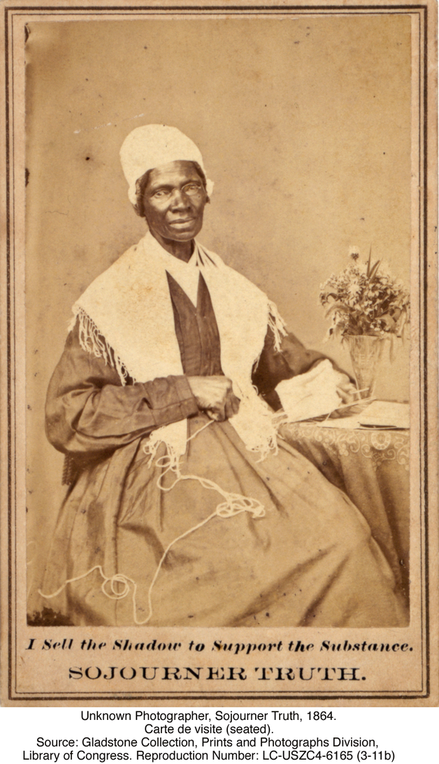
Sojourner Truth (c. 1797–1883) was born into slavery and became one of the best-known abolitionists and campaigners for women’s rights of her time. She sat for several portraits in the early 1860s and sold them as cartes de visite to fund her activities. The mount of this one carries a copyright notice in her own name, dated 1864, and the line “I sell the shadow to support the substance”. The caption turns a stock phrase of early studio photography about securing the shadow before the substance fades into an economic statement (Art Institute of Chicago). The photographer is unknown; the author of the object is not.
Here a woman who had herself once been sold as property turns her likeness into income, and decides under what name it circulates. Who may look, who may be looked at, and who profits from the looking: this is the first, and the most basic, of the questions that the sequence will keep asking about women in front of the camera. The art historian Darcy Grimaldo Grigsby has followed Truth’s use of photography in detail in the exhibition Sojourner Truth, Photography, and the Fight Against Slavery (BAMPFA, 2016).
Key text: bell hooks, “The Oppositional Gaze: Black Female Spectators”, in Black Looks: Race and Representation (1992).
- The politics of looking. hooks starts from the fact that enslaved people were punished for looking. The right to look, and to look back, was a political right, and the gaze became a site of resistance.
- The oppositional gaze. Black women spectators, she argues, did not identify with the images offered to them. They looked critically, contested the representations made for others, and invented other ways of looking.
- The missing spectator. The feminist film theory of the 1970s built its account of the “male gaze” on a white female spectator. hooks writes race, and the Black female viewer, back into the theory.
Augustine: The Symptom
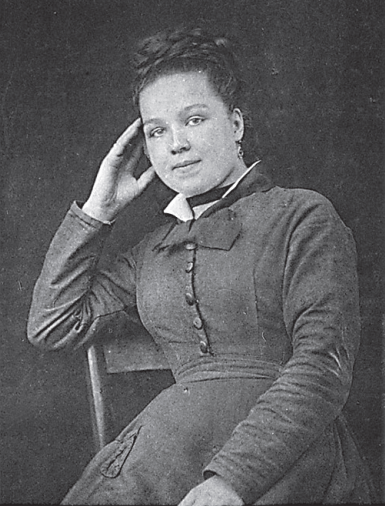
At the Salpêtrière hospital in Paris, the neurologist Jean-Martin Charcot studied women patients with convulsions. His assistant Désiré-Magloire Bourneville edited the three-volume Iconographie photographique de la Salpêtrière, with photographs by Paul Régnard. Its most photographed case is Augustine (Louise Augustine Gleizes), who was admitted in 1875 at the age of fifteen. The case notes record that her first attacks followed a rape by her mother’s employer and lover (Photomonitor, Le Temps). The plates show the attacks as carefully lit and staged scenes, captioned with titles of ecstasy and passion. She eventually escaped the hospital.
The photographs do not simply record a disease. They help to make it. The poses are repeated, the attacks are performed for the camera and for the audiences of Charcot’s lectures, and the resulting images then serve as evidence for the category they illustrate. Sojourner Truth sold her shadow to support her substance; Augustine’s shadow was collected to support somebody else’s theory. This is a woman’s body as the proof of an argument, and an early case of an apparatus producing what it claims to document.
Key text: Georges Didi-Huberman, Invention of Hysteria: Charcot and the Photographic Iconography of the Salpêtrière (1982; English 2003).
- Not objective documentation. Didi-Huberman traces the reciprocal relationship between psychiatry and photography in the late nineteenth century, and shows the crucial role of photography in the invention of the category of hysteria (MIT Press).
- Performing the type. The patients portrayed their own hysterical “type”. They enjoyed a special status in the hospital’s experimental ward, under the threat of being sent back to the incurables, and posed and performed their attacks accordingly.
- From complicity to antipathy. In Augustine’s case, Didi-Huberman follows a path from collaboration to resistance, which ends with her flight.
Shirley: The Norm
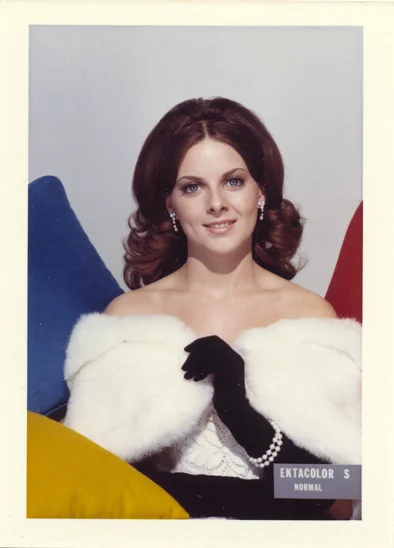
From the mid-1950s Kodak supplied its colour printing labs with reference cards that showed a woman in a high-contrast outfit. The cards were named after the first model, Shirley Page, a Kodak studio model. Lab technicians adjusted their printers until her skin looked right, on the principle that if Shirley looked good, everything else would be fine (NPR). Kodak sold almost all the colour film in the United States at the time, and the cards travelled wherever Kodak printers were used. For decades the models on them were white.
The media scholar Lorna Roth, who has researched the history of the cards, notes that they encoded a particular idea of beauty, and that the dynamic range of the film itself was biased towards white skin. In 1978 Jean-Luc Godard refused to use Kodak film in Mozambique, declaring it racist. Kodak later made multiracial reference cards, but the card kept its structure: one woman, standing in for what a correct image should look like. The Shirley is not looked at as a person but looked through, as a measuring instrument. The objectification here is not an image but an infrastructure.
Key text: Richard Dyer, White (1997), with Lorna Roth, “Looking at Shirley, the Ultimate Norm” (2009).
- Whiteness as the unmarked norm. Dyer argues that white is treated as the default, as the human, as the absence of colour, and that this invisibility is how it holds power.
- Technology inherits the norm. Film stock, lighting and camera practice were developed with the white face as the benchmark, so that a “good” photograph of a white person became the measure of photographic quality.
- The card as case study. Roth shows how the Shirley card sat between film design, lab practice and a standard of feminine beauty, and how it was eventually revised.
Lenna and Jennifer: The Proxy
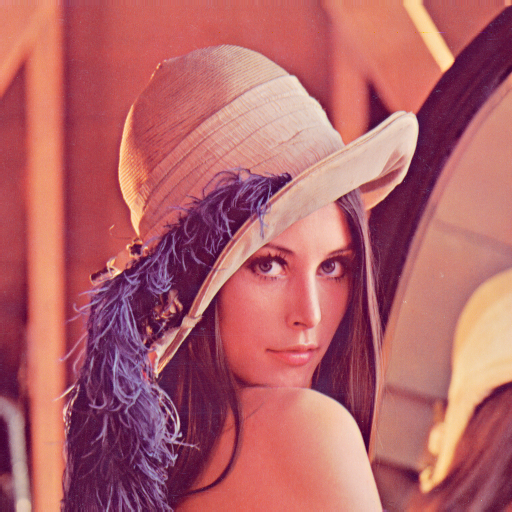
In June or July 1973, researchers at the University of Southern California’s Signal and Image Processing Institute were looking for a new image to scan for a colleague’s conference paper. They were tired of their usual test images, and somebody had a copy of Playboy. They scanned the upper part of the centrefold of the Swedish model Lena Forsén, photographed by Dwight Hooker in 1972 (IEEE). Visitors to the lab asked for copies, and the crop became the standard test image for compression and processing algorithms, for decades. It was there long before the JPEG standard of 1992, and long after. In 2024 the IEEE Computer Society announced it would no longer accept papers using it, citing the wishes of Forsén herself, who in the 2019 documentary Losing Lena said it was time for her to retire from tech (Digital Camera World).
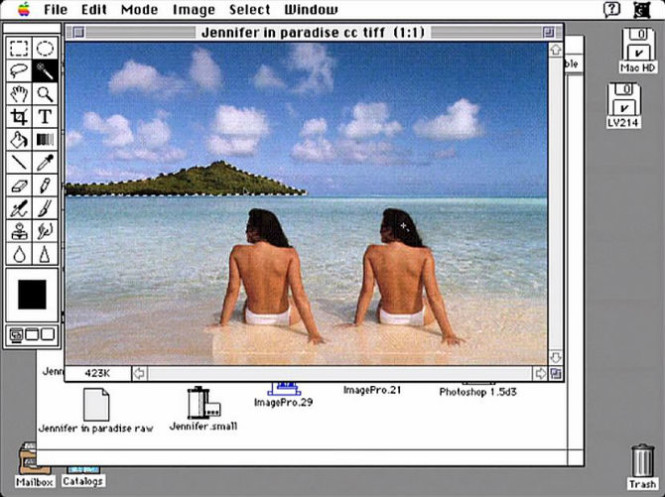
The second image has a similar career. In 1987 John Knoll photographed his girlfriend, later his wife, Jennifer, on a beach in Bora Bora. He and his brother Thomas were developing the software that would become Photoshop, and the picture was the first colour image they used to demo it. John Knoll has said that it was pleasing to look at and offered many things that could be done to it technically (designboom). Adobe licensed the software in 1989 and shipped Photoshop 1.0 in 1990 (Shutterbug).
Two private images became public infrastructure: one picked by a lab, the other by a lover and a developer. Both were chosen by engineers, for what is useful and pleasing to them, and both women stand in for the “ordinary” image on which a technology is to work.
Key text: Dylan Mulvin, Proxies: The Cultural Work of Standing In (2021).
- Standing in. Test images, models and crash test dummies stand in for populations and future situations. They are chosen for convenience, and they carry the assumptions of those who choose them.
- From convenience to standard. A one-off choice in one lab hardens into a benchmark once it circulates. Lenna, in use for some fifty years, is one of Mulvin’s cases.
- Friction. Standards written around white skin pass through technology with ease; darker skin meets friction.
Les Horribles Cernettes: The Promise
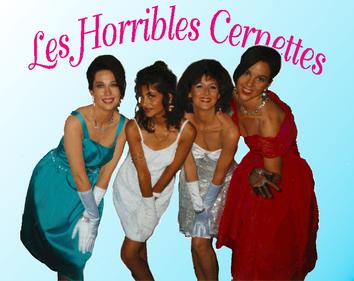
On 18 July 1992, the CERN computer scientist Silvano de Gennaro photographed the band Les Horribles Cernettes backstage and composed the picture into an album cover in Photoshop 1.0. A few weeks later Tim Berners-Lee, who wanted an image to test the features of the World Wide Web, got a scan of the cover as a GIF, which was around 120 × 50 pixels and took more than a minute to load (Guinness World Records). It is often called the first photograph on the web. Whether it was really the first is unclear, since Berners-Lee was almost certainly testing before then (Gizmodo).
The band had been formed in 1990 by Michele de Gennaro, a graphic designer at CERN, with colleagues from the administrative staff and partners of scientists. Their songs were about particle physics and the frustrations of dating scientists. The web arrived as a space of information for researchers, a promise of communication without bodies, and its first photograph shows four women from the building. A colleague of Berners-Lee reportedly explained the choice with the line that sex sells. But the women were not simply illustrations: they wrote and performed songs about their own place in a physics lab. And the picture was already a composite made with the same software that had been demoed on Jennifer: the first photograph on the web was a manipulated one.
Key text: VNS Matrix, “A Cyberfeminist Manifesto for the 21st Century” (1991).
- A manifesto for the net. Four artists in Adelaide (Josephine Starrs, Julianne Pierce, Francesca da Rimini and Virginia Barratt) wrote it in 1991. It circulated on billboards, posters, radio and television as well as online (Monoskop).
- The machine has a gender. The text casts women as the saboteurs of “big daddy mainframe”, infiltrating a masculine system from inside, where the dominant story of the network said that it was neutral.
- Bodies in the network. Against the promise of disembodiment, cyberfeminism insists that the body is wired in. For the wider discussion see Sadie Plant, Zeros + Ones (1997), and the VNS Matrix archive.
Paris Hilton: The Display

On 19 November 2006 Paris Hilton and Britney Spears photographed themselves, a few months before the first iPhone. Hilton has repeated for years, in 2017 and again in 2020, that this is the day they invented the selfie. The claim does not survive a check (Snopes): people had been turning cameras on themselves since Robert Cornelius in 1839. But the rebuttal usually takes the form of a hunt for precedents, and most genealogies of the selfie look for its ancestors in the history of the self-portrait. In doing so they disregard the social context of early smartphone photography and the ecology of media that emerged with the first networked platforms for sharing images. What changed in 2006 was less the pose than where the picture went and who saw it.
The selfie also arrived with a gendered verdict attached. It has been read as vanity, narcissism and shallowness, most often when young women are the ones taking it. Hilton, whose public persona was built on being photographed, is a fitting figure for this ambivalence. Her claim to have invented the selfie can be taken as a joke at her own expense or as a shrewd bid to own the history of a practice that has been used to belittle women like her. Either way, the picture is no longer only an image of a woman looked at: it is an image in which she looks at herself and shows others how.
Key text: Nathan Jurgenson, The Social Photo: On Photography and Social Media (2019).
- Social photography, not vanity. Jurgenson defends the selfie against charges of shallowness, arguing that it is a familiar form of social photography that makes the construction of identity visible. Unlike the painted self-portrait, seen from outside the body, its point of view is that of the hand holding the phone (Verso excerpt).
- Front stage and back stage. Drawing on Erving Goffman, he argues that selfies, especially playful “ugly” ones, expose the preparation behind a public performance. Drawing on Charles Cooley’s “looking-glass self”, he argues that there is no fixed, authentic self beneath the performance: the self takes shape in how we imagine others see us.
- Gendered stigma. Citing Anne Burns, he argues that the criticism of selfies, especially of those taken by young women, is often sexist and works to regulate behaviour through shame.
For a media-historical account of why sharing changed what a photograph is, see André Gunthert, L’image partagée (Textuel, 2015).
Joy Buolamwini: The Audit
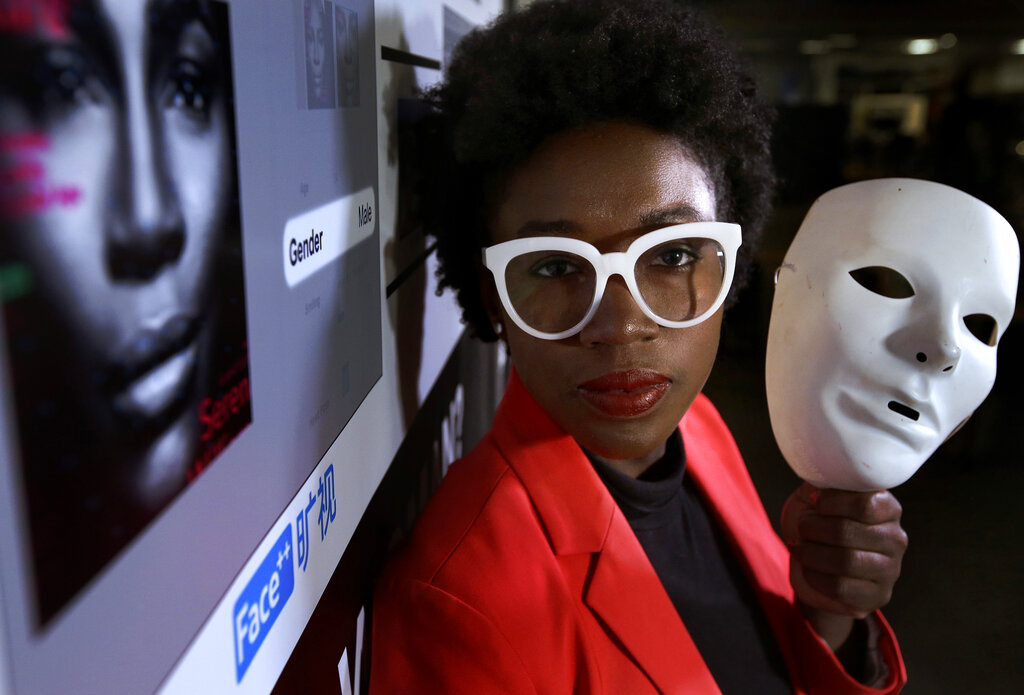
In 2015, Joy Buolamwini was a graduate student at the MIT Media Lab, working on an art project that used face-tracking software. The software failed to detect her face until she held a plain white mask in front of it. She described the experience in a 2016 TED talk, and said that the mask was a closer match to what the system had learned a face to be than her own face was (Google Arts & Culture). The mask is the Shirley card made into an object: the face the system was trained to see.
She then built the test that Lenna had never been. In “Gender Shades” (2018), with Timnit Gebru, she tested the gender classification software of IBM, Microsoft and Face++ on 1,270 faces of parliamentarians from three African and three European countries (Sharon Lohr). Error rates were below one per cent for lighter-skinned men and as high as 35 per cent for darker-skinned women (MIT Technology Review). Buolamwini herself pointed to Frantz Fanon’s Black Skin, White Masks (1952). The difference from the Shirley card is who finds the norm and how. It was not discovered by technicians decades later, but measured, named and published by one of the people it excluded. The benchmark has its own limits, since it works with binary gender categories, and that is a reminder that every audit also sets a standard.
Key text: Joy Buolamwini and Timnit Gebru, “Gender Shades: Intersectional Accuracy Disparities in Commercial Gender Classification” (2018).
- Auditing the benchmark. The datasets used to evaluate face analysis were overwhelmingly lighter-skinned and male. The authors built a more balanced one and tested the commercial systems against it.
- Intersectional error. Reporting results by gender and skin type together shows what an aggregate accuracy figure hides: the worst failures fell on darker-skinned women.
- The coded gaze. Buolamwini’s term for the preferences and blind spots of those who build a system, which it then reproduces. It returns us to hooks: if there is a coded gaze, there can also be an oppositional one.
The Woman Trajectory
Laid side by side, the images tell their own history of photography.
| Woman | Image | Photographic shift | Key text |
|---|---|---|---|
| Sojourner Truth | Carte de visite, 1864 | The gaze: who may look and who owns the image | hooks, “The Oppositional Gaze” (1992) |
| Augustine | Iconographie photographique de la Salpêtrière, 1876–80 | The symptom: the apparatus produces what it records | Didi-Huberman, Invention of Hysteria (1982) |
| Shirley Page | Shirley card, from the 1950s | The norm: the standard built into the instrument | Dyer, White (1997) |
| Lena Forsén / Jennifer Knoll | Lenna, 1973 / Jennifer in Paradise, 1987 | The proxy: standing in for the medium | Mulvin, Proxies (2021) |
| Les Horribles Cernettes | 1992 | The promise: a network without bodies | VNS Matrix (1991) |
| Paris Hilton | Selfie with Britney Spears, 2006 | The display: the self as social performance | Jurgenson (2019) |
| Joy Buolamwini | White mask, c. 2016 | The audit: the norm measured | Buolamwini and Gebru (2018) |
We begin with a woman who sells her own shadow and end with a face that the machine cannot see. In between, women are made into evidence, standard, test, joke and brand, and in several of these images they are also the authors of the picture, the band, the manifesto or the audit. No shift replaces the one before. The gaze, the symptom, the norm, the proxy, the promise, the display and the audit coexist in the images we encounter today, and the course will keep returning to them.
In dieser Vorlesung folge ich einer Reihe von Bildern von Frauen, um zentrale Momente in der Geschichte der Fotografie und des digitalen Bildes zu streifen. Frauen stehen seit den ersten Porträtstudios vor der Kamera, und sie mussten dort viele Rollen übernehmen: Porträtierte, Patientin, Model, Testobjekt, Kalibrierstandard, Urheberin. Die Vorlesung folgt einer feministischen Lesart der Fotografie und des digitalen Bildes und fragt, was diese Bilder für das Medium geleistet haben und was das Medium den Frauen in ihnen angetan hat. Sie fragt, was es bedeutet, wenn eine Technologie eine Frau als Objekt, als Beweis, als Standard, als Test, als Inhalt behandelt, und auf welche Weisen die Frauen in diesen Bildern widersprechen.
Anders als der Papst, der eine teilweise willkürliche Leitfigur war, ist „die Frau“ keine neutrale Figur, und sie ist auch keine einzelne. Die Frauen, um die es im Folgenden geht, nehmen sehr unterschiedliche Positionen ein: Eine besitzt das Urheberrecht an ihrem eigenen Bild, eine wurde dazu gebracht, für die Kamera zu performen, eine ist ein Studiomodel, dessen Gesicht zum Messinstrument wurde, und eine hat darum gebeten, dass ihr Bild aus dem Verkehr gezogen wird. Die Auswahl trägt zudem eine deutliche Verzerrung, die in der Geschichte der Fotografie prominent angelegt ist und in heutigen Bildgebungssystemen fortlebt: Die meisten Frauen sind weiss, und die meisten Bilder stammen aus Europa und Nordamerika, weil die technischen Standards des Mediums um diesen Körper herum gebaut wurden. Die Verzerrung gehört zum Gegenstand. Die Abfolge versucht, ihr entgegenzuwirken, indem sie mit Schwarzen Frauen beginnt und endet, die die Bedingungen des Bildes anfechten.
Die Abfolge ist nicht streng chronologisch. Sie folgt sieben konzeptuellen Verschiebungen: vom Blick über das Symptom, die Norm, den Proxy (Stellvertreter) und das Versprechen bis zur Zurschaustellung und schliesslich zum Audit. Jeder Abschnitt stellt ein Bild vor, erläutert die Rolle der Frau darin und verankert die Episode in einem Schlüsseltext der feministischen Theorie sowie der Medien- und Fototheorie.
Sojourner Truth: Der Blick
Sojourner Truth (um 1797–1883) wurde in die Sklaverei geboren und wurde zu einer der bekanntesten Abolitionistinnen und Frauenrechtlerinnen ihrer Zeit. Sie sass Anfang der 1860er-Jahre für mehrere Porträts und verkaufte sie als Cartes de Visite, um ihre Arbeit zu finanzieren. Auf dem Karton dieses Exemplars steht ein Copyright-Vermerk auf ihren eigenen Namen, datiert 1864, sowie der Satz „I sell the shadow to support the substance“ (etwa: „Ich verkaufe den Schatten, um die Substanz zu erhalten“). Die Beschriftung macht aus einer Standardformel der frühen Studiofotografie, man solle den Schatten sichern, bevor die Substanz schwindet, eine ökonomische Aussage (Art Institute of Chicago). Der Fotograf ist unbekannt; die Urheberin des Objekts nicht.
Hier macht eine Frau, die selbst einst als Eigentum verkauft worden war, ihr Abbild zu Einkommen und entscheidet, unter welchem Namen es zirkuliert. Wer schauen darf, wer angeschaut werden darf und wer vom Schauen profitiert: Das ist die erste und grundlegendste der Fragen, die die Abfolge an Frauen vor der Kamera immer wieder stellen wird. Die Kunsthistorikerin Darcy Grimaldo Grigsby hat Truths Gebrauch der Fotografie in der Ausstellung Sojourner Truth, Photography, and the Fight Against Slavery (BAMPFA, 2016) im Detail nachgezeichnet.
Schlüsseltext: bell hooks, „The Oppositional Gaze: Black Female Spectators“, in Black Looks: Race and Representation (1992).
- Die Politik des Schauens. hooks geht von der Tatsache aus, dass versklavte Menschen für Blicke bestraft wurden. Das Recht zu schauen und zurückzuschauen war ein politisches Recht, und der Blick wurde zu einem Ort des Widerstands.
- Der oppositionelle Blick. Schwarze Zuschauerinnen, so ihr Argument, identifizierten sich nicht mit den Bildern, die ihnen angeboten wurden. Sie schauten kritisch, stellten die für andere gemachten Darstellungen in Frage und erfanden andere Weisen des Schauens.
- Die fehlende Zuschauerin. Die feministische Filmtheorie der 1970er-Jahre baute ihre Theorie des „männlichen Blicks“ (male gaze) auf einer weissen weiblichen Zuschauerin auf. hooks schreibt Race und die Schwarze Zuschauerin in die Theorie zurück.
Augustine: Das Symptom
Im Pariser Spital Salpêtrière untersuchte der Neurologe Jean-Martin Charcot Patientinnen mit Krampfanfällen. Sein Assistent Désiré-Magloire Bourneville gab die dreibändige Iconographie photographique de la Salpêtrière heraus, mit Fotografien von Paul Régnard. Der am häufigsten fotografierte Fall ist Augustine (Louise Augustine Gleizes), die 1875 im Alter von fünfzehn Jahren eingeliefert wurde. Die Krankenakten halten fest, dass ihre ersten Anfälle auf eine Vergewaltigung durch den Arbeitgeber und Liebhaber ihrer Mutter folgten (Photomonitor, Le Temps). Die Tafeln zeigen die Anfälle als sorgfältig ausgeleuchtete und inszenierte Szenen, mit Bildunterschriften, die von Ekstase und Leidenschaft sprechen. Schliesslich floh sie aus dem Spital.
Die Fotografien halten eine Krankheit nicht einfach fest. Sie helfen, sie herzustellen. Die Posen wiederholen sich, die Anfälle werden für die Kamera und für das Publikum von Charcots Vorlesungen aufgeführt, und die entstandenen Bilder dienen dann als Beweis für die Kategorie, die sie illustrieren. Sojourner Truth verkaufte ihren Schatten, um ihre Substanz zu erhalten; Augustines Schatten wurde gesammelt, um die Theorie eines anderen zu stützen. Das ist der Körper einer Frau als Beweisstück eines Arguments und ein früher Fall eines Apparats, der hervorbringt, was er zu dokumentieren vorgibt.
Schlüsseltext: Georges Didi-Huberman, Invention of Hysteria: Charcot and the Photographic Iconography of the Salpêtrière (1982; englisch 2003).
- Keine objektive Dokumentation. Didi-Huberman zeichnet die wechselseitige Beziehung zwischen Psychiatrie und Fotografie im späten 19. Jahrhundert nach und zeigt die entscheidende Rolle der Fotografie bei der Erfindung der Kategorie der Hysterie (MIT Press).
- Den Typus aufführen. Die Patientinnen stellten ihren eigenen hysterischen „Typus“ dar. Sie genossen auf der Versuchsstation des Spitals einen Sonderstatus, unter der Drohung, zu den Unheilbaren zurückgeschickt zu werden, und posierten und inszenierten ihre Anfälle entsprechend.
- Von der Komplizenschaft zur Ablehnung. In Augustines Fall verfolgt Didi-Huberman einen Weg von der Zusammenarbeit zum Widerstand, der mit ihrer Flucht endet.
Shirley: Die Norm
Ab Mitte der 1950er-Jahre belieferte Kodak seine Farbkopierlabors mit Referenzkarten, auf denen eine Frau in einem kontrastreichen Outfit zu sehen war. Die Karten wurden nach dem ersten Model benannt, Shirley Page, einem Studiomodel von Kodak. Die Labortechniker:innen justierten ihre Drucker, bis ihre Haut richtig aussah, nach dem Grundsatz: Wenn Shirley gut aussah, war alles andere in Ordnung (NPR). Kodak verkaufte damals fast den gesamten Farbfilm in den USA, und die Karten reisten überallhin, wo Kodak-Drucker im Einsatz waren. Über Jahrzehnte waren die Models darauf weiss.
Die Medienwissenschaftlerin Lorna Roth, die die Geschichte der Karten erforscht hat, hält fest, dass sie eine bestimmte Vorstellung von Schönheit kodierten und dass der Dynamikumfang des Films selbst auf weisse Haut ausgerichtet war. 1978 weigerte sich Jean-Luc Godard, in Mosambik mit Kodak-Film zu drehen, und erklärte ihn für rassistisch. Kodak stellte später multiethnische Referenzkarten her, doch die Karte behielt ihre Struktur: eine Frau, die dafür steht, wie ein korrektes Bild auszusehen hat. Shirley wird nicht als Person betrachtet, sondern wie ein Messinstrument benutzt: Man schaut durch sie hindurch. Die Objektivierung liegt hier nicht in einem Bild, sondern in einer Infrastruktur.
Schlüsseltext: Richard Dyer, White (1997), mit Lorna Roth, „Looking at Shirley, the Ultimate Norm“ (2009).
- Weisssein als unmarkierte Norm. Dyer argumentiert, dass Weiss als Standard, als das Menschliche, als Abwesenheit von Farbe behandelt wird und dass diese Unsichtbarkeit die Weise ist, wie es Macht ausübt.
- Die Technik erbt die Norm. Filmmaterial, Beleuchtung und Kamerapraxis wurden mit dem weissen Gesicht als Massstab entwickelt, sodass ein „gutes“ Foto einer weissen Person zum Mass fotografischer Qualität wurde.
- Die Karte als Fallstudie. Roth zeigt, wie die Shirley-Karte zwischen Filmentwicklung, Laborpraxis und einem Standard weiblicher Schönheit stand und wie sie schliesslich revidiert wurde.
Lenna und Jennifer: Der Proxy
Im Juni oder Juli 1973 suchten Forschende am Signal and Image Processing Institute der University of Southern California ein neues Bild, das sie für den Konferenzbeitrag eines Kollegen einscannen konnten. Sie hatten genug von ihren üblichen Testbildern, und jemand hatte ein Exemplar des Playboy zur Hand. Sie scannten den oberen Teil des Centerfolds des schwedischen Models Lena Forsén, 1972 von Dwight Hooker fotografiert (IEEE). Besucher:innen des Labors fragten nach Kopien, und der Ausschnitt wurde über Jahrzehnte zum Standardtestbild für Kompressions- und Bildverarbeitungsalgorithmen. Es war schon lange vor dem JPEG-Standard von 1992 im Einsatz und blieb es lange danach. 2024 gab die IEEE Computer Society bekannt, keine Beiträge mehr anzunehmen, die es verwenden, unter Berufung auf den Wunsch von Forsén selbst, die im Dokumentarfilm Losing Lena von 2019 sagte, es sei Zeit für sie, sich aus der Tech-Welt zurückzuziehen (Digital Camera World).
Das zweite Bild hat eine ähnliche Karriere. 1987 fotografierte John Knoll seine Freundin und spätere Frau Jennifer an einem Strand auf Bora Bora. Er und sein Bruder Thomas entwickelten damals die Software, die zu Photoshop werden sollte, und das Bild war das erste Farbbild, mit dem sie sie vorführten. John Knoll sagte, es sei angenehm anzuschauen gewesen und habe technisch viele Möglichkeiten geboten, es zu bearbeiten (designboom). Adobe lizenzierte die Software 1989 und lieferte Photoshop 1.0 1990 aus (Shutterbug).
Zwei private Bilder wurden zu öffentlicher Infrastruktur: das eine ausgewählt von einem Labor, das andere von einem Liebhaber und Entwickler. Beide wurden von Ingenieur:innen gewählt, nach dem, was ihnen nützlich und gefällig ist, und beide Frauen stehen stellvertretend für das „gewöhnliche“ Bild, an dem eine Technologie arbeiten soll.
Schlüsseltext: Dylan Mulvin, Proxies: The Cultural Work of Standing In (2021).
- Stellvertreten. Testbilder, Models und Crashtest-Dummys stehen stellvertretend für Bevölkerungen und künftige Situationen. Sie werden aus Bequemlichkeit gewählt und tragen die Annahmen derer in sich, die sie wählen.
- Von der Bequemlichkeit zum Standard. Eine einmalige Wahl in einem Labor verfestigt sich zum Massstab, sobald sie zirkuliert. Lenna, rund fünfzig Jahre im Gebrauch, ist einer von Mulvins Fällen.
- Reibung. Um weisse Haut herum geschriebene Standards passieren die Technik mühelos; dunklere Haut stösst auf Reibung.
Les Horribles Cernettes: Das Versprechen
Am 18. Juli 1992 fotografierte der CERN-Informatiker Silvano de Gennaro die Band Les Horribles Cernettes hinter der Bühne und setzte das Bild in Photoshop 1.0 zu einem Albumcover zusammen. Einige Wochen später erhielt Tim Berners-Lee, der ein Bild brauchte, um die Funktionen des World Wide Web zu testen, einen Scan des Covers als GIF, das etwa 120 × 50 Pixel gross war und mehr als eine Minute zum Laden brauchte (Guinness World Records). Es wird oft als erste Fotografie im Web bezeichnet. Ob es tatsächlich die erste war, ist unklar, da Berners-Lee mit hoher Wahrscheinlichkeit schon zuvor getestet hatte (Gizmodo).
Die Band war 1990 von Michele de Gennaro gegründet worden, einer Grafikerin am CERN, zusammen mit Kolleginnen aus der Verwaltung und Partnerinnen von Wissenschaftler:innen. Ihre Lieder handelten von Teilchenphysik und den Frustrationen von Beziehungen mit Wissenschaftler:innen. Das Web kam als Informationsraum für Forschende auf, als Versprechen einer Kommunikation ohne Körper, und seine erste Fotografie zeigt vier Frauen aus dem Haus. Ein Kollege von Berners-Lee soll die Wahl mit dem Spruch erklärt haben, Sex sells. Doch die Frauen waren nicht bloss Illustrationen: Sie schrieben und sangen Lieder über ihren eigenen Platz in einem Physiklabor. Und das Bild war bereits eine Montage, hergestellt mit derselben Software, die an Jennifer vorgeführt worden war: Die erste Fotografie im Web war eine manipulierte.
Schlüsseltext: VNS Matrix, „A Cyberfeminist Manifesto for the 21st Century“ (1991).
- Ein Manifest für das Netz. Vier Künstlerinnen in Adelaide (Josephine Starrs, Julianne Pierce, Francesca da Rimini und Virginia Barratt) schrieben es 1991. Es zirkulierte auf Plakatwänden, Postern, im Radio und im Fernsehen ebenso wie online (Monoskop).
- Die Maschine hat ein Geschlecht. Der Text stellt Frauen als Saboteurinnen des „big daddy mainframe“ dar, die ein männliches System von innen unterwandern, während die herrschende Erzählung des Netzes behauptete, es sei neutral.
- Körper im Netzwerk. Gegen das Versprechen der Körperlosigkeit besteht der Cyberfeminismus darauf, dass der Körper mit eingebunden ist. Zur weiteren Diskussion siehe Sadie Plant, Zeros + Ones (1997), und das VNS-Matrix-Archiv.
Paris Hilton: Die Zurschaustellung
Am 19. November 2006 fotografierten sich Paris Hilton und Britney Spears, wenige Monate vor dem ersten iPhone. Hilton behauptet seit Jahren, 2017 und erneut 2020, dies sei der Tag, an dem sie das Selfie erfunden hätten. Die Behauptung hält einer Überprüfung nicht stand (Snopes): Menschen richteten die Kamera schon seit Robert Cornelius 1839 auf sich selbst. Doch die Widerlegung nimmt meist die Form einer Suche nach Vorläufern an, und die meisten Genealogien des Selfies suchen seine Ahnen in der Geschichte des Selbstporträts. Dabei übergehen sie den sozialen Kontext der frühen Smartphone-Fotografie und die Medienökologie, die mit den ersten vernetzten Plattformen zum Teilen von Bildern entstand. Was sich 2006 veränderte, war weniger die Pose als der Ort, an den das Bild gelangte, und wer es sah.
Das Selfie kam zudem mit einem geschlechtsspezifischen Urteil im Gepäck. Es wurde als Eitelkeit, Narzissmus und Oberflächlichkeit gelesen, am häufigsten, wenn junge Frauen es aufnehmen. Hilton, deren öffentliche Persona darauf beruhte, fotografiert zu werden, ist eine passende Figur für diese Ambivalenz. Ihren Anspruch, das Selfie erfunden zu haben, kann man als Scherz auf eigene Kosten lesen oder als geschickten Versuch, sich die Geschichte einer Praxis anzueignen, mit der Frauen wie sie kleingemacht wurden. So oder so ist das Bild nicht mehr nur das Bild einer Frau, die angeschaut wird: Es ist ein Bild, in dem sie sich selbst anschaut und anderen zeigt, wie.
Schlüsseltext: Nathan Jurgenson, The Social Photo: On Photography and Social Media (2019).
- Soziale Fotografie statt Eitelkeit. Jurgenson verteidigt das Selfie gegen den Vorwurf der Oberflächlichkeit und argumentiert, es sei eine vertraute Form sozialer Fotografie, die die Konstruktion von Identität sichtbar macht. Anders als das gemalte Selbstporträt, das von ausserhalb des Körpers gesehen wird, ist sein Blickpunkt derjenige der Hand, die das Telefon hält (Verso-Auszug).
- Vorder- und Hinterbühne. Mit Erving Goffman argumentiert er, dass Selfies, besonders verspielte „hässliche“, die Vorbereitung hinter einem öffentlichen Auftritt offenlegen. Mit Charles Cooleys „looking-glass self“ (Spiegel-Selbst) argumentiert er, dass unter der Performance kein festes, authentisches Selbst liegt: Das Selbst bildet sich darin, wie wir uns vorstellen, dass andere uns sehen.
- Geschlechtsspezifisches Stigma. Mit Verweis auf Anne Burns argumentiert er, die Kritik an Selfies, besonders an jenen junger Frauen, sei oft sexistisch und regle Verhalten über Scham.
Für eine medienhistorische Darstellung dazu, warum das Teilen verändert hat, was eine Fotografie ist, siehe André Gunthert, L’image partagée (Textuel, 2015).
Joy Buolamwini: Das Audit
2015 war Joy Buolamwini Masterstudentin am MIT Media Lab und arbeitete an einem Kunstprojekt, das Gesichtserkennungssoftware nutzte. Die Software erkannte ihr Gesicht nicht, bis sie eine schlichte weisse Maske davorhielt. Sie beschrieb die Erfahrung in einem TED-Talk von 2016 und sagte, die Maske entspreche eher dem, was das System als Gesicht gelernt habe, als ihr eigenes Gesicht (Google Arts & Culture). Die Maske ist die Shirley-Karte als Objekt: das Gesicht, das das System zu sehen gelernt hatte.
Danach baute sie den Test, der Lenna nie gewesen war. In „Gender Shades“ (2018) testete sie zusammen mit Timnit Gebru die Geschlechtsklassifizierungssoftware von IBM, Microsoft und Face++ an 1’270 Gesichtern von Parlamentarier:innen aus drei afrikanischen und drei europäischen Ländern (Sharon Lohr). Die Fehlerquoten lagen bei hellhäutigen Männern unter einem Prozent und bei dunkelhäutigen Frauen bei bis zu 35 Prozent (MIT Technology Review). Buolamwini selbst verwies auf Frantz Fanons Black Skin, White Masks (1952; deutsch Schwarze Haut, weisse Masken). Der Unterschied zur Shirley-Karte liegt darin, wer die Norm findet und wie. Sie wurde nicht Jahrzehnte später von Techniker:innen entdeckt, sondern von einer der Personen, die sie ausschloss, gemessen, benannt und veröffentlicht. Der Massstab hat seine eigenen Grenzen, da er mit binären Geschlechterkategorien arbeitet, und das ist eine Erinnerung daran, dass jedes Audit auch einen Standard setzt.
Schlüsseltext: Joy Buolamwini und Timnit Gebru, „Gender Shades: Intersectional Accuracy Disparities in Commercial Gender Classification“ (2018).
- Den Massstab prüfen. Die Datensätze zur Bewertung von Gesichtsanalyse bestanden überwiegend aus hellhäutigen, männlichen Gesichtern. Die Autorinnen bauten einen ausgewogeneren Datensatz und testeten die kommerziellen Systeme daran.
- Intersektionale Fehler. Die gemeinsame Auswertung nach Geschlecht und Hauttyp zeigt, was eine aggregierte Genauigkeitszahl verbirgt: Die schlimmsten Ausfälle trafen dunkelhäutige Frauen.
- Der codierte Blick. Buolamwinis Begriff (coded gaze) für die Vorlieben und blinden Flecken derer, die ein System bauen und die es dann reproduziert. Er führt uns zu hooks zurück: Wenn es einen codierten Blick gibt, kann es auch einen oppositionellen geben.
Die Frauen-Trajektorie
Nebeneinandergelegt erzählen die Bilder ihre eigene Geschichte der Fotografie.
| Frau | Bild | Fotografische Verschiebung | Schlüsseltext |
|---|---|---|---|
| Sojourner Truth | Carte de Visite, 1864 | Der Blick: wer schauen darf und wem das Bild gehört | hooks, „The Oppositional Gaze“ (1992) |
| Augustine | Iconographie photographique de la Salpêtrière, 1876–80 | Das Symptom: der Apparat bringt hervor, was er aufzeichnet | Didi-Huberman, Invention of Hysteria (1982) |
| Shirley Page | Shirley-Karte, ab den 1950er-Jahren | Die Norm: der ins Instrument eingebaute Standard | Dyer, White (1997) |
| Lena Forsén / Jennifer Knoll | Lenna, 1973 / Jennifer in Paradise, 1987 | Der Proxy: stellvertretend für das Medium | Mulvin, Proxies (2021) |
| Les Horribles Cernettes | 1992 | Das Versprechen: ein Netz ohne Körper | VNS Matrix (1991) |
| Paris Hilton | Selfie with Britney Spears, 2006 | Die Zurschaustellung: das Selbst als soziale Performance | Jurgenson (2019) |
| Joy Buolamwini | Weisse Maske, ca. 2016 | Das Audit: die vermessene Norm | Buolamwini und Gebru (2018) |
Wir beginnen mit einer Frau, die ihren eigenen Schatten verkauft, und enden mit einem Gesicht, das die Maschine nicht sehen kann. Dazwischen werden Frauen zu Beweis, Standard, Test, Witz und Marke, und in mehreren dieser Bilder sind sie auch die Urheberinnen des Bildes, der Band, des Manifests oder des Audits. Keine Verschiebung ersetzt die vorherige. Der Blick, das Symptom, die Norm, der Proxy, das Versprechen, die Zurschaustellung und das Audit bestehen in den Bildern, denen wir heute begegnen, nebeneinander fort, und der Kurs wird immer wieder auf sie zurückkommen.