The Body as Online Identity Der Körper als Online-Identität
Presentations
Choose one of the three themes from today’s session (Screen → Body, Body → Screen, Body as Content) and create a work of photography in response to one of the examples we have seen in class. The work should be a traditional photographic series of 3 – 5 images, made with a camera (in the studio or outside).
Upload your image(s) to the shared doc, together with a title and one sentence naming the theme and the example you responded to.
Inscribed Bodies
Daniele Buetti, Looking for Love, 1994 – 2011
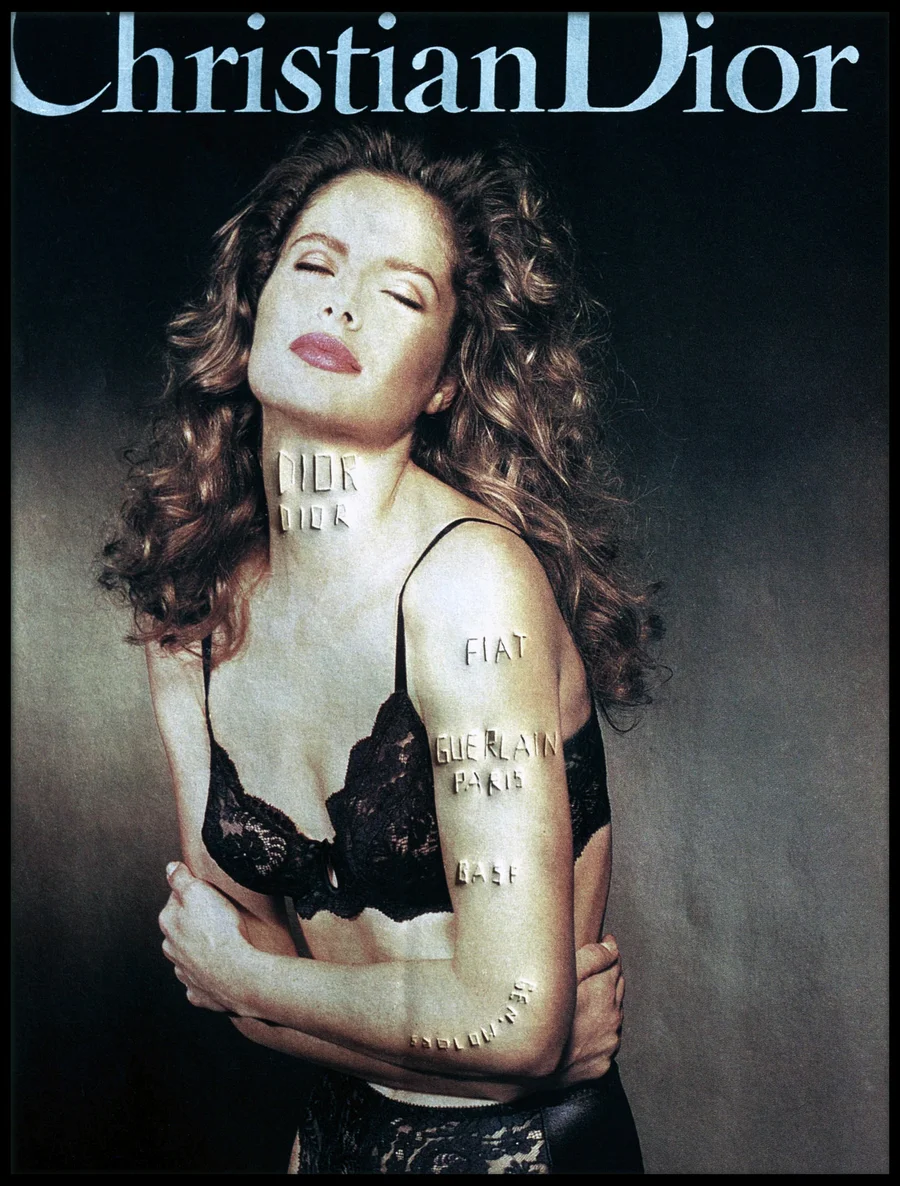
Daniele Buetti is a contemporary Swiss artist whose multi-media practice incorporates light installations, performance, photography, and sculpture in exposing the fragility of popular culture. In his series Looking for Love, he modified pictures of supermodels from journals and magazine, drawing tattoos, and scratching adhesions on their printed skin. [...] Born on November 17, 1955 in Fribourg, Switzerland, he worked for fashion editorials during the 1990s before turning to fine art.
Jon Yuyi, The New York Times “Welcome to the Post-Text future”, 2018
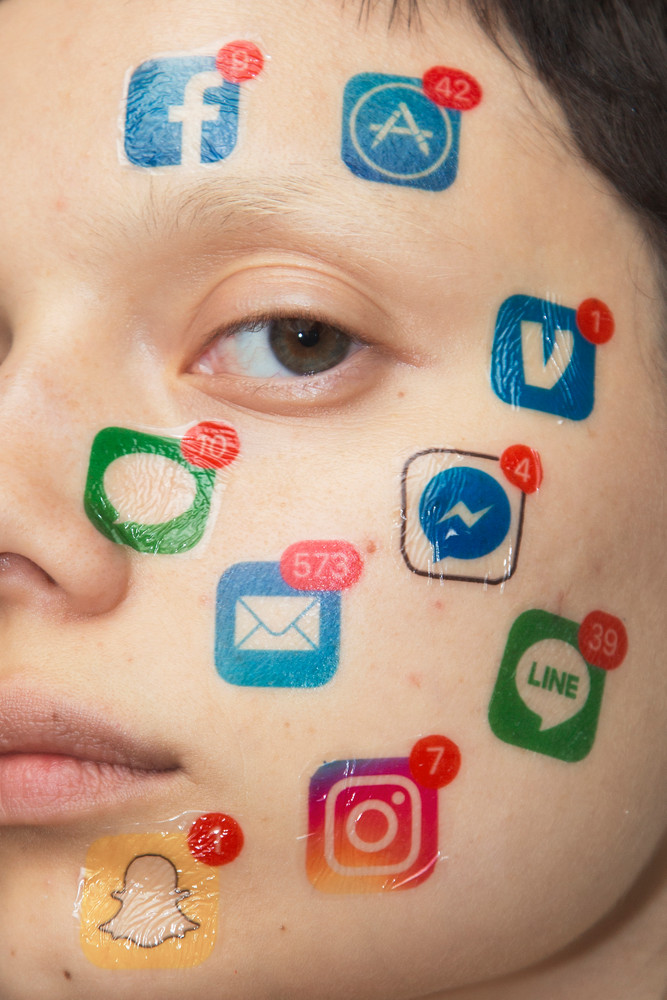
Born in 1991, Yuyi grew up online in the post-Internet generation, and that experience has consistently filtered back into the way she makes work. In fact, before being an artist or a photographer, she worked in the fashion world, and gained a following as an influencer, styling herself in outfits and posting the images on social media. It was only later though, when she sought a different creative outlet, that she went viral.
In 2015, Yuyi was travelling between Taiwan, where she had been working as a stylist, and New York, where she had been interning at a design studio. She wanted to move to New York more permanently, and that meant applying for an artist visa, which in turn meant raising the funds for it. The idea came to her to make temporary tattoos and sell them online to make some cash, so she bought the machine to do so and got to work. At first, she made them from her own illustrations, and then later, from photographs of a swimsuit collection she had designed. From here, her ideas tumbled into ever-more conceptual realms, and she began making tattoos out of social media-related symbols, like Facebook logos and ‘like’ buttons. She transferred them all over her own body, photographed herself and created new images out of them. Later, she used friends as models too. Both the tattoos and the resulting images were wildly popular, and the artist soon made a name for herself.
Skinvertising: Kari Smith and GoldenPalace.com, 2005
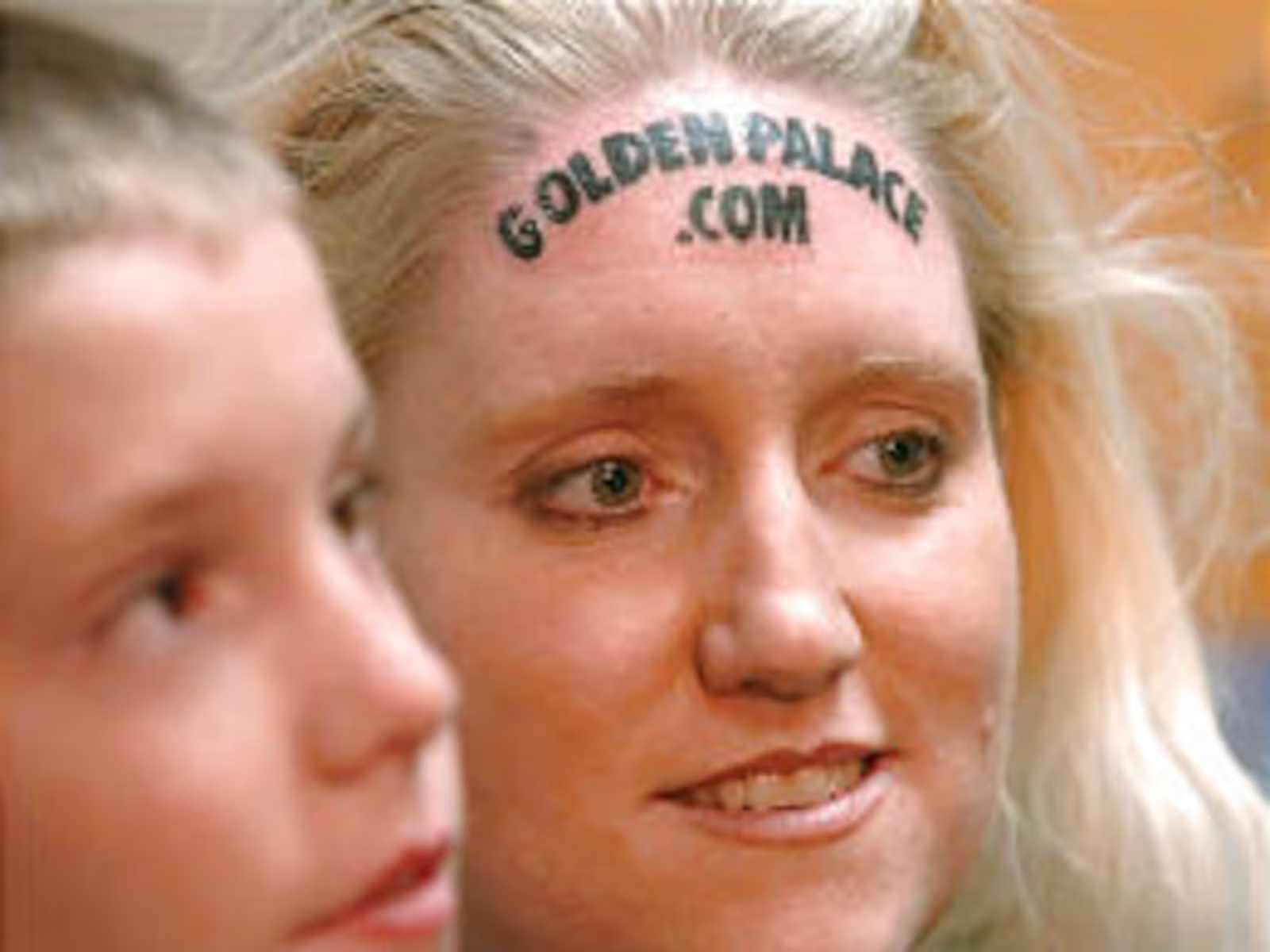
For $10,000 and a brighter future for her son, Kari Smith on Wednesday became a real life pop-up ad for a virtual casino.
"It feels like someone is taking a pin and just stabbing you with it," Smith told her son, Brady, seated nearby on the floor as tattoo artist Don Brouse — in permanent black block letters — branded her forehead with the Web site domain GoldenPalace.com.
The 30-year-old Bountiful mother, who put the space up for auction on the Web, will be promoting the multinational gambling site, which makes the claim — using a little more color and a lot more flash — to be the No. 1 online casino.
Source: deseret.com/2005/6/30/19900047/mom-sells-face-space-for-tattoo-advertisement
!Mediengruppe Bitnik, Flagged for Explicit Image, 2021
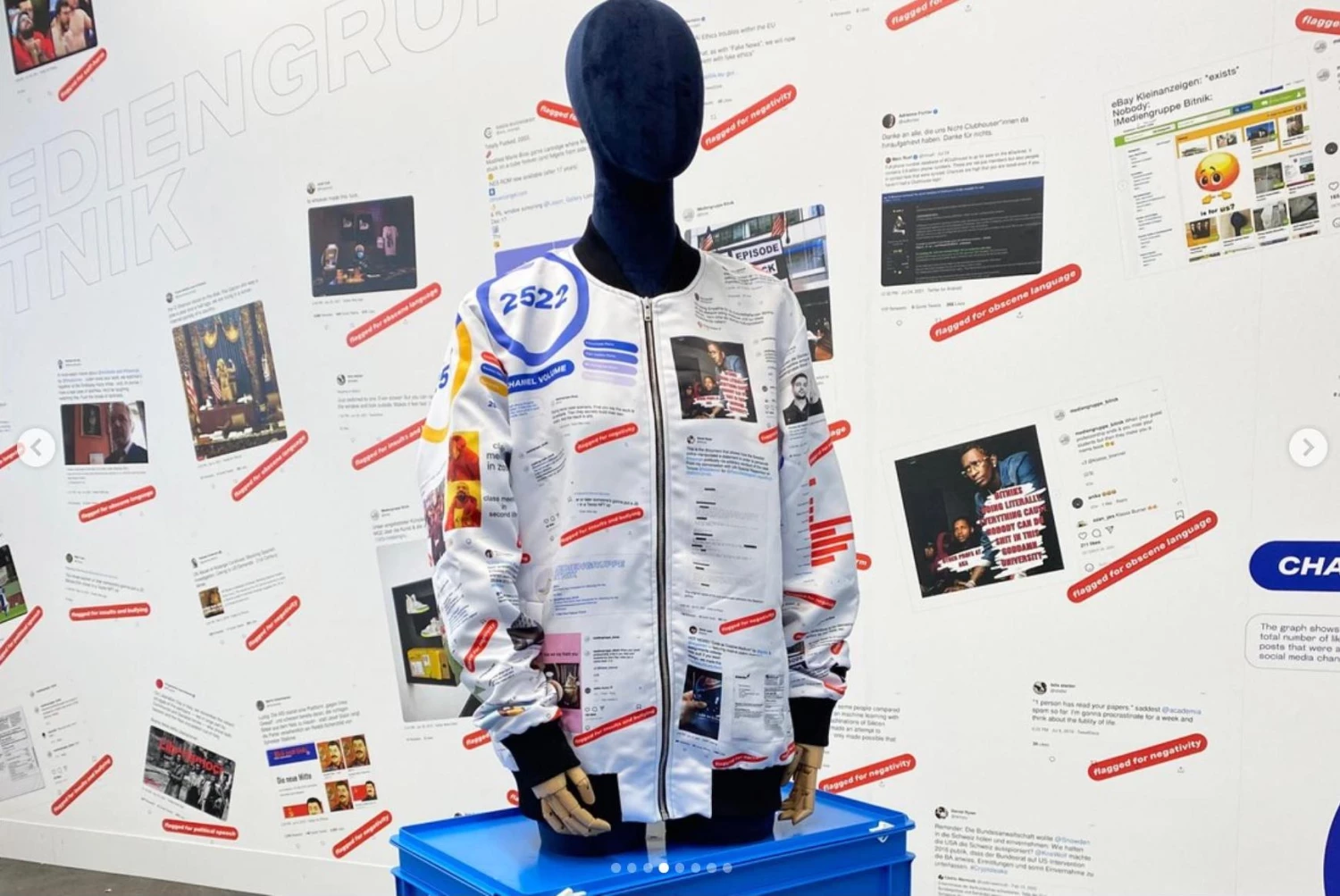
Thanks to !Mediengruppe Bitnik you can now find out how your social media profiles score. !Mediengruppe Bitnik evaluates your social media data through a commercial algorithm and prints it on a unique bomber jacket for you to wear and for all to see!
!Mediengruppe Bitnik ran their own social media profiles through the service. Bitnik then interpreted the results of the analysis and used this as the basis to devise a customized bomber jacket each.
Each shirt shows Bitnik's interpretation of one persons personal social media ratings. Besides their social media scores for different parameters, each of the jackets publicly displays a number of flagged posts which were rated as toxic and the reason for this rating.
Like the clothes we wear, our social media profiles have become the carrier of our identities. These online identities are used more and more by the gatekeepers of institutions, countries and organisations to verify that we are worthy of access.
Source: bitnik.org/fei
Performed Bodies
Antoine Geiger, sur-fake, 2015
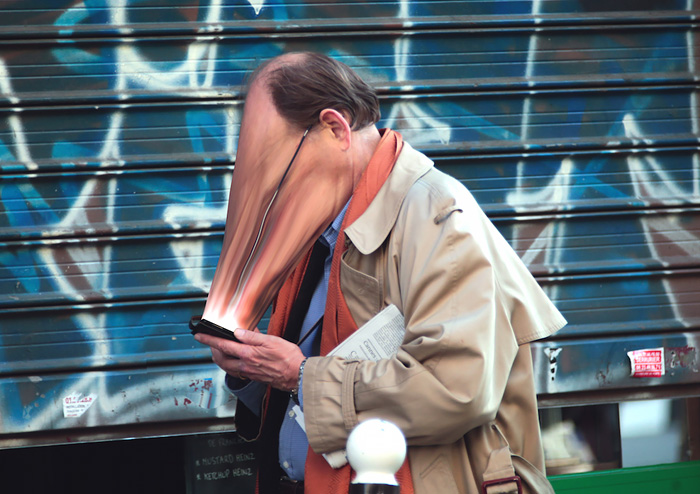
Surfake is a series I did in 2015 that represents people who are in the street, or in museums, or in their everyday lives, using their phones. And so I decided to represent their faces literally sucked into their phones, which makes them beings that are suddenly deprived of their identity, sucked into social networks and into a universe that is no longer related to the place in which we are, or the time in which we are. Apart from the simple message “look we’re all zombies” there’s also “look at what we’re doing” and how we act in public spaces, but also how much we’re losing a certain sense of intimacy, of living things for ourselves… and so trying to understand how every moment of our lives is becoming a bargaining chip, but not just for us. That is to say, behind it there are tons of people who are pushing us to these behaviors. We are losing what it is to live things for ourselves. And this is a huge social pressure, but I think that this pressure… this huge pressure is in our pocket as a matter of fact. That’s what I find very impressive about the phone.
Source: therealists.org/2018/12/exclusive-video-antoine-geiger-and-surfake
Amalia Ulman, Excellences & Perfections, 2014
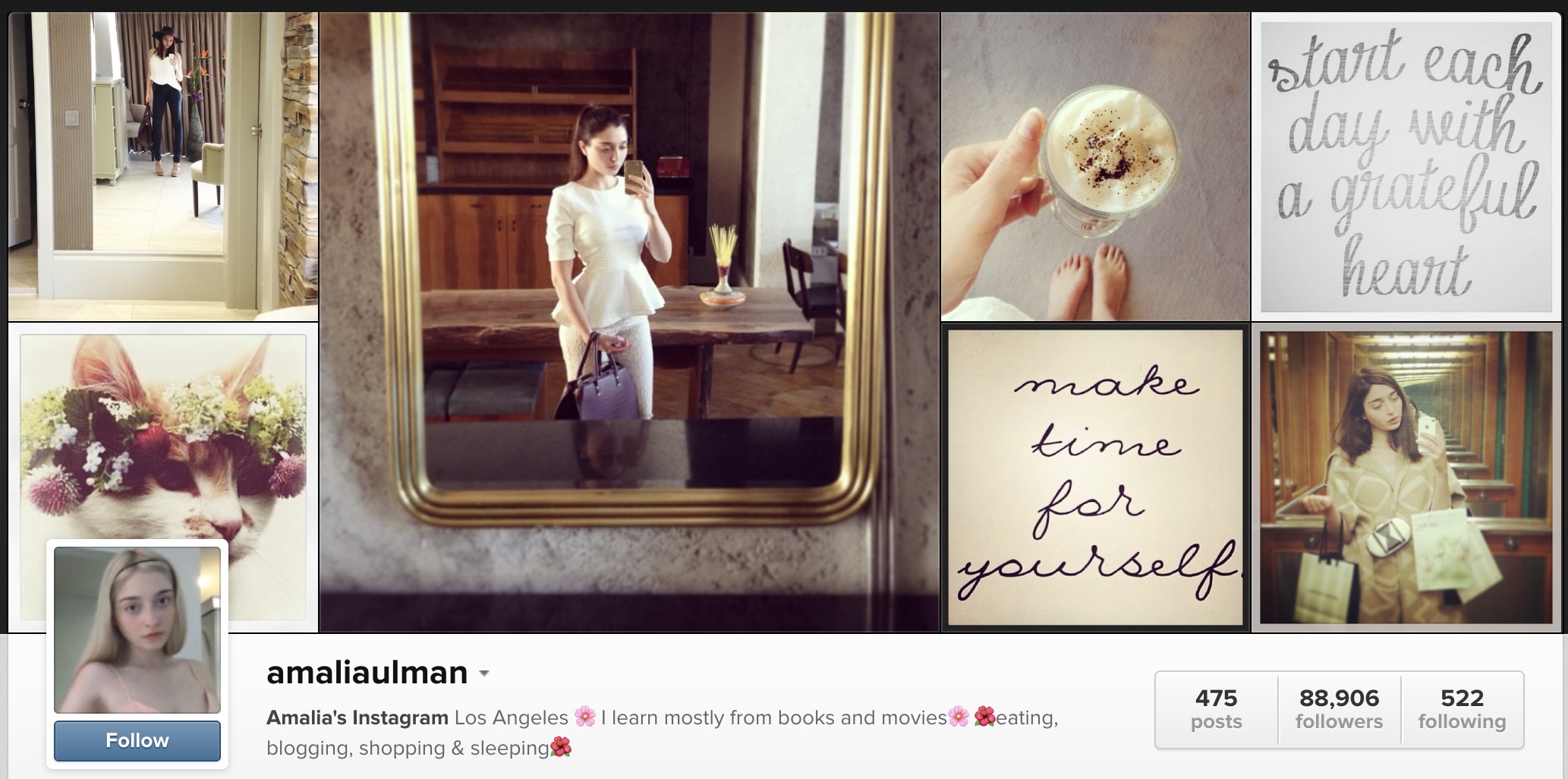
On April 19, 2014, Amalia Ulman uploaded an image to her Instagram account of the words "Part I" in black serifed lettering on a white background. The caption read, cryptically, "Excellences & Perfections." It received twenty-eight likes.
For the next several months, she conducted a scripted online performance via her Instagram and Facebook profiles. As part of this project, titled Excellences & Perfections, Ulman underwent an extreme, semi-fictionalized makeover.
She pretended to have a breast augmentation, posting images of herself in a hospital gown and with a bandaged chest, using a padded bra and Photoshop to manipulate her image. Other elements of the makeover were not feigned; she followed the Zao Dha Diet strictly, for example, and went to pole-dancing lessons often.
Through judicious use of sets, props, and locations, Excellences & Perfections evoked a consumerist fantasy lifestyle. Ulman's Instagram account is a parade of carefully arranged flowers and expensive lingerie and highly groomed interiors and perfectly plated brunches. These images are excessive, but also believable—because they're so familiar. For many privileged users, social media is a way of selling one's lifestyle, of building one's brand. And Ulman went to great lengths to replicate the narrative conventions of these privileged feeds, from her use of captions and hashtags (#simple, #cutegasm), to the pace and timing of uploads, to the discerning inclusion of "authentic" intimate or emotional content (a photo of a lover or a moment of despair).
Source: rhizome.org/editorial/2014/oct/20/first-look-amalia-ulmanexcellences-perfections
Ewa Doroszenko, Body Editor, 2018 – 2020
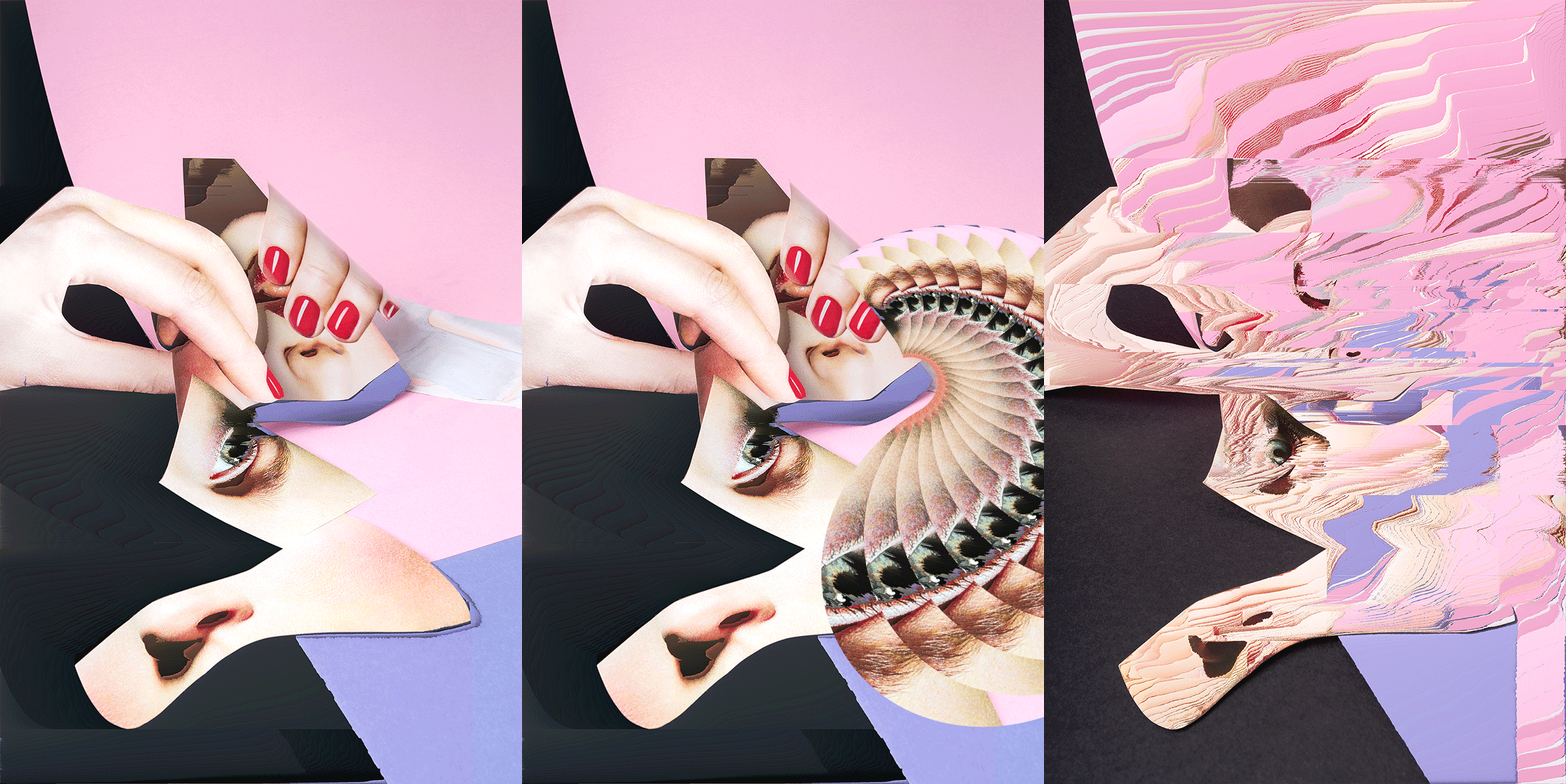
Although the internet can appear disconnected from the physical world, the activity that takes place there profoundly shapes how people experience life beyond the screen. In an era defined by social media – where selfhood is increasingly displaced by self-promotion and the glorification of digital beauty undermines authentic self – women are confronted with an ever-widening gap between their real appearance and its idealised digital counterpart. Contemporary technology offers tools that accelerate this process: beauty applications allow users to smooth and contour the face, whiten teeth, adjust height, enlarge eyes, reshape lips, and apply countless other corrections, producing a curated image with little resemblance to the person behind the camera.
Body Editor takes these tools and their cultural consequences as its subject. The project has its roots in Doroszenko’s own ambivalent relationship to images of female beauty – a tension between fascination and unease that runs throughout the work. Inspired by the failures and glitches that occur within popular beauty applications – moments in which artificially perfected bodies collapse into grotesque distortions – Doroszenko constructs large-format photographic collages using a custom-commissioned programme designed to generate errors in digital files. This deliberate introduction of glitch becomes both a technical method and a critical gesture: by exposing the mechanisms through which digital tools construct and normalise the female image, the work invites reflection on the nature of post-photographic representation and the ways technology shapes self-perception. Visible traces of digital processing are left throughout the prints, partly revealing the artist’s working methods and foregrounding the constructed character of every edited image.
Alba Zari, Fear of Mirrors, 2025
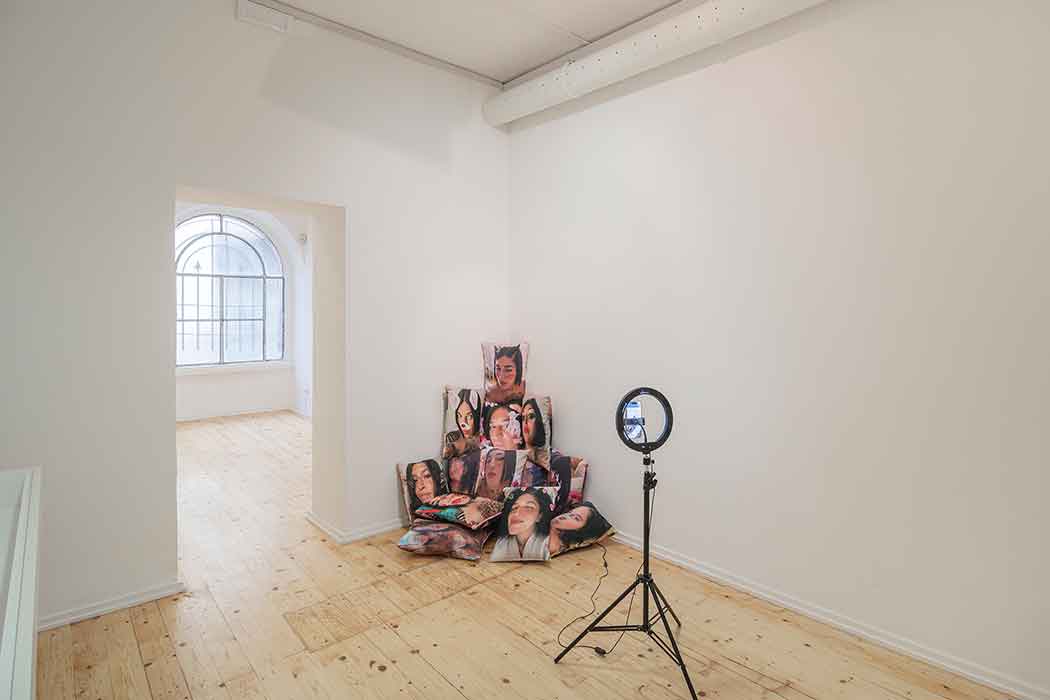
Alba Zari explores the attraction to one's own reflection—an ancestral pull that represents the first step toward self-awareness. Recognizing oneself in the mirror gives boundaries, shapes, and colors to the image we have of ourselves. But what happens when the mirror becomes a screen?
From this premise arises Fear Of Mirrors, a project that explores the dynamics of representation in the digital age. Through a visual and conceptual journey, Alba Zari investigates the relationship between image, identity, and cultural conditioning, questioning how new technologies influence self-perception.
The exhibition takes the form of an immersive experience, a flow of images and reflections that challenges contemporary visual and social constructs. Through a variety of languages and references, the artist invites the viewer to question what we define as authentic and to consider how much our image is truly free—or shaped by external gazes.
Fear Of Mirrors does not offer definitive answers, but opens a dialogue about our digital present: has the mirror finally shattered, or are we still prisoners of its reflection?
Source: phmuseum.com/exhibitions/fear-of-mirrors-by-alba-zari-at-fondazione-pastificio-cerere
Assignment
Choose one of the works from today’s session and create a photographic series of 3 – 5 images in response to it. As last week, the work should be made with a camera (in the studio or outside). If you intervene on a body, a print or a screen, do it physically in front of the camera rather than in post-production.
You are free to develop your own approach. If you are looking for a starting point, here are some ideas:
- Write on the skin: draw or apply temporary marks of platform symbols (likes, notification badges, logos) on a body and photograph them (Yuyi)
- Deface the portrait: print a portrait, draw or scratch onto its surface, and re-photograph it (Buetti)
- Wear your score: turn your own platform data (Screen Time, follower count, flagged or deleted posts) into a garment or a mark on the body, and portray yourself in it (Bitnik)
- Script a persona: stage a sequence of images that follows the conventions of a platform genre (wellness, fitness, travel) to construct a fictional self, captions and hashtags included (Ulman)
Only photograph people who have agreed to take part, and use temporary, skin-safe materials for anything applied to the body.
Upload your images to the shared doc, together with a title and one sentence naming the work you responded to.
Präsentationen
Wählt eines der drei Themen der heutigen Sitzung (Screen → Body, Body → Screen, Body as Content) und entwickelt eine fotografische Arbeit als Antwort auf eines der im Kurs gezeigten Beispiele. Die Arbeit soll eine traditionelle fotografische Serie aus 3 – 5 Bildern sein, die mit einer Kamera entsteht (im Studio oder draußen).
Ladet eure Bilder in das geteilte Dokument hoch, zusammen mit einem Titel und einem Satz, der das Thema und das Beispiel nennt, auf das ihr euch bezieht.
Eingeschriebene Körper
Daniele Buetti, Looking for Love, 1994 – 2011
Daniele Buetti is a contemporary Swiss artist whose multi-media practice incorporates light installations, performance, photography, and sculpture in exposing the fragility of popular culture. In his series Looking for Love, he modified pictures of supermodels from journals and magazine, drawing tattoos, and scratching adhesions on their printed skin. [...] Born on November 17, 1955 in Fribourg, Switzerland, he worked for fashion editorials during the 1990s before turning to fine art.
Jon Yuyi, The New York Times “Welcome to the Post-Text future”, 2018
Born in 1991, Yuyi grew up online in the post-Internet generation, and that experience has consistently filtered back into the way she makes work. In fact, before being an artist or a photographer, she worked in the fashion world, and gained a following as an influencer, styling herself in outfits and posting the images on social media. It was only later though, when she sought a different creative outlet, that she went viral.
In 2015, Yuyi was travelling between Taiwan, where she had been working as a stylist, and New York, where she had been interning at a design studio. She wanted to move to New York more permanently, and that meant applying for an artist visa, which in turn meant raising the funds for it. The idea came to her to make temporary tattoos and sell them online to make some cash, so she bought the machine to do so and got to work. At first, she made them from her own illustrations, and then later, from photographs of a swimsuit collection she had designed. From here, her ideas tumbled into ever-more conceptual realms, and she began making tattoos out of social media-related symbols, like Facebook logos and ‘like’ buttons. She transferred them all over her own body, photographed herself and created new images out of them. Later, she used friends as models too. Both the tattoos and the resulting images were wildly popular, and the artist soon made a name for herself.
Skinvertising: Kari Smith und GoldenPalace.com, 2005
For $10,000 and a brighter future for her son, Kari Smith on Wednesday became a real life pop-up ad for a virtual casino.
"It feels like someone is taking a pin and just stabbing you with it," Smith told her son, Brady, seated nearby on the floor as tattoo artist Don Brouse — in permanent black block letters — branded her forehead with the Web site domain GoldenPalace.com.
The 30-year-old Bountiful mother, who put the space up for auction on the Web, will be promoting the multinational gambling site, which makes the claim — using a little more color and a lot more flash — to be the No. 1 online casino.
Quelle: deseret.com/2005/6/30/19900047/mom-sells-face-space-for-tattoo-advertisement
!Mediengruppe Bitnik, Flagged for Explicit Image, 2021
Thanks to !Mediengruppe Bitnik you can now find out how your social media profiles score. !Mediengruppe Bitnik evaluates your social media data through a commercial algorithm and prints it on a unique bomber jacket for you to wear and for all to see!
!Mediengruppe Bitnik ran their own social media profiles through the service. Bitnik then interpreted the results of the analysis and used this as the basis to devise a customized bomber jacket each.
Each shirt shows Bitnik's interpretation of one persons personal social media ratings. Besides their social media scores for different parameters, each of the jackets publicly displays a number of flagged posts which were rated as toxic and the reason for this rating.
Like the clothes we wear, our social media profiles have become the carrier of our identities. These online identities are used more and more by the gatekeepers of institutions, countries and organisations to verify that we are worthy of access.
Quelle: bitnik.org/fei
Performte Körper
Antoine Geiger, sur-fake, 2015
Surfake is a series I did in 2015 that represents people who are in the street, or in museums, or in their everyday lives, using their phones. And so I decided to represent their faces literally sucked into their phones, which makes them beings that are suddenly deprived of their identity, sucked into social networks and into a universe that is no longer related to the place in which we are, or the time in which we are. Apart from the simple message “look we’re all zombies” there’s also “look at what we’re doing” and how we act in public spaces, but also how much we’re losing a certain sense of intimacy, of living things for ourselves… and so trying to understand how every moment of our lives is becoming a bargaining chip, but not just for us. That is to say, behind it there are tons of people who are pushing us to these behaviors. We are losing what it is to live things for ourselves. And this is a huge social pressure, but I think that this pressure… this huge pressure is in our pocket as a matter of fact. That’s what I find very impressive about the phone.
Quelle: therealists.org/2018/12/exclusive-video-antoine-geiger-and-surfake
Amalia Ulman, Excellences & Perfections, 2014
On April 19, 2014, Amalia Ulman uploaded an image to her Instagram account of the words "Part I" in black serifed lettering on a white background. The caption read, cryptically, "Excellences & Perfections." It received twenty-eight likes.
For the next several months, she conducted a scripted online performance via her Instagram and Facebook profiles. As part of this project, titled Excellences & Perfections, Ulman underwent an extreme, semi-fictionalized makeover.
She pretended to have a breast augmentation, posting images of herself in a hospital gown and with a bandaged chest, using a padded bra and Photoshop to manipulate her image. Other elements of the makeover were not feigned; she followed the Zao Dha Diet strictly, for example, and went to pole-dancing lessons often.
Through judicious use of sets, props, and locations, Excellences & Perfections evoked a consumerist fantasy lifestyle. Ulman's Instagram account is a parade of carefully arranged flowers and expensive lingerie and highly groomed interiors and perfectly plated brunches. These images are excessive, but also believable—because they're so familiar. For many privileged users, social media is a way of selling one's lifestyle, of building one's brand. And Ulman went to great lengths to replicate the narrative conventions of these privileged feeds, from her use of captions and hashtags (#simple, #cutegasm), to the pace and timing of uploads, to the discerning inclusion of "authentic" intimate or emotional content (a photo of a lover or a moment of despair).
Quelle: rhizome.org/editorial/2014/oct/20/first-look-amalia-ulmanexcellences-perfections
Ewa Doroszenko, Body Editor, 2018 – 2020
Although the internet can appear disconnected from the physical world, the activity that takes place there profoundly shapes how people experience life beyond the screen. In an era defined by social media – where selfhood is increasingly displaced by self-promotion and the glorification of digital beauty undermines authentic self – women are confronted with an ever-widening gap between their real appearance and its idealised digital counterpart. Contemporary technology offers tools that accelerate this process: beauty applications allow users to smooth and contour the face, whiten teeth, adjust height, enlarge eyes, reshape lips, and apply countless other corrections, producing a curated image with little resemblance to the person behind the camera.
Body Editor takes these tools and their cultural consequences as its subject. The project has its roots in Doroszenko’s own ambivalent relationship to images of female beauty – a tension between fascination and unease that runs throughout the work. Inspired by the failures and glitches that occur within popular beauty applications – moments in which artificially perfected bodies collapse into grotesque distortions – Doroszenko constructs large-format photographic collages using a custom-commissioned programme designed to generate errors in digital files. This deliberate introduction of glitch becomes both a technical method and a critical gesture: by exposing the mechanisms through which digital tools construct and normalise the female image, the work invites reflection on the nature of post-photographic representation and the ways technology shapes self-perception. Visible traces of digital processing are left throughout the prints, partly revealing the artist’s working methods and foregrounding the constructed character of every edited image.
Alba Zari, Fear of Mirrors, 2025
Alba Zari explores the attraction to one's own reflection—an ancestral pull that represents the first step toward self-awareness. Recognizing oneself in the mirror gives boundaries, shapes, and colors to the image we have of ourselves. But what happens when the mirror becomes a screen?
From this premise arises Fear Of Mirrors, a project that explores the dynamics of representation in the digital age. Through a visual and conceptual journey, Alba Zari investigates the relationship between image, identity, and cultural conditioning, questioning how new technologies influence self-perception.
The exhibition takes the form of an immersive experience, a flow of images and reflections that challenges contemporary visual and social constructs. Through a variety of languages and references, the artist invites the viewer to question what we define as authentic and to consider how much our image is truly free—or shaped by external gazes.
Fear Of Mirrors does not offer definitive answers, but opens a dialogue about our digital present: has the mirror finally shattered, or are we still prisoners of its reflection?
Quelle: phmuseum.com/exhibitions/fear-of-mirrors-by-alba-zari-at-fondazione-pastificio-cerere
Aufgabe
Wählt eines der Werke der heutigen Sitzung und entwickelt eine fotografische Serie aus 3 – 5 Bildern als Antwort darauf. Wie letzte Woche soll die Arbeit mit einer Kamera entstehen (im Studio oder draußen). Wenn ihr in einen Körper, einen Print oder einen Bildschirm eingreift, tut dies physisch vor der Kamera und nicht in der Postproduktion.
Ihr seid frei, euren eigenen Ansatz zu entwickeln. Falls ihr einen Ausgangspunkt sucht, hier einige Ideen:
- Auf die Haut schreiben: Zeichnet oder tragt temporäre Zeichen von Plattformsymbolen (Likes, Benachrichtigungs-Badges, Logos) auf einen Körper auf und fotografiert sie (Yuyi)
- Das Porträt entstellen: Druckt ein Porträt aus, zeichnet oder kratzt auf seiner Oberfläche und fotografiert es erneut (Buetti)
- Den eigenen Score tragen: Verwandelt eure eigenen Plattformdaten (Screen Time, Follower:innen-Zahl, markierte oder gelöschte Posts) in ein Kleidungsstück oder eine Markierung auf dem Körper und porträtiert euch darin (Bitnik)
- Eine Persona inszenieren: Inszeniert eine Bildsequenz, die den Konventionen eines Plattform-Genres folgt (Wellness, Fitness, Reisen), um ein fiktives Selbst zu konstruieren, inklusive Bildunterschriften und Hashtags (Ulman)
Fotografiert nur Personen, die mit der Teilnahme einverstanden sind, und verwendet für alles, was auf den Körper aufgetragen wird, temporäre, hautverträgliche Materialien.
Ladet eure Bilder in das geteilte Dokument hoch, zusammen mit einem Titel und einem Satz, der das Werk nennt, auf das ihr euch bezieht.