The Screen Time Body The Screen Time Body
Screen Time Selfies
Take a screenshot of your Screen Time average from last week and uplaod it to our shared doc
Screen → Body
Eric Pickersgill, Removed, 2014 –
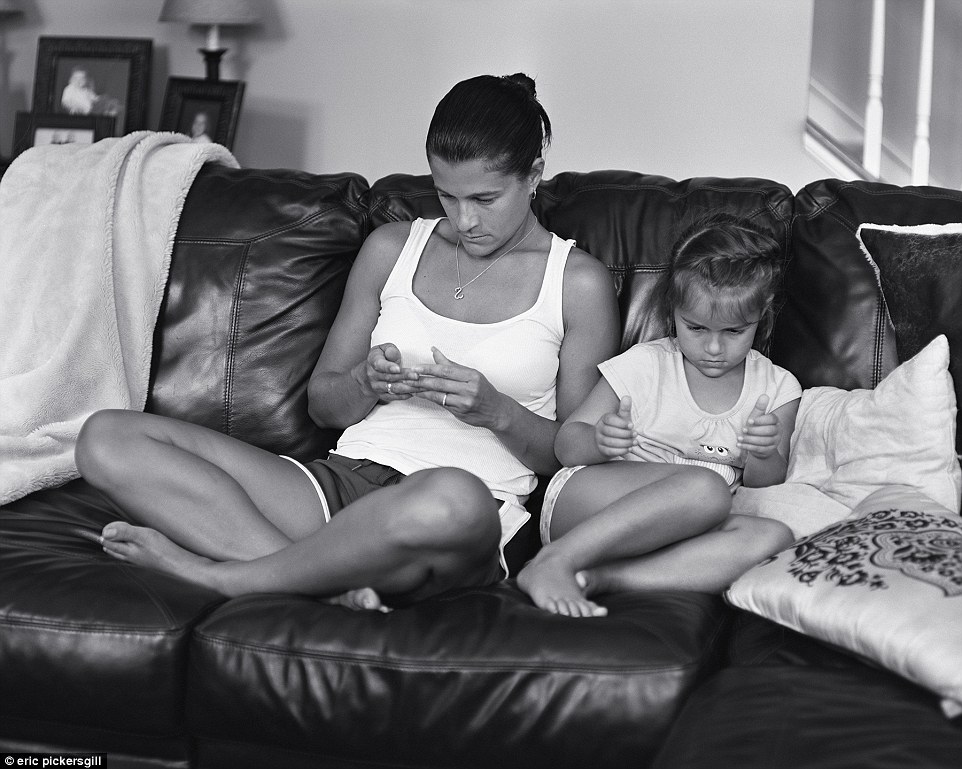
The joining of people to devices has been rapid and unalterable. The application of the personal device in daily life has made tasks take less time. Far away places and people feel closer than ever before. Despite the obvious benefits that these advances in technology have contributed to society, the social and physical implications are slowly revealing themselves. In similar ways that photography transformed the lived experience into the photographable, performable, and reproducible experience, personal devices are shifting behaviors while simultaneously blending into the landscape by taking form as being one with the body. This phantom limb is used as a way of signaling busyness and unapproachability to strangers while existing as an addictive force that promotes the splitting of attention between those who are physically with you and those who are not. [...]
The large format portraits are of individuals who appear to be holding personal devices although the devices have been physically removed from the sitter’s hand. They are asked to hold their stare and posture as I remove their device and then I make the exposure. The photographs represent reenactments of scenes that I experience daily. We have learned to read the expression of the body while someone is consuming a device and when those signifiers are activated it is as if the device can be seen taking physical form without the object being present.
Source: ericpickersgill.com/removed
Roc Herms, <YO><YO><YO>, 2007–2015
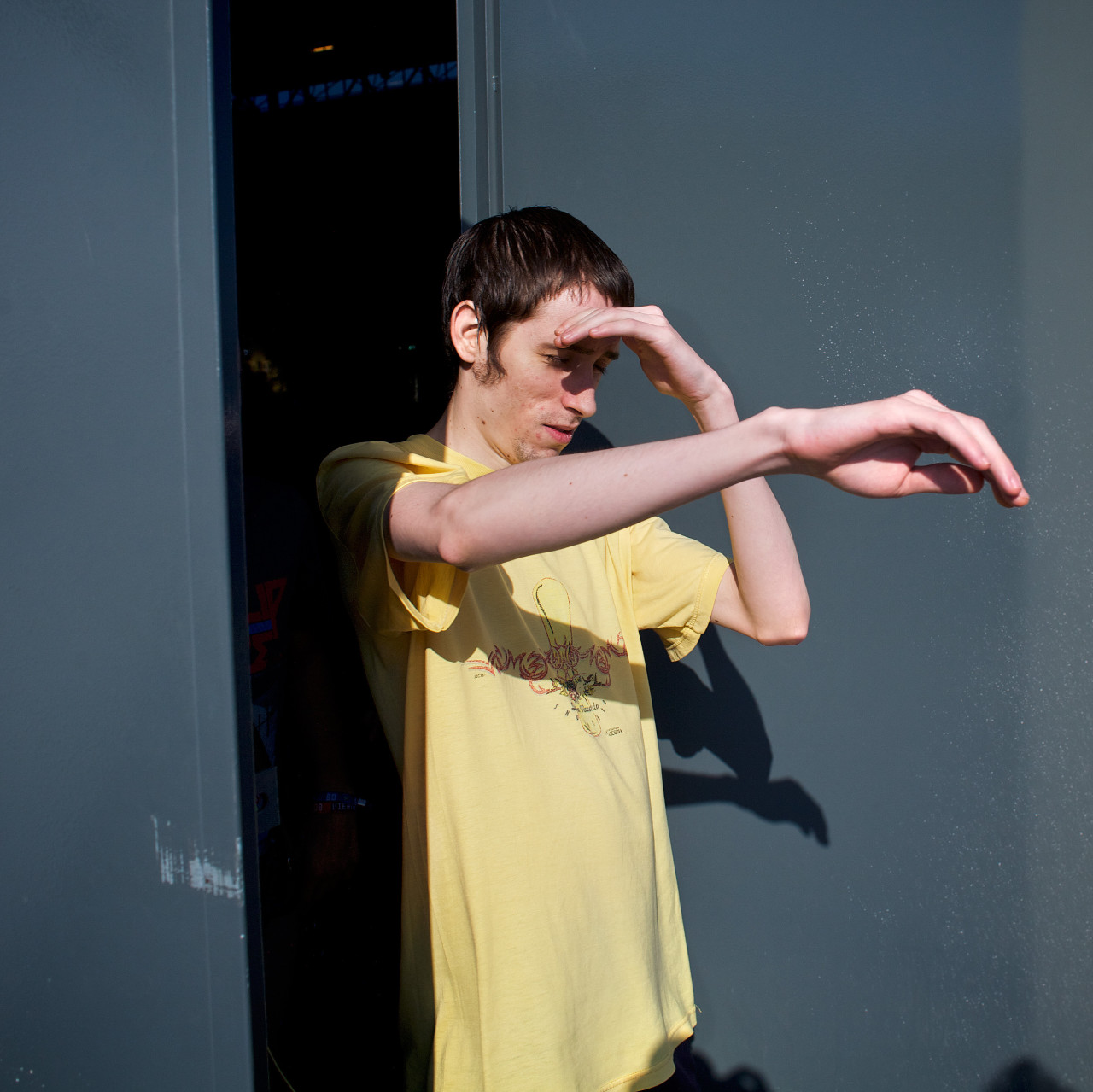
In recent years Valencia has been posting the so-called Campus Party. In this type of social-cultural gatherings, thousands of young adults —software developers, lovers of digital works and robots, hackers and defenders of free software, gamers and simulation fanatics, ciber-apostles and modding artists— come together to exchange archives and share their experiences, living for a week connected to each other.
For these super-users —digital natives that make computer technology a way of life and who are often classified as the new urban tribe of the geeks— computers are much more than just a device for work, they are an extension of their identity and the digital ecosystem where they decide to live.
< YO >< YO >< YO > Sets out a journey from the plug into the computer, with the intention of portraying along the way this kind of super-user: an exaggerated reflection of our relation with technology.
Source: rocherms.com/projects/yo-yo-yo
David Bjorgen, Game Boy Around the World, 2006 – 2008
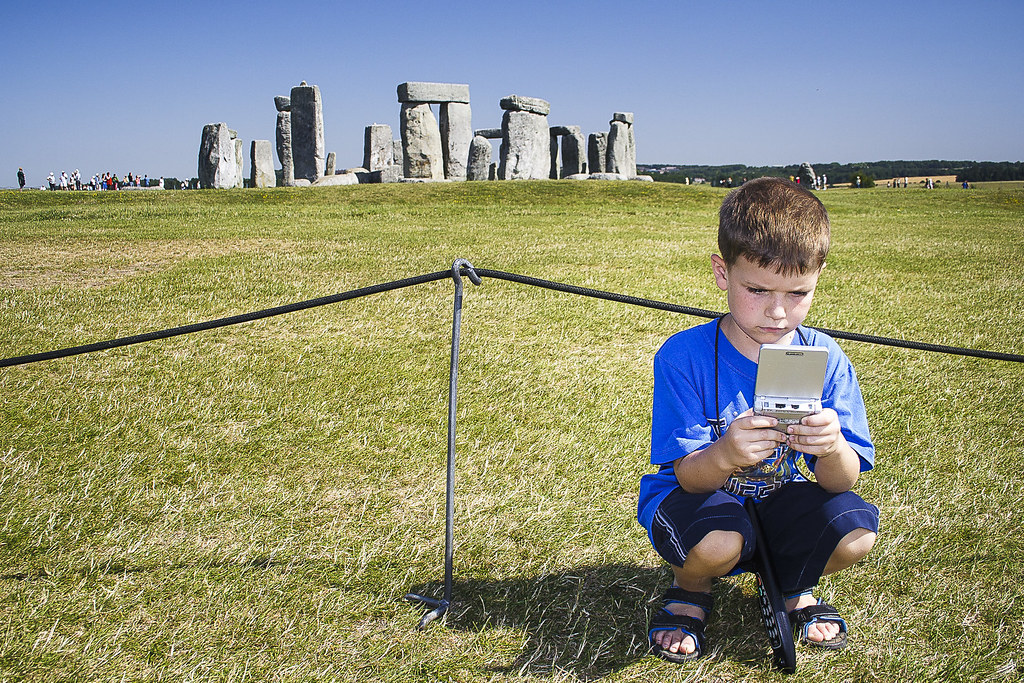
In 2006, photographer David Bjorgen (aka Cybjorg) started documenting something he noticed while traveling with his son—no matter where they were in the world, the Nintendo Game Boy always seemed more interesting than the landmark behind him.
From Stonehenge to Petra, his series “Game Boy Around the World” captured his son completely absorbed in his screen while standing in front of some of the world’s most iconic places.
What began as a father-son joke became one of the internet’s earliest and most relatable commentaries on screen addiction.
Source: instagram.com/p/DYIQ676D1aN
Matteo Bittanti and IOCOSE, Game Arthritis, 2011
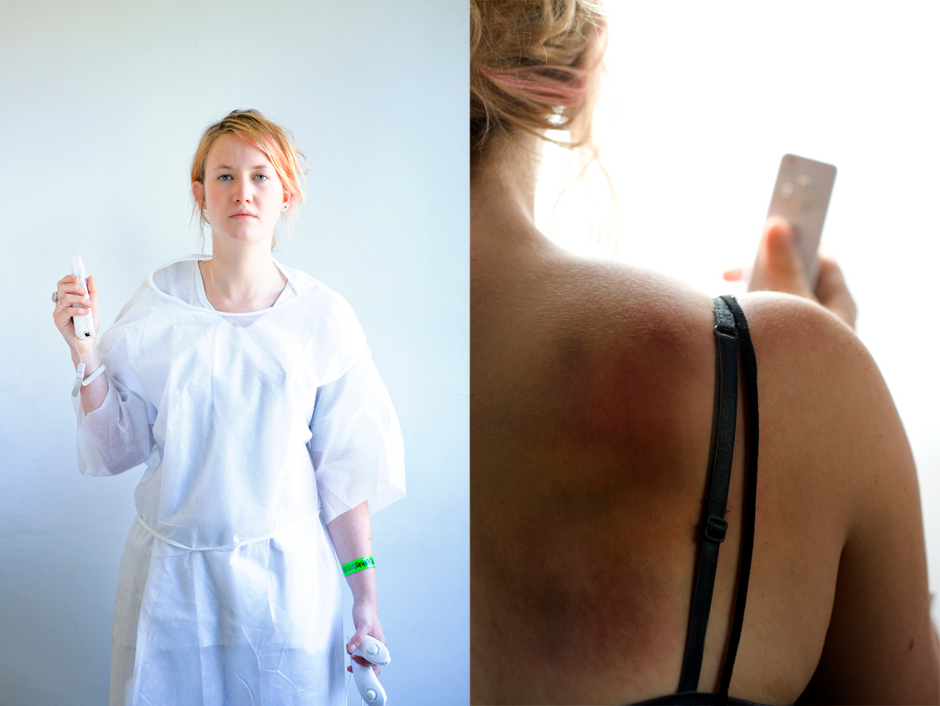
What are the real effects of digital gaming to our fingers, hands, and bodies? The conformity of interfaces produces deformity. It’s a fact. Call it “the reality of the virtual”. Prolonged vicarious aggression lead to permanent physical disfiguration. Gaming activities produce real consequences for the users. Research has been conducted for years in several clinical laboratories across the globe but doctors and researchers are not willing to share their findings with the general population. However, evidence of new technologically-induced diseases is now becoming known outside of the scientific community.
These pathologies – labeled collectively “Game arthritis” – are officially not “recognized”. The authorities have dismissed this hidden epidemic as “mass hysteria”. But according to some scientists – who speak under condition of anonymity fearing ostracization – these undiagnosed disorders are the psychopathology of ludic societies. Digital technology is indeed damaging users’ fingers, arms, postures… Even their DNA is compromised. Game arthritis is not supposed to exist. Game companies do not want to talk about it. Clinicians and dermatologists do not want to discuss it. Labs refuse to run tests. And yet, thousands of players manifest similar symptoms. Thousands of players feel real pain in their bodies. Affected subjects are not delusional.
Source: iocose.org/works/game-arthritis
Tetris Pro Players NES Rolling Technique, ca. 2020
NES Tetris players are using a new technique called Rolling to set new world records by achieving button presses of over 20 times per second. [...] Prior to this, DAS and Hypertapping were the two standards for Tetris pros, but Rolling allows for a high amount of button presses per second without the "superhuman finger speeds" needed for Hypertapping, modified controllers, or any gloves - which also makes it is perfectly legal for tournament play.
This technique, which is also called Flyheccing, was popularized by Hector "Fly" Rodriguez, who used Rolling on arcade cabinets to achieve higher speeds on Track and Field. However, the buttons on arcade cabinets are much larger than an NES controller, making it hard for it to translate to Tetris on Nintendo's first console, up until now.
Body → Screen
“The iPhone Duo is here, but users question if their fingers are long enough”, 2026
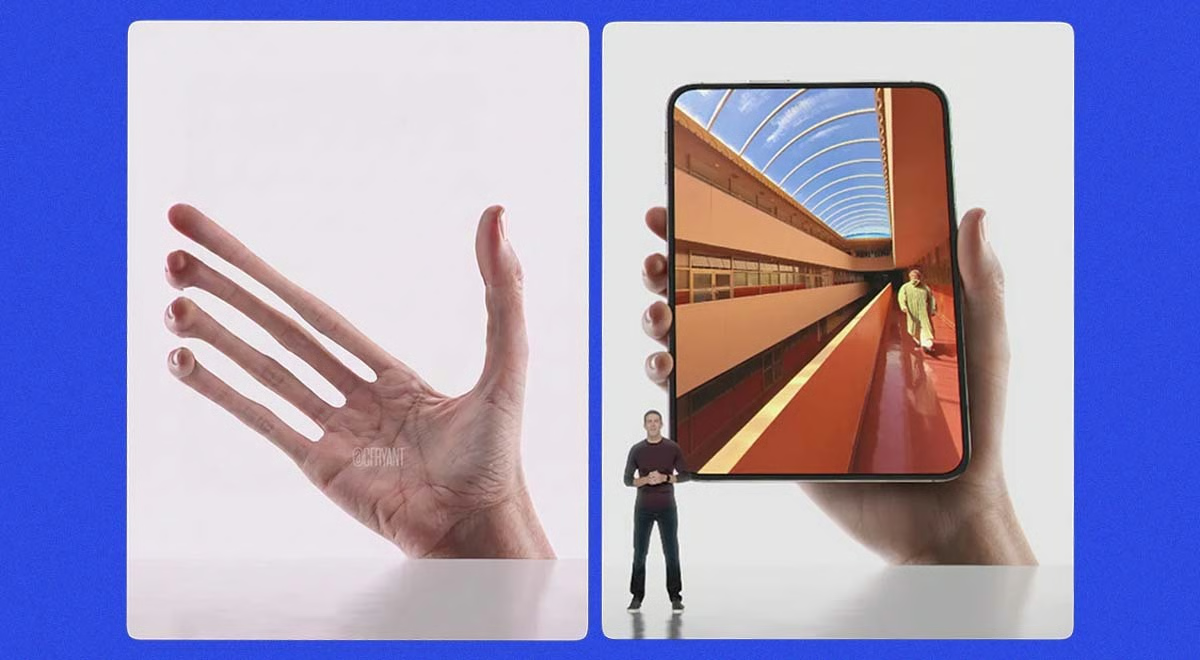
An official image showing the unfolded iPhone Duo cradled in one hand has become the centre of online speculation, with users claiming Apple may have digitally altered the size of the hand to make the phone appear easier to grip with one hand.
The image shows the fingers wrapping around a substantial portion of the device, prompting social media users to question the proportions after digitally removing the phone from the picture. The edited versions quickly became part of the online conversation around Apple's latest flagship. [...]
Even without proof of tampering, the controversy raises a genuine question about the Duo: how practical is it to use one-handed? Apple says the device has a 5.4-inch outer display when closed and a 7.6-inch screen when opened. The company describes the closed phone as compact and says its design is intended to make essential controls easier to reach.
Real-world impressions suggest the question is worth asking. The Wall Street Journal's early hands-on assessment noted that the Duo's width and weight can make one-handed use and typing difficult, particularly for people with smaller hands.
Jake Elwes, Digital Caress, 2015
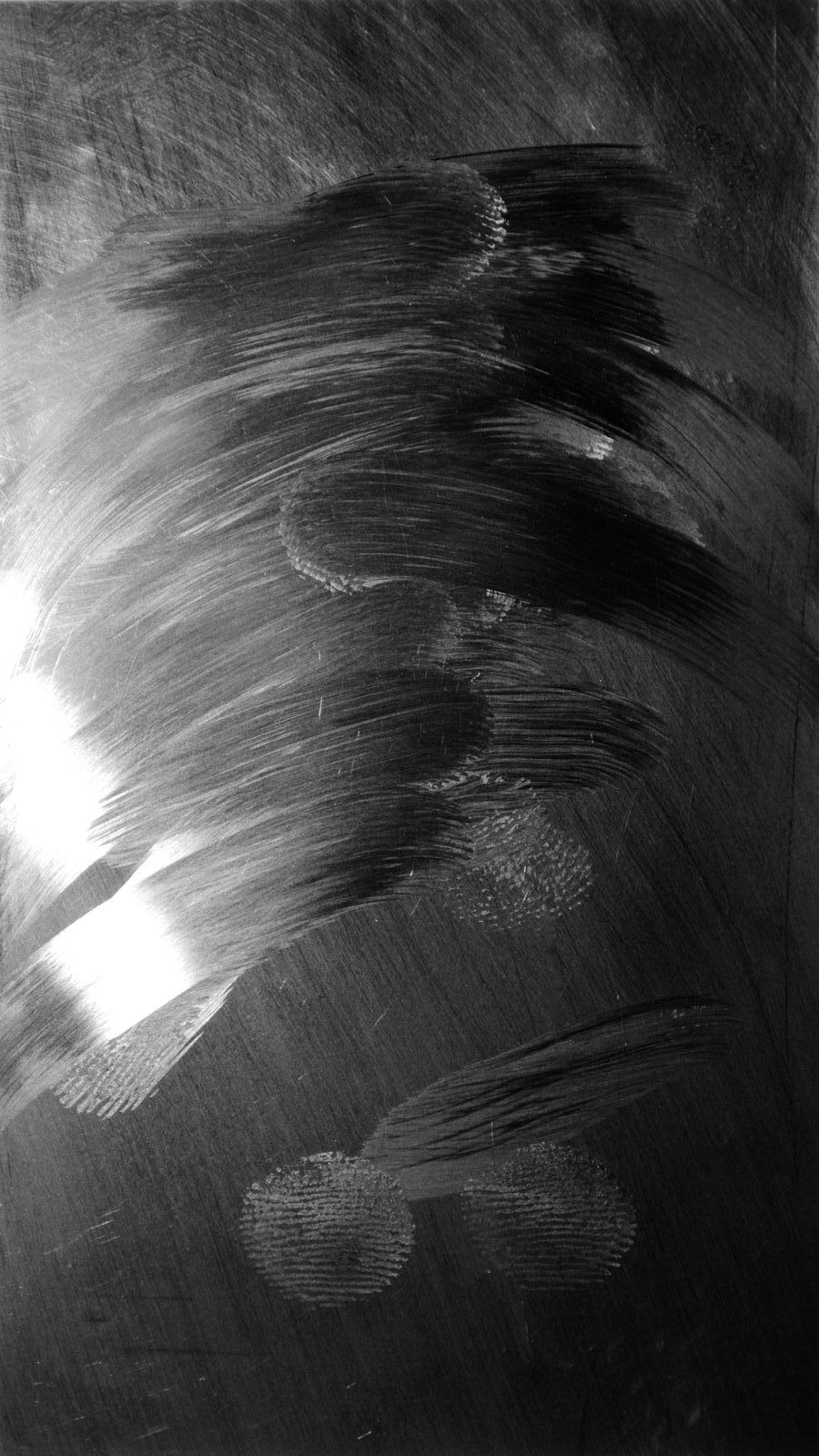
These gestures are the residue left on the screen of an iPhone from human touch (the grease of one’s finger). The gestures and twitches are often recognisable according to the app. For example, the swiping left and right of Tinder, and the imprint from stubble from a phone call. Each image derives from a different app, displaying the material remnants of interacting with a virtual window.
Tabitha Soren, Surface Tension, 2013 – 2021
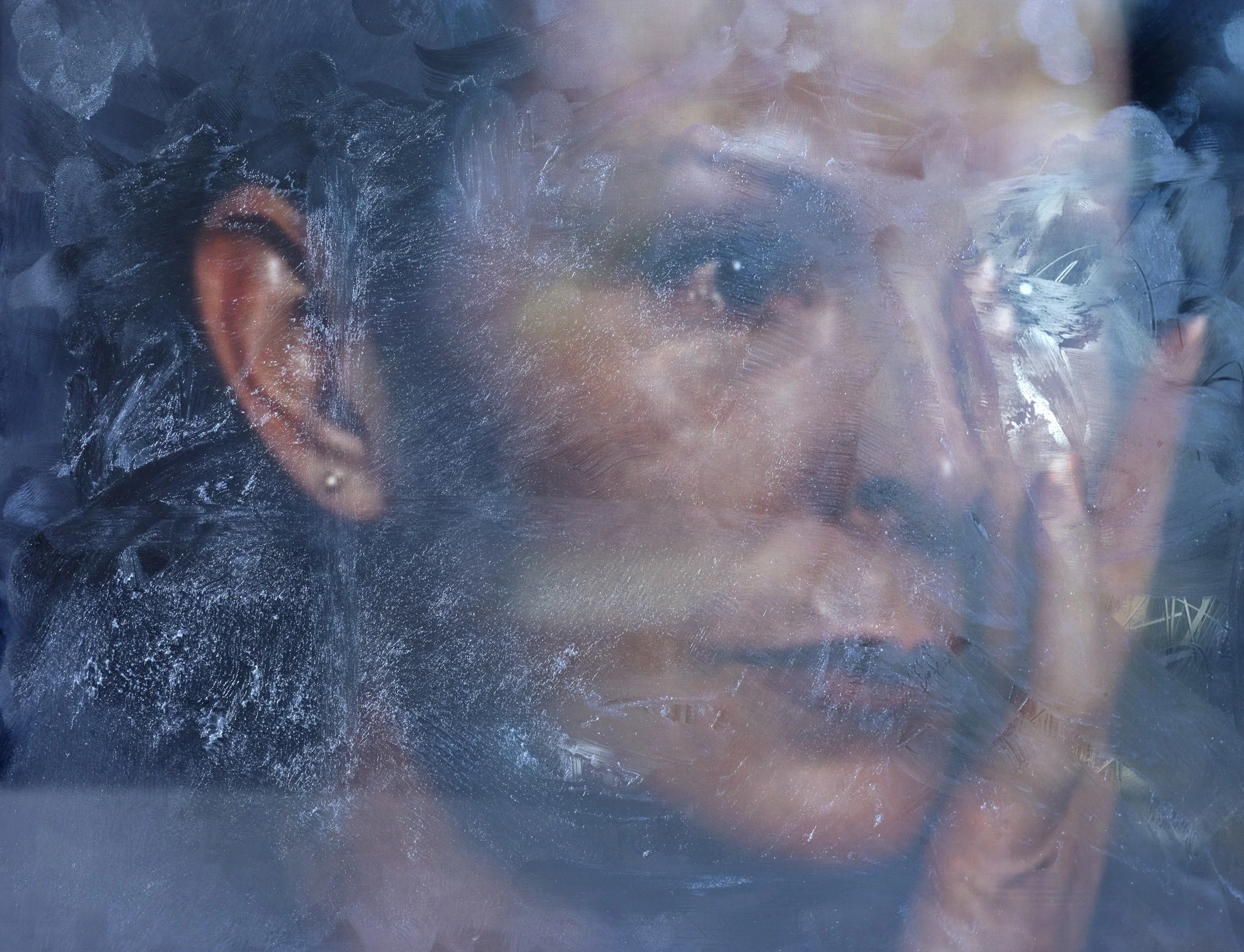
Surface Tension isolates one of the most intimate layers of our daily experience: the place where our warm animal bodies, our simplest instincts, collide with the cold and infinite knowledge of the technological world.
These photos speak of the startling and uncanny continual interaction between our skin, itself a screen for complex fleshly machinery, and the phone, which masks a world of machinery that was built with the express purpose of more efficiently monetizing everything that our flesh (and mind, and soul) might desire. These two systems, animal and machine, meet on this glassy surface; the marks left behind are the only physical record of this meeting, and the marks have become near-invisible to us, in part because they’re on the eye’s surface, and are thus one of the few parts of daily experience that the eye can’t easily record.
Body as Content
Sofia Caesar, Workation, 2019
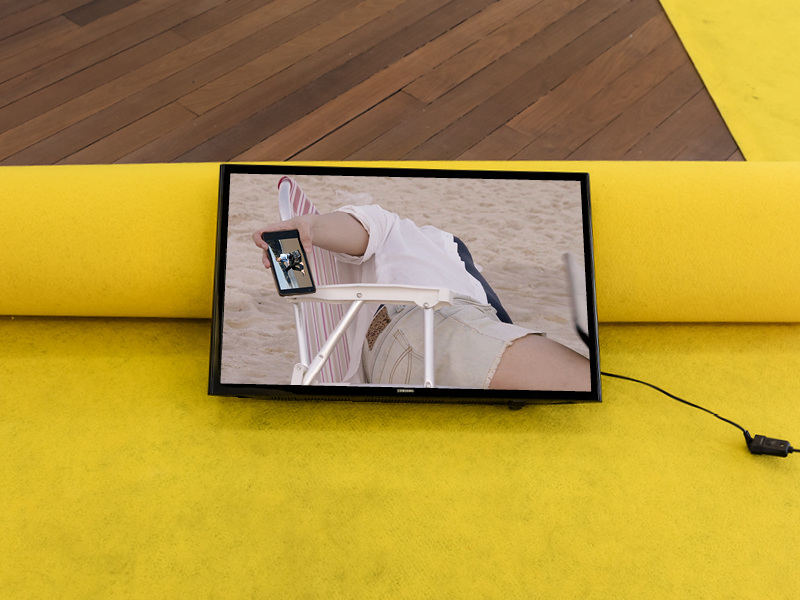
The day I learnt to say "workation" I was working in the hammock. I googled the word, this strange adding up of work and vacation, on my phone. Results came up with stock images of white men working in bed, in the hammock, at the beach. I was in Rio, at my mother's house, in the hammock, working. The guy in the image in my phone was in the hammock working. My head felt very heavy so I let its weight go. As I let it go, gravity slowly took me down to the ground. After falling, I dropped my phone on the floor. I imagined the carpet of offices becoming sand on a beach. I imagined the waves coming to take our phones away.
Eva & Franco Mattes, BEFNOED, 2013 – 2017
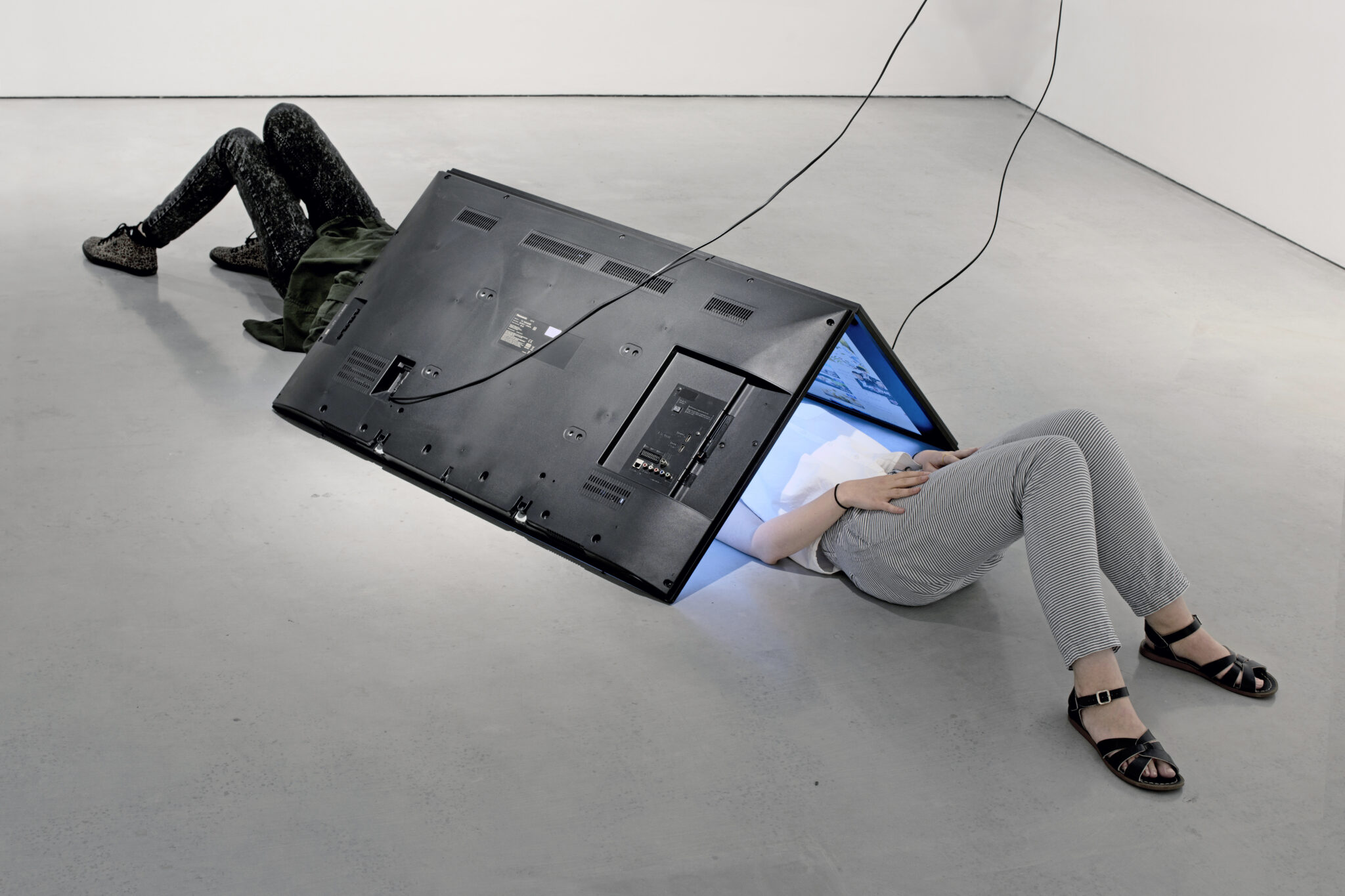
BEFNOED—an acronym for By Everyone, For No One, Every Day—is a project in which anonymous workers are instructed to film themselves performing various acts. Because they are hired through crowdsourcing platforms, their identities, locations, and motivations remain unknown. The resulting videos are exhibited in museums and circulated across obscure, peripheral, or forgotten social networks worldwide. In the museum, the monitors are arranged to force viewers into uncomfortable viewing positions.
Source: 0100101110101101.org/befnoed
Summer Wagner, Untitled, 2026 –

I like to sometimes practice thinking of technologies themselves as being neutral, but the culture which wields them will determine what type of infliction they cause. The US, for example, has a culture largely concerned with success and productivity, so there is this feeling that what exists of us online is only the fragment of ourselves that might best represent those qualities in ourselves. This isn’t to entirely villainize the ego or the way we exist online, but to recognize that the abstraction we proliferate through the way we represent ourselves reduces not only others' experience of us, but also our own experience of connection. We feel alienated from one another, only connected through shadows of ourselves online, but illiterate on how to connect through levels of communication that are embodied — the language of the beating heart, the squint of an eye, the sharp inhale or longing exhale.
Assignment
Choose one of the three themes from today’s session (Screen → Body, Body → Screen, Body as Content) and create a work of photography in response to one of the examples we have seen in class. The work should be a traditional photographic series of 3 – 5 images, made with a camera (in the studio or outside).
You are free to develop your own approach. If you are looking for a starting point, here are some ideas:
- Remove the device: photograph someone in a habitual screen posture with the device taken out of the frame (Pickersgill)
- Invent a pathology: document a speculative condition caused by an interface or platform (Game Arthritis)
- Document surface traces: photograph the marks that your body leaves on a screen (Elwes, Soren)
- Re-stage the stock photograph: recreate a stock image of remote work or leisure with your own body and in your own space (Caesar)
- Create the surreal screen body: make an image of the body entangled with the screen, in the style of Summer Wagner
Upload your image(s) to the shared doc, together with a title and one sentence naming the theme and the example you responded to.
Screen Time Selfies
Macht einen Screenshot eurer durchschnittlichen Screen Time der letzten Woche und ladet ihn in unser geteiltes Dokument hoch.
Screen → Body
Eric Pickersgill, Removed, 2014 –
The joining of people to devices has been rapid and unalterable. The application of the personal device in daily life has made tasks take less time. Far away places and people feel closer than ever before. Despite the obvious benefits that these advances in technology have contributed to society, the social and physical implications are slowly revealing themselves. In similar ways that photography transformed the lived experience into the photographable, performable, and reproducible experience, personal devices are shifting behaviors while simultaneously blending into the landscape by taking form as being one with the body. This phantom limb is used as a way of signaling busyness and unapproachability to strangers while existing as an addictive force that promotes the splitting of attention between those who are physically with you and those who are not. [...]
The large format portraits are of individuals who appear to be holding personal devices although the devices have been physically removed from the sitter’s hand. They are asked to hold their stare and posture as I remove their device and then I make the exposure. The photographs represent reenactments of scenes that I experience daily. We have learned to read the expression of the body while someone is consuming a device and when those signifiers are activated it is as if the device can be seen taking physical form without the object being present.
Source: ericpickersgill.com/removed
Roc Herms, <YO><YO><YO>, 2007–2015
In recent years Valencia has been posting the so-called Campus Party. In this type of social-cultural gatherings, thousands of young adults —software developers, lovers of digital works and robots, hackers and defenders of free software, gamers and simulation fanatics, ciber-apostles and modding artists— come together to exchange archives and share their experiences, living for a week connected to each other.
For these super-users —digital natives that make computer technology a way of life and who are often classified as the new urban tribe of the geeks— computers are much more than just a device for work, they are an extension of their identity and the digital ecosystem where they decide to live.
< YO >< YO >< YO > Sets out a journey from the plug into the computer, with the intention of portraying along the way this kind of super-user: an exaggerated reflection of our relation with technology.
Source: rocherms.com/projects/yo-yo-yo
David Bjorgen, Game Boy Around the World, 2006 – 2008
In 2006, photographer David Bjorgen (aka Cybjorg) started documenting something he noticed while traveling with his son—no matter where they were in the world, the Nintendo Game Boy always seemed more interesting than the landmark behind him.
From Stonehenge to Petra, his series “Game Boy Around the World” captured his son completely absorbed in his screen while standing in front of some of the world’s most iconic places.
What began as a father-son joke became one of the internet’s earliest and most relatable commentaries on screen addiction.
Source: instagram.com/p/DYIQ676D1aN
Matteo Bittanti and IOCOSE, Game Arthritis, 2011
What are the real effects of digital gaming to our fingers, hands, and bodies? The conformity of interfaces produces deformity. It’s a fact. Call it “the reality of the virtual”. Prolonged vicarious aggression lead to permanent physical disfiguration. Gaming activities produce real consequences for the users. Research has been conducted for years in several clinical laboratories across the globe but doctors and researchers are not willing to share their findings with the general population. However, evidence of new technologically-induced diseases is now becoming known outside of the scientific community.
These pathologies – labeled collectively “Game arthritis” – are officially not “recognized”. The authorities have dismissed this hidden epidemic as “mass hysteria”. But according to some scientists – who speak under condition of anonymity fearing ostracization – these undiagnosed disorders are the psychopathology of ludic societies. Digital technology is indeed damaging users’ fingers, arms, postures… Even their DNA is compromised. Game arthritis is not supposed to exist. Game companies do not want to talk about it. Clinicians and dermatologists do not want to discuss it. Labs refuse to run tests. And yet, thousands of players manifest similar symptoms. Thousands of players feel real pain in their bodies. Affected subjects are not delusional.
Source: iocose.org/works/game-arthritis
Tetris Pro Players NES Rolling Technique, ca. 2020
NES Tetris players are using a new technique called Rolling to set new world records by achieving button presses of over 20 times per second. [...] Prior to this, DAS and Hypertapping were the two standards for Tetris pros, but Rolling allows for a high amount of button presses per second without the "superhuman finger speeds" needed for Hypertapping, modified controllers, or any gloves - which also makes it is perfectly legal for tournament play.
This technique, which is also called Flyheccing, was popularized by Hector "Fly" Rodriguez, who used Rolling on arcade cabinets to achieve higher speeds on Track and Field. However, the buttons on arcade cabinets are much larger than an NES controller, making it hard for it to translate to Tetris on Nintendo's first console, up until now.
Body → Screen
“The iPhone Duo is here, but users question if their fingers are long enough”, 2026
An official image showing the unfolded iPhone Duo cradled in one hand has become the centre of online speculation, with users claiming Apple may have digitally altered the size of the hand to make the phone appear easier to grip with one hand.
The image shows the fingers wrapping around a substantial portion of the device, prompting social media users to question the proportions after digitally removing the phone from the picture. The edited versions quickly became part of the online conversation around Apple's latest flagship. [...]
Even without proof of tampering, the controversy raises a genuine question about the Duo: how practical is it to use one-handed? Apple says the device has a 5.4-inch outer display when closed and a 7.6-inch screen when opened. The company describes the closed phone as compact and says its design is intended to make essential controls easier to reach.
Real-world impressions suggest the question is worth asking. The Wall Street Journal's early hands-on assessment noted that the Duo's width and weight can make one-handed use and typing difficult, particularly for people with smaller hands.
Jake Elwes, Digital Caress, 2015
These gestures are the residue left on the screen of an iPhone from human touch (the grease of one’s finger). The gestures and twitches are often recognisable according to the app. For example, the swiping left and right of Tinder, and the imprint from stubble from a phone call. Each image derives from a different app, displaying the material remnants of interacting with a virtual window.
Tabitha Soren, Surface Tension, 2013 – 2021
Surface Tension isolates one of the most intimate layers of our daily experience: the place where our warm animal bodies, our simplest instincts, collide with the cold and infinite knowledge of the technological world.
These photos speak of the startling and uncanny continual interaction between our skin, itself a screen for complex fleshly machinery, and the phone, which masks a world of machinery that was built with the express purpose of more efficiently monetizing everything that our flesh (and mind, and soul) might desire. These two systems, animal and machine, meet on this glassy surface; the marks left behind are the only physical record of this meeting, and the marks have become near-invisible to us, in part because they’re on the eye’s surface, and are thus one of the few parts of daily experience that the eye can’t easily record.
Body as Content
Sofia Caesar, Workation, 2019
The day I learnt to say "workation" I was working in the hammock. I googled the word, this strange adding up of work and vacation, on my phone. Results came up with stock images of white men working in bed, in the hammock, at the beach. I was in Rio, at my mother's house, in the hammock, working. The guy in the image in my phone was in the hammock working. My head felt very heavy so I let its weight go. As I let it go, gravity slowly took me down to the ground. After falling, I dropped my phone on the floor. I imagined the carpet of offices becoming sand on a beach. I imagined the waves coming to take our phones away.
Eva & Franco Mattes, BEFNOED, 2013 – 2017
BEFNOED—an acronym for By Everyone, For No One, Every Day—is a project in which anonymous workers are instructed to film themselves performing various acts. Because they are hired through crowdsourcing platforms, their identities, locations, and motivations remain unknown. The resulting videos are exhibited in museums and circulated across obscure, peripheral, or forgotten social networks worldwide. In the museum, the monitors are arranged to force viewers into uncomfortable viewing positions.
Source: 0100101110101101.org/befnoed
Summer Wagner, Untitled, 2026 –
I like to sometimes practice thinking of technologies themselves as being neutral, but the culture which wields them will determine what type of infliction they cause. The US, for example, has a culture largely concerned with success and productivity, so there is this feeling that what exists of us online is only the fragment of ourselves that might best represent those qualities in ourselves. This isn’t to entirely villainize the ego or the way we exist online, but to recognize that the abstraction we proliferate through the way we represent ourselves reduces not only others' experience of us, but also our own experience of connection. We feel alienated from one another, only connected through shadows of ourselves online, but illiterate on how to connect through levels of communication that are embodied — the language of the beating heart, the squint of an eye, the sharp inhale or longing exhale.
Aufgabe
Wählt eines der drei Themen der heutigen Sitzung (Screen → Body, Body → Screen, Body as Content) und entwickelt eine fotografische Arbeit als Antwort auf eines der im Kurs gezeigten Beispiele. Die Arbeit soll eine traditionelle fotografische Serie aus 3 – 5 Bildern sein, die mit einer Kamera entsteht (im Studio oder draußen).
Ihr seid frei, euren eigenen Ansatz zu entwickeln. Falls ihr einen Ausgangspunkt sucht, hier einige Ideen:
- Das Gerät entfernen: Fotografiert eine Person in einer gewohnten Bildschirmhaltung, wobei das Gerät aus dem Bild genommen wird (Pickersgill)
- Eine Pathologie erfinden: Dokumentiert einen spekulativen Krankheitszustand, der durch ein Interface oder eine Plattform verursacht wird (Game Arthritis)
- Oberflächenspuren dokumentieren: Fotografiert die Spuren, die euer Körper auf einem Bildschirm hinterlässt (Elwes, Soren)
- Das Stockfoto nachinszenieren: Inszeniert ein Stockfoto von Remote-Arbeit oder Freizeit mit eurem eigenen Körper und in eurem eigenen Raum nach (Caesar)
- Den surrealen Bildschirmkörper erschaffen: Gestaltet ein Bild des Körpers, der mit dem Bildschirm verflochten ist, im Stil von Summer Wagner
Ladet eure Bilder in das geteilte Dokument hoch, zusammen mit einem Titel und einem Satz, der das Thema und das Beispiel nennt, auf das ihr euch bezieht.